Below: Fifth Avenue in Midtown Manhattan on a weekday afternoon in February 2017. This is “traffic bedlam”? (See commentary below.)
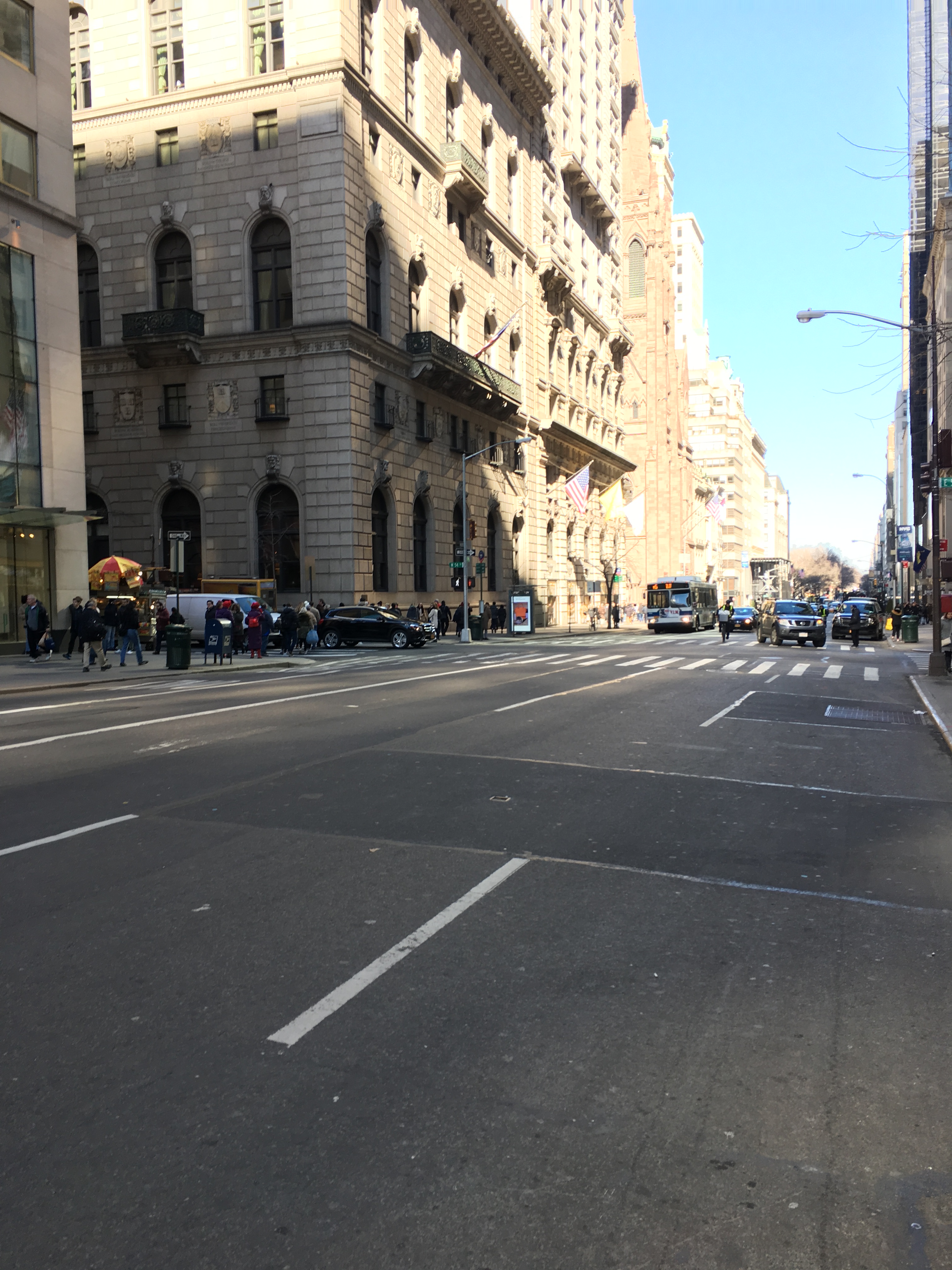
Below: Fifth Avenue near 50th Street at 2:15 p.m. on Thursday, April 27, 2017. Same comment as above. (Traffic engineer needed?)

Below: Fifth Avenue at 34th Street, 1:59 p.m., Monday, May 8, 2017. Traffic flowing just fine on a weekday and is in fact light.

Below: two photos of pedestrians on Fifth Avenue in Midtown near 42nd Street and in the 60’s just north of 59th Street. “One of the world’s densest concentrations of humanity”?
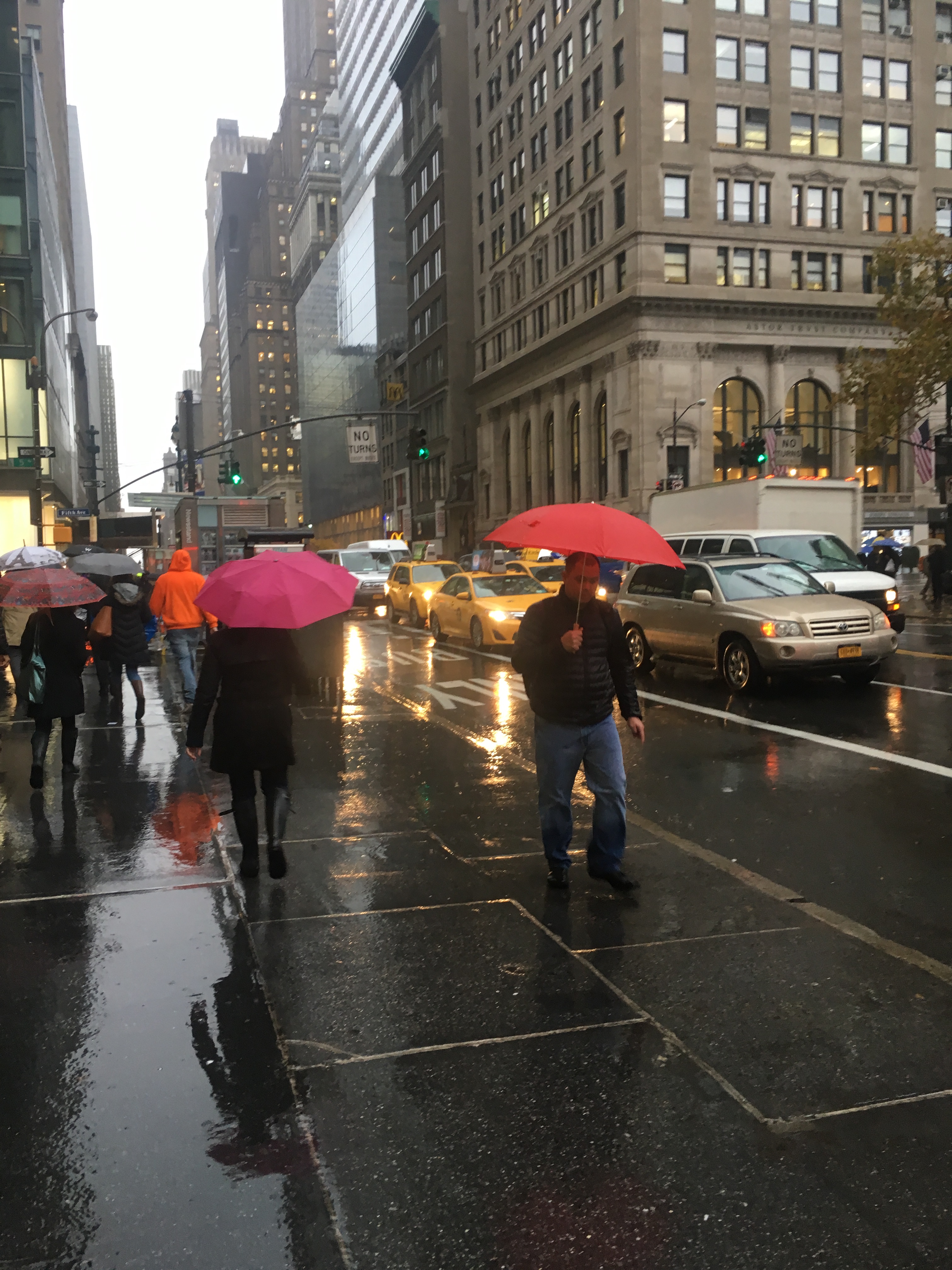
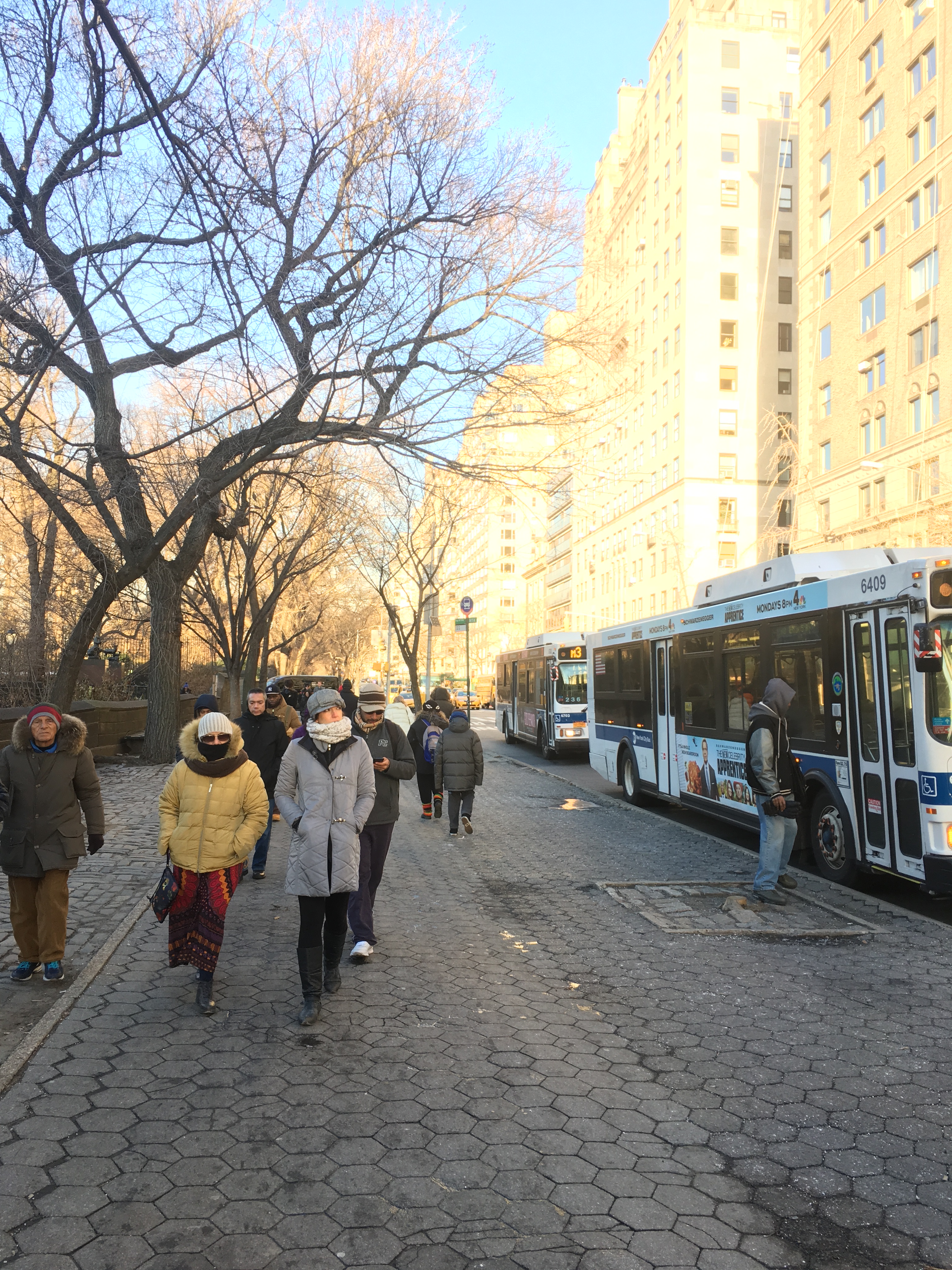

Fifth Avenue 4:20 p.m., November 27, 2016 — at or near rush hour; hardly any pedestrians and nary a car

Fifth Avenue, 4:20 p.m., November 27, 2016 — holiday weekend; guess the cars decided to stay away

Fifth Avenue near 42nd Street, 5:47 p.m., September 7, 2016 — rush hour: where are the “traffic bedlam” and crush of pedestrians?

Fifth Avenue,11:14 a.m., September 13, 2016
*****************************************************
Re
“A Plea for Fifth Avenue” by Janette Sadik-Khan (former commissioner of the New York City Department of Transportation), op-ed, The New York Times , January 9, 2017
A_Plea_for_Fifth_Avenue
******************************************************
This op ed should be retitled: “A PLAN to DESTROY Fifth Avenue.”
It is a horrible piece, founded on plain bad thinking. It doesn’t take a traffic engineer, city planner, or urban studies professor to see this.
If Jane Jacobs could read this piece, she would be rolling over in her grave.
Below are the points made by Ms. Sadik-Khan (in boldface), followed seriatim by my commentary.
— Roger W. Smith
January 2017; updated April 2017
************************************************
To quote from Ms. Sadik-Khan’s New York Times op ed piece. (Her words are in boldface, followed by my comments.)
“President-elect Donald J. Trump, lives in New York City, on Fifth Avenue.”
So what? Fifth Avenue has been a Manhattan thoroughfare over 150 years; Donald Trump’s presidency will last at most for eight years. Fifth Avenue is approximately 135 city blocks — or just under seven miles — long from south to north. Donald Trump’s residence, Trump Tower, is situated on a single block between 56th and 57th Streets.
Fifth Avenue in Midtown Manhattan is “home to one of the world’s densest concentrations of humanity and traffic bedlam.”*
Except for the fact that a few sections such as streets in the vicinity of Trump Tower have been closed to traffic, causing traffic problems (and a block long stretch of the avenue having been closed to pedestrians on the block where Trump Tower is located),* traffic on the avenue usually flows smoothly, as I have observed for years — there is hardly ever “traffic bedlam.” Yes, there is often a dense concentration of humanity on some parts of the avenue, such as near Rockefeller Center and Grand Army Plaza, but wide sidewalks make the avenue very walkable, and there is nothing like the congestion, pedestrian wise, that one often experiences in Times Square.
Fifth Avenue is not “home to one of the world’s densest concentrations of humanity.” Factually inaccurate. Maybe Calcutta.
* This was a problem in January 2017 when this post was written. With Trump having moved to Washington, pedestrian and vehicular traffic on Fifth Avenue near Trump Tower now flows well. Some side streets are still closed off.
“Fifth Avenue’s five lanes run past landmarks like the New York Public Library, the Empire State Building and Rockefeller Center, as well as numerous cathedrals of commerce, tourism and high-end retail. Because the avenue is such a popular destination, retail floor space there rents for $3,000 per square foot a year, the highest price in the world, more than double the cost of similar space along the Champs Élysées. It seems appropriate that gold is a popular color for building facades on Fifth.”
So what? Landmarks make the avenue special. Expensive retail shops give it a feeling of luxuriousness. Yes, Fifth Avenue is a premium locale, Manhattan’s priciest and most exclusive avenue, with expensive properties. Is that a bad thing? People of modest means or less than high class status are by no means barred from it.
“Fifth Avenue at 56th Street is the site of Mr. Trump’s apartment in Trump Tower, which has rapidly turned into a fortress of Secret Service agents and heavily armed police officers surrounded by curious tourists, camera crews and protesters. They join the usual shoppers, workers and other pedestrians on what were already crowded sidewalks, and often spill into the street. This has significantly slowed traffic, and security concerns have forced the closing of side streets.”
This is too bad. But is the solution for this inconvenience to restrict access to the avenue even more? When and to what end, I ask. What will this accomplish? The solution proposed is right out of Part III of Gulliver’s Travels (“A Voyage to Laputa”; the opening chapters of same).
“While Mr. Trump has said he will move into the White House, his wife and youngest child plan to wait until at least the end of the school year. During the campaign, Mr. Trump was known for flying home late at night so that he could wake up in his own bed, and he has said that he plans to return to the city frequently. If he chooses to stay even part of the week in New York, Trump Tower will become a de facto presidential residence and seat of global power.”
More power to him (and Madame Trump). For this, the traffic czars want to restrict traffic access to Fifth Ave?
“The motorcades and security restrictions that will result will permanently paralyze the city’s streets. The swearing-in hasn’t even happened, but the swearing has already started: New Yorkers want their Fifth Avenue back.”
Ditto. I don’t like the disruption of traffic and pedestrian flow caused by Trump Tower’s being the home of the newly elected president. Let’s hope they don’t “permanently paralyze the city’s streets.” Is she thinking of shutting the City down?
“As much as Mr. Trump’s election is a historic moment, it also provides an extraordinary opportunity to reclaim Fifth Avenue as a pedestrian street, free of private vehicular traffic but shared with mass transit. The change, which should span the stretch of the avenue from Central Park to the Empire State Building at 34th Street, would create a truly American public space: an entirely new civic platform at the nation’s new center of political gravity.”
Aha, here’s what she wants! To get rid of traffic on Fifth Avenue and recreate on one of the world’s great avenues a so called “public space”! Her zany proposal, if implemented, will ruin the avenue and destroy its character, for sure. Look what the traffic engineers have already done to Times Square and other parts of the city, such as Herald Square. (See photo below of miserable people in the horrible, ugly “public space” that now graces — meant sarcastically — the epicenter of Times Square.)
Who says (why in God’s name does she?) that Fifth Avenue has to be “reclaimed?” As if we were in the South Bronx of the 1970’s.
“[R]eclaim Fifth Avenue as a pedestrian street.” What? It’s already a great pedestrian street. (See photos below.) It’s not in need of “reclamation”!
“A natural comparison would be with car-free Pennsylvania Avenue in front of the White House. Creating public plazas out of streets physically embodies democracy in cities. It gives people room to reflect on their civic institutions instead of being herded along — as they currently are around Trump Tower.”
“Creating public plazas out of streets physically embodies democracy in cities.”
Highfalutin psychobabble. NONSENSE masquerading as wisdom.
“It gives people room to reflect on their civic institutions instead of being herded along — as they currently are around Trump Tower.”
“Herded along”? I can walk just fine on Fifth Avenue, thank you very much, without any one redesigning it for me. It’s a great street to walk on. So much fun. Wide sidewalks. No impediments, save for the barriers and police presence between 56th And 57th Streets, which I myself don’t like, and which are quite recent. Because of this, this nutty “savant “wants to shut down fifteen more blocks of the avenue (to traffic).
“Room to reflect on their civic institutions”? That’s a good one. Is this what the people in the photo below of Times Square’s truly horrible public space are doing?
Think about it. Traffic runs one way on Fifth Avenue (downtown, from north to south). This was the result of making Manhattan’s avenues one way in the 1950’s to improve traffic flow. There are ample sidewalks on either side of the avenue, which give pedestrians the opportunity to not only stroll the avenue and people watch, but also to look at and perhaps visit the shops and institutions which they pass. For example, I like to walk past the New York Public Library on Fifth Avenue between 40th and 42nd Streets and admire its beauty and grandeur (people are always congregated on the library steps and in front of the building, enjoying the sun in the summer time, taking photos, enjoying a coffee), past department stores such as Lord and Taylor’s at 38th and Fifth Avenue, and so on.
Fifth Avenue is a great street to walk on, plain and simple. But what does Janette Sadik-Khan, who is anti-automobile, propose doing? Shutting down three lanes of the avenue, which would be exclusively for pedestrians. Why? Who wants to walk in the MIDDLE of the street, and who said there wasn’t already a place to walk?
“Unlike Pennsylvania Avenue [in Washington, DC], however, Fifth Avenue is a vital transit conduit for 38 bus lines carrying tens of thousands of people every day across Manhattan and to and from the other boroughs. Reserving two lanes for their use (and for the motorcades) would allow the other three to be dedicated to pedestrians.”
As I have said above, traffic flows fine right now on Fifth Avenue, at most times; obviously, it flows better at some times than others. There was severe traffic congestion for a day or two right after Trump was elected when demonstrations were taking place in front of Trump Tower, and there may be congestion — near, say, Rockefeller Center — around Christmastime, but even that is occasional. There are nice wide sidewalks already for pedestrians to walk on!
I have always liked the fact that, in cities, there is a mixture of pedestrians, automobiles, buses, and subways. It means one has a choice of how to get around. (I actually take a perverse pleasure in jaywalking and dodging cars.)
I like the traffic on Fifth Avenue. While strolling on the broad sidewalks north of 59th Street (cobblestone on the west side of the avenue) — with Central Park to one’s left; or, conversely, on the other side of the street, luxurious apartment buildings — I like to mix with the pedestrian throng while at the same time viewing the cars and buses as they rumble down the avenue. There’s something pleasant about realizing that not only is it a beautiful avenue, but that it also serves a purpose as an efficient conduit for north-south traffic.
I rarely drive or ride in a car when in the City. I love being a pedestrian because of the peaceful feeling, the exercise, the opportunity one has to view, at a leisurely pace, any and all sorts of interesting places and commercial establishments. Fifth Avenue is already great to walk along. So now we have to create three dedicated pedestrian lanes. For what? So that people can walk in the avenue. Who wants to walk there? What’s wrong with the good old sidewalks? They do attract a lot of pedestrians, which make them even more fun to stroll on. But, pedestrian traffic is almost never impeded, for any reason whatsoever – except for the situation in front of Trump Tower, which is not the result of Fifth Avenue being Fifth Avenue.
“Commercial traffic has already long been banned from Fifth Avenue, and deliveries by truck could continue at enhanced delivery zones on side streets during set times of the day. As for taxis, the city can make accommodations for passenger drop-offs, but prevent cabs from cruising along empty for blocks on end.”
What, in the name of God, is an “enhanced delivery zone”?
Why harass cab drivers? It’s tough enough for them to make a living, and it’s very hard to hail an unoccupied cab in the City.
Ban cars and taxis from a stretch of Fifth Avenue. Why? Every time this sort of thing is done, it creates more congestion on the other avenues which flow from south to north or in the other direction.
“This isn’t just a feel-good experiment in civics, nor is it a public transit boondoggle.”
Says who? The clueless author of this article, that’s who.
“Streets that accommodate more people are also better for business.”
Really? My wife likes to drive to shop at a fancy store on Fifth Avenue on off hours when traffic is light and parking is available. How will deliveries be made to these retail establishments?
“In a similar project I helped introduce in 2009, in the administration of Mayor Michael R. Bloomberg, seven blocks of Broadway in Times Square were closed to traffic, and two traffic lanes were removed between Columbus Circle at 59th Street and 17th Street, a distance of more than two miles.”
I have already noted that Times Square is unpleasant to hang out in because of the changes made by Mayor Bloomberg and his traffic commissioner, Ms. Sadik-Kahn. The public spaces, to put it kindly, are horrible. Don’t take my word for it. Go there sometime, if you can.
“New Yorkers in cars and cabs are quick to adapt to change, and drivers easily found alternate routes.”
Wishful thinking, Ms. Sadik-Khan is totally anti-car and is in la la land, so to speak, as regards transportation realities. It’s the polar opposite of (insofar as Ms. Sadik-Khan is anti-car), but the same high handed, autocratic “we know what’s best for the public” attitude that the urban designers who were totally anti-pedestrian, of the 1950’s had.
Drivers in NYC are always looking for alternate routes. Why foist on them the burden and aggravation of having to look for more?
Shutting down a stretch of Fifth Avenue to vehicular traffic will force a spillover of traffic to avenues further east, such as Park, Lexington, and Second Avenues, which are already clogged.
“The expansion of rapid bus networks in the city and the opening of the Second Avenue subway mean that there are more alternatives than ever to driving in Midtown Manhattan. Turning Fifth Avenue into a bus- and pedestrian-friendly corridor can be the next step: It would not only solve the problem of the Trump Tower jam but also encourage more people to walk, use the growing bike share system and enjoy the better bus service.”
In other words, let’s get rid of cars, which will supposedly force people to walk, ride bicycles, or take the subway. A utopian, impractical scheme. I myself prefer to walk or take public transportation. But, as Jane Jacobs wrote in The Death and Life of Great American Cities, “automobiles are hardly inherent destroyers of cities”; they are not bad. Many people prefer them. Others need to use them. And, cars and vans are an efficient way to make deliveries.
“… [T]his transformation of Fifth Avenue may be that sweet spot where urbanism, transportation engineering, democracy and politics can align.”
This is purple prose and pure nonsense. Pray that her loony idea never comes to fruition.
******************************************************
P.S. An op ed page should be a place for divergent opinions. But, really, what were the New York Times editors thinking when they published this piece? Does it echo their thinking? I have a sneaking suspicion that it does. Social engineers are always trying to retool institutions, overhaul codes of behavior, alter public spaces, and so forth, supposedly for our “betterment,” ignoring accumulated wisdom, common sense, and the experience of life as the benighted masses actually live and experience it.
— Roger W. Smith
January 18, 2017
******************************************************
photographs
The Times Square public space

(Internet photo)
******************************************************
Below (also depicted above) are photographs of the Times Square public space taken by Roger W. Smith. It was virtually empty on midday on a recent February 2017 afternoon. The temperature was in the mid 40’s. It’s truly ugly and I wonder if the few people there are “reflect[ing] on their civic institutions.”

Times Square Public space, February 2, 2017 (photo by Roger W. Smith)

Times Square Public space, February 2, 2017 (photo by Roger W. Smith)

Times Square Public space, February 2, 2017 (photo by Roger W. Smith)

Times Square Public space, February 2, 2017 (photo by Roger W. Smith)

Times Square Public space, February 2, 2017 (photo by Roger W. Smith)
******************************************************
Also below is a photo by Roger W. Smith of another one of the urban “oases” (read, eyesores) created by Ms. Sadik-Khan: the Garment District seating area at 40th Street and Broadway. Hardly anyone is there, and the seats are empty. It serves mainly to create another traffic obstruction.

Garment District seating area, February 2, 2017 (photo by Roger W. Smith)
******************************************************
Below are photographs of Fifth Avenue taken by Roger W. Smith in the early afternoon on Saturday, February 4, 2017. Take a look. Where are the “traffic bedlam” and the crowds? “[H]ome to one of the world’s densest concentrations of humanity and traffic bedlam”?

Fifth Avenue 2:44 p.m., February 4, 2017 (photo by Roger W. Smith)

Fifth Avenue 2:45 p.m., February 4, 2017 (photo by Roger W. Smith)
************************************************
Addendum:
I took the attached photo of Fifth Ave near 79th St. yesterday afternoon at around rush hour:
Where is the heavy vehicular and pedestrian traffic that the traffic engineers have been writing jeremiads about? They want to solve the “problem” by shutting part of the avenue down.

Fifth Avenue, January 2017 (photograph by Roger W. Smith)
–– Roger W. Smith, email to a friend, February 1, 2017
************************************************

Fifth Avenue, 12:25 p.m.; August 20, 2018
I took the above photo on Fifth Avenue in the 40’s at midday on a Monday afternoon in August 2018. Where is the traffic jam? The truth is that traffic usually flows very well on Fifth Avenue, which runs in one direction, downtown, from north to south. No traffic crisis requiring the intervention of city planners.

 Roger Smith's New York