Category Archives: my city and neighborhood

Walt Whitman (again)


from ‘There was a child went forth’


The streets themselves and the facades of houses, and goods in
the windows,
Vehicles, teams, the heavy-plank’d wharves, the huge crossing
at the ferries,
The village on the highland seen from afar at sunset, the river
between,
Shadows, aureola and mist, the light falling on roofs and gables
of white or brown two miles off,
The schooner near by sleepily dropping down the tide, the little
boat slack-tow’ d astern,
The hurrying tumbling waves, quick-broken crests, slapping,
The strata of color’d clouds, the long bar of maroon-tint away
solitary by itself, the spread of purity it lies motionless in,
The horizon’s edge, the flying sea- crow, the fragrance of salt
marsh and shore mud,
These became part of that child who went forth every day, and
who now goes, and will always go forth every day.

— from Walt Whitman, “There Was a Child Went Forth” (1855)


*****************************************************

As noted by James Perrin Warren in his monograph Walt Whitman’s Language Experiment, “This passage catalogues the scenes of New York and Brooklyn, scenes that will become central to later poems like ‘Crossing Brooklyn Ferry;’ ‘Out of the Cradle Endlessly Rocking;’ and ‘As I Ebb’d with the Ocean of Life.’ ”

The beautiful passage evokes images and thoughts of New York City which I can relate to.


Roger W. Smith

   August 2020

an island … a city surrounded by WATER II (update of a previous post)


There now is your insular city of the Manhattoes, belted round by wharves as Indian isles by coral reefs–commerce surrounds it with her surf. Right and left, the streets take you waterward. Its extreme downtown is the battery, where that noble mole is washed by waves, and cooled by breezes, which a few hours previous were out of sight of land. Look at the crowds of water-gazers there.

Circumambulate the city of a dreamy Sabbath afternoon. Go from Corlears Hook to Coenties Slip, and from thence, by Whitehall, northward. What do you see?–Posted like silent sentinels all around the town, stand thousands upon thousands of mortal men fixed in ocean reveries. Some leaning against the spiles; some seated upon the pier-heads; some looking over the bulwarks of ships from China; some high aloft in the rigging, as if striving to get a still better seaward peep. But these are all landsmen; of week days pent up in lath and plaster–tied to counters, nailed to benches, clinched to desks. How then is this? Are the green fields gone? What do they here?

But look! here come more crowds, pacing straight for the water, and seemingly bound for a dive. Strange! Nothing will content them but the extremest limit of the land; loitering under the shady lee of yonder warehouses will not suffice. No. They must get just as nigh the water as they possibly can without falling in. And there they stand–miles of them–leagues. Inlanders all, they come from lanes and alleys, streets and avenues–north, east, south, and west. Yet here they all unite. Tell me, does the magnetic virtue of the needles of the compasses of all those ships attract them thither? … There is magic in it. Let the most absent-minded of men be plunged in his deepest reveries–stand that man on his legs, set his feet a-going, and he will infallibly lead you to water. … Yes, as every one knows, meditation and water are wedded for ever.

— Herman Melville, Moby-Dick; Chapter 1 (“Loomings”)

*****************************************************

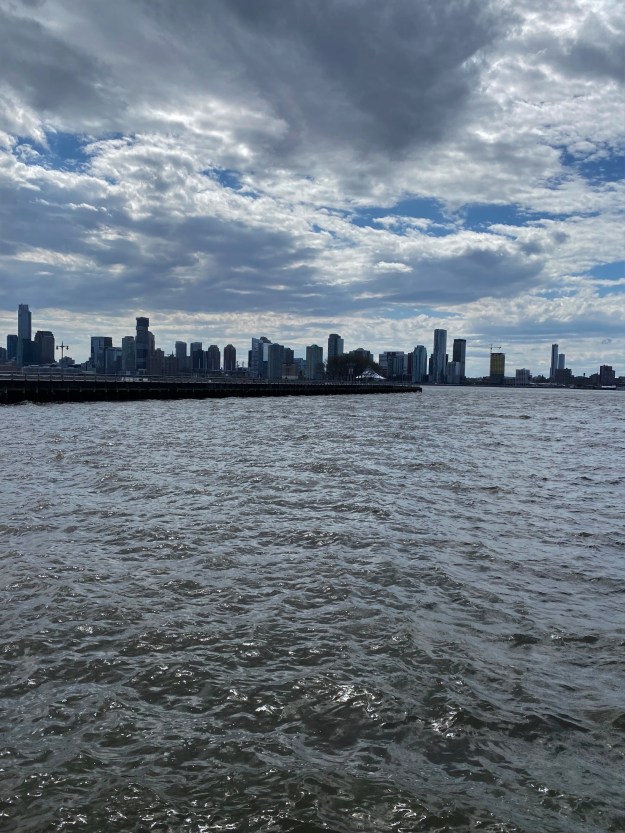
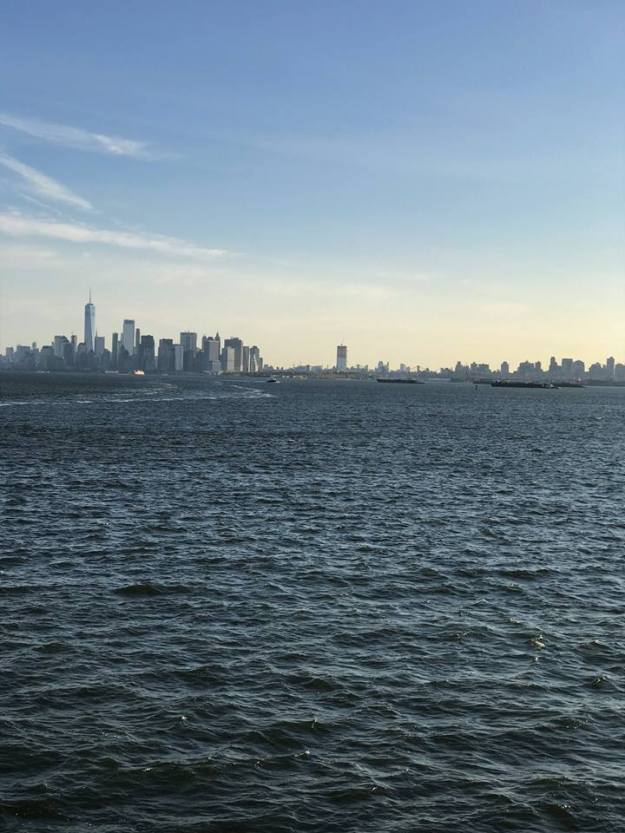
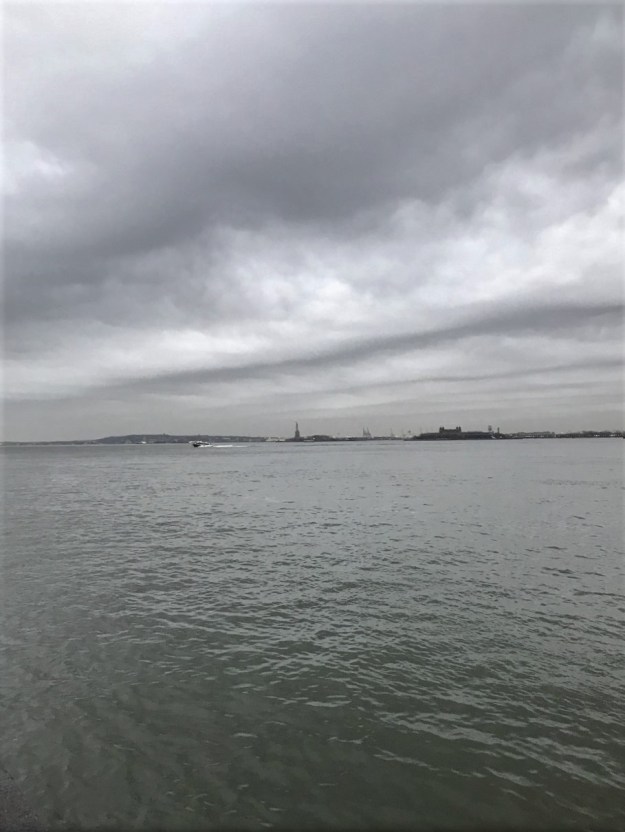
I love skylines, love dense clouds. New York City has wonderful skylines. You can’t really see them from Manhattan, but you can from the waterside and from the outer boroughs, which have lower buildings.

It is wonderful that Manhattan is an island bounded by water: the ocean (New York Harbor), the East River, the Hudson River, the Harlem River.

One thing this does is prevent urban sprawl and the development of a megalopolis ending nowhere.

It also gives the city an almost enchanted quality or aspect. It leads to dreamy speculation and reflection, as Herman Melville noted.

My departed friend Bill Dalzell alerted me to this special aspect of New York City some fifty years ago.

I love the curve of the bay at the bottom of Manhattan Island. Such a beautiful harbor.

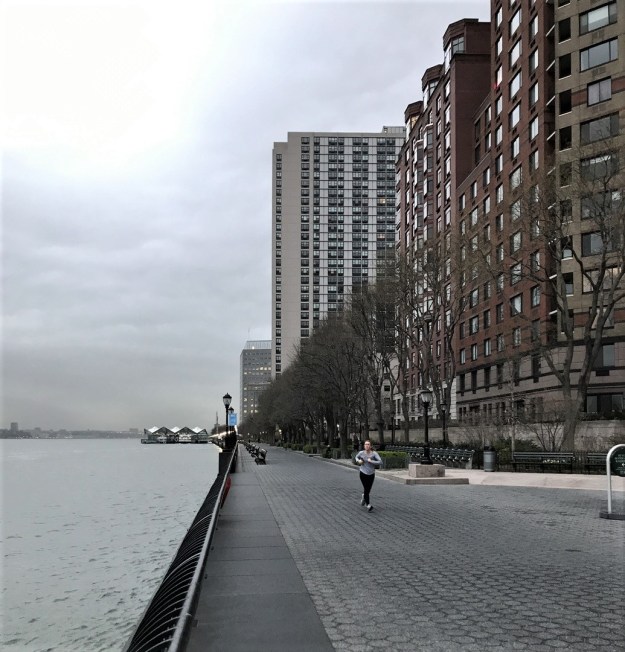
Today, I walked along the water’s edge from 14th Street to the Battery. Such a wonderful stiff breeze off the river. Such a wonderful walk at a time of despair,

— Roger W. Smith

   May 4, 2020


*****************************************************

photographs by Roger W. Smith

New York Harbor 11-42 a.m. 10-7-2019

New York Harbor 11-11 a.m. 5-29-2018

New York Harbor 4-54 p.m. 5-4-2020

New York Harbor 3-28 p.m. 3-17-2020

Hudson River 2-52 p.m. 5-4-2020


211925055274824

“Oh, For a Lodge in Some Warm Wilderness!” (a New Yorker’s dream)


OH, FOR A LODGE IN SOME WARM WILDERNESS!

The Cry of Many a New-Yorker Whose Business Worries are Aggravated by a Bad Cold.

New-York Tribune

February 21, 1904


Doubtless, this winter, when the North River,* overhung with mist and full of huge cakes of ice, resembled a scene on the coasts of Labrador, and the streets have seemed never to be free from snow and ice, many a New-Yorker with a cold has found the Psalmist’s words: “Oh, that I had the wings of a dove; for then I would fly away and be at rest,”** highly expressive of his feelings. Forgetting that one of the great characteristics of the human being which most widely differentiates him from other animals is his ability to adapt himself to the rigors of any climate, and that, therefore, he ought to give proof of his superiority by gloriously braving it out, he would gladly take wing and follow the birds to the warmer climates where there is no pneumonia, where the furnace troubleth not and the walks are fringed with green instead of covered with white. This winter has been more trying than previous winters for a number of years. The constantly recurring snowstorms and cold waves, almost clasping hands with one another, have worn down the patience of many persons who cannot get away. The very cough syrup, with its reminder of the wholesome, aromatic atmosphere of the great pine forests of the gentle tempered South, has tantalized while it performed its work of healing. If one could only adopt the mind cure and imagine himself in some semi-tropical isle in the Spanish Main, what a consolation it would be as one sits back at one’s desk, every window tightly closed to prevent draughts and keep out the fog laden air, twisting one’s nose with moist handkerchief! A vision of

The slender coco’s drooping crown of plumes,
The lightning flash of insect and of bird,
The lustre of the long convolvuluses,***

rises in one’s mind and feels how pleasant it would be to lazily loll for a few weeks in that country, with its changing tropical lights.

If the climate of New York in winter is not an ideal one, there is the consoling thought that within the confines of the United States one may experience any kind of climate one desires, from the arctic temperature of Alaska to the semi-tropical of Florida. Of course, one does not wish to think of the former, with its frozen temperatures. It is much pleasanter to dream, if one cannot realize it, of “the South where the gulf breezes blow.” To know that one may enjoy in March strawberries, ripe and red on the table; violet blossoms in the woods, the breath of jasmines in the air, and glimpses of the passion flower, scarlet trumpet creeper, wild honeysuckle, blossoming blackberry vines; delicate hued lichens, is enough to make a New-Yorker desire to sell his business and go instantly to such a favored clime with his family. While a New-Yorker is breathing the stuffy air of his office, in another part if his “native land” myriads of orchids are perfuming the air of dense forests with no man near to appreciate their beauty and fragrance. Forests of live oaks with hanging banners of Spanish moss; cypresses and blossoming magnolias invite the eye, and strange birds with tropical melodies entice the ear as they dart through the darkened recesses of the woodland. And if a little adventure is desired, it may be had by awakening an alligator lazily sunning himself at the edge of the stream.

Or, in another part of country, thousands of miles away, where once the indolent dons cultivated their ranches, flaming poppies, ranging from bright yellow to scarlet, violets, primroses, sweet clover, yellow and purple; the blue larkspur and the scarlet silene are mingling with the green of the fields and making an entrancing carpeting. There the mercury remains almost stationary in the tube. and the rain falls almost never.

* The North, now Hudson, River.

** I never knew where the words “wings of the dove” come from.

** * The lines are from Alfred, Lord Tennyson’s poem “Enoch Arden.”


— posted by Roger W. Smith

   December 2020


*****************************************************

Addendum:

I myself have seen the “huge cakes of ice” on the Hudson, viewed from Riverside Park, during one particularly cold winter when the river partly froze over. It was beautiful. You could hear the ice hissing as the chunks broke up.

good riddance to urban renewal


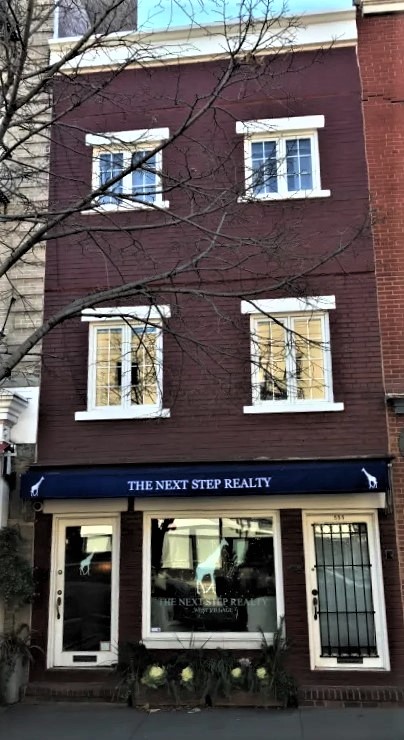
former residence of Jane Jacobs, 555 Hudson Street, New York, NY; photo by Roger W. Smith

The following is an email of mime from today to Lizabeth Cohen, a professor of American Studies at Harvard University.


Dear Professor Cohen,

I read the review in The New York Times Book Review of your Saving America’s Cities: Ed Logue and the Struggle to Renew Urban America in the Suburban Age. As I said to my wife, it looks like an excellent and very informative book.

I appreciate what was said about it by the reviewer: that it is an even-handed treatment of Logue.

If I may, I would like to share a few thoughts, memories, etc. with you.

I grew up in Cambridge. We lived on Mellen Street near Harvard Square. My parents moved us to the suburb of Canton on the South Shore in my adolescent years, which was in the late 1950s.

In the 1960s, I recall seeing articles in the papers about Logue all the time. As the reviewer notes that your book notes, Logue was revered and received almost unvarying praise. At that age, being the son of liberal, educated parents, I thought that slum clearance was, unquestionably, desirable.

I was an avid Red Sox fan, I regularly read the sports pages in the Boston Herald. I read many articles stating that it was high time Boston had a new park. It was regarded as not even worth or needing proof that Fenway Park was too small (mainly in terms of seating capacity), old, and shabby. The endless refrain was, when are we going to get our new stadium?

No one remembers this, and Friendly Fenway is regarded by one and all as a jewel of a ballpark. A landmark that will never be torn down.

I moved to New York City for good in my young adulthood. After some adjustment, I grew to love it. I made a good friend who was a nonconformist and lived an alternative lifestyle. He was cultured and articulate but lived very modestly in a walkup apartment with a bathroom in the hall on East Fifth Street between Avenues A and B. He helped me to appreciate Manhattan and to begin to think differently. He was prescient. He said to me, at a time when urban renewal and slum clearance were in the air: “I live in a slum and I like it.” He pointed out that PEOPLE were living in these buildings. (And could afford them.)

I am attaching a photo I took on one of my walks recently of Jane Jacobs’s former residence on Hudson Street in Manhattan. I became familiar with her writings in my adult years after moving to Manhattan. I think she is an example of someone whose plain writing and lifestyle, and lack of academic credentials, may make it likely that she gets less recognition than she deserves (which is not to say that her importance and genius are not acknowledged; and I think she was actually a genius). In my opinion, she is up there with some of the great thinkers and writers who very simply take a fresh look at prevailing opinions and wisdom, go back to square one — or “first principles” — and, in plain language, without overtheorizing — looking with their own eyes — get us to see the world anew. It’s sort of like an Emperor’s New Clothes phenomenon.

How did she manage to defeat Robert Moses? At the outset, I am sure it would have been regarded as quixotic to try. If Moses had rammed an expressway through the Village and Soho, it would have ruined Manhattan — is the word rape too strong?

Jane Jacobs did not like Lincoln Center. I don’t like it either. I recall when I was in high school and Jacqueline Kennedy and others on television were providing a virtual tour of our “wonderful” new arts center, Lincoln Center. I assumed it must have been so, and who cared about the gritty (then) West Side neighborhood where Jets and Sharks did battle? I hate to go to Lincoln Center now. Aside from the concert halls, which I find dark and unwelcoming, the whole center is a horrible place to hang out in, should anyone care to. The buildings are ugly.

Usually, the plaza with its fountain is pretty much deserted, and it’s unwelcoming, as is the Center. The surrounding neighbored now has no life; there are a few rip off restaurants across the street. The few blocks behind the Center (between it and the river) are deadly, or better said, dead.

I go back to Boston occasionally. I was too young to remember Scollay Square before Government Center was built (though people often mentioned it). The Government Center complex has a Lincoln Center-like feel, and I found it very unpleasant and unenjoyable to walk or spend time in or around it.

Sincerely,

Roger W. Smith, Maspeth, Queens, NY


— posted by  Roger W. Smith

   November 17, 2019

NYC encourages conversation (a photo-essay)


“The blab of the pave … the … talk of the promenaders”

— Walt Whitman, “Song of Myself” (cataloguing the delights of the City)


I continuously see people on the street, in the park on sidewalk benches, in gathering places such as cafes and bars — everywhere — in pairs or larger groupings, engaged in deep conversation and repartee.

People feel less self-conscious in New York. Free to express themselves. New York encourages thought and exchange of ideas.

It’s wonderfully liberating.


— Roger W. Smith

   June 2019; updated January 2026


*****************************************************

Addendum: Another thought. The fact that NYC is in large part a city in which people are on foot when they are outdoors, and not in cars, but instead are walking, or resting on benches, say; and, when they are traveling, are often on subways or buses, where conversation frequently occurs, is a facilitator of conversation and interaction.


****************************************************

photographs by Roger W. Smith


42nd Street

42nd Street

42nd Street

42nd Street

42nd Street

Sixth Avenue

59th Street.jpg

59th Street

Battery Park City

Battery Park City

Bryant Park

Bryant Park

Bryant Park

Bryant Park

Central Park

Central Park (2).jpg

Central Park near Columbus Circle

Central Park (3).jpg

Central Park

Central Park

City Hall Park 2-58 p.m. 6-23-2019.JPG

City Hall Park

Fifth Avenue

Fifth Avenue

Fifth Avenue

Fifth Avenue

Fifth Avenue

Grand Central Oyster Bar

Hudson River Park

Hudson River Park

Hudson River Park (2).jpg

Hudson River Park

Hudson River Park (3)

Hudson River Park

Hudson Yards.jpg

Hudson Yards

Hudson Yards

Lexington Avenue

Lexington Avenue

Madison Square Park.jpg

Madison Square Park

Madison Square Park (2).jpg

Madison Square Park

Madison Square Park (3)

Madison Square Park

Madison Square Park (4).jpg

Madison Square Park

Madison Square Park (5).jpg

Madison Square Park

Madison Square Park (6).jpg

Madison Square Park

Madison Square Park (7).jpg

Madison Square Park

Madison Square Park (8).jpg

Madison Square Park

Madison Square Park (9).jpg

Madison Square Park

Madison Square Park 10-10-2019.JPG

Madison Square Park

Gregory's Coffee 7-7-2019

Ninth Avenue coffeehouse

P. J. Carney’s pub, Seventh Avenue

P J. Carney’s pub

P. J. Carney’s

P. J. Carney’s

P. J. Carney’s

P J. Carney’s

P. J. Carney’s

P. J. Carney’s

P. J. Carney’s

P. J. Carney’s

P. J. Carney’s

P. J. Carney’s

P. J. Carney’s

P. J. Carney’s

P. J. Carney’s

P. J. Carney’s

P. J. Carney’s

P. J. Carney’s

P. J. Carney’s

P. J. Carney’s

P. J. Carney’s

P. J. Carney’s

P. J. Carney’s

P. J. Carney’s

P. J. Carney’s

P. J. Carney’s

P. J. Carney’s

P. J. Carney’s

P. J. Carney’s

P. J. Carney’s

P. J. Carney’s

P. J. Carney’s

P. J. Carney’s

P. J. Carney’s

P, J. Carney’s

P. J. Carney’s

P. J. Carney’s

P. J. Carney’s

P. J. Carney’s

P. J. Carney’s

P. J. Carney’s

P. J. Carney’s

P J. Carney’s

P. J. Carney’s

P J. Carney’s

P. J. Carney’s

P. J. Carney’s

P J, Carney’s

P. J. Carney’s

P. J.

P. J. Carney’s

P. J. Carney’s

P. J. Carney’s

P. J. Carney’s

P. J. Carney’s

P. J. Carney’s

P. J. Carney’s


P. J. Carney’s

Rockefeller Center

Seventh Avenue

Seventh Avenue

Seventh Avenue

Sixth Avenue

Soho

Soho

Union Square Park.jpg

Union Square Park

Union Square.jpg

Union Square

Upper West Side

Upper West Side

West Side

R train

R train

R train

R train

R train

R train

R train

R train

A train

L train

L train

Seventh Avenue

59th Street

59th Street


Walt Whitman … profoundly a New Yorker


In his sprawl, his vaunting ambition, and his humanity, Walt Whitman was profoundly a New Yorker. His poetry bore no little resemblance to the “mettlesome, mad, extravagant city” that he called home, and to the end of his life, he remained “a Manhattanese, free, friendly and proud.”

Whitman was born in the small community of West Hills in Suffolk County, and he returned often to the rural scenes of “fish-shape Paumanok,” as he called Long Island. But he grew up in Brooklyn, at a time when it was growing explosively, and proudly called himself a “Brooklyn boy.” Like his father, he found occasional work in carpentry and contracting, and that may have affected the way he thought about his poetry–with “the preparatory jointing, squaring, sawing, mortising, the hoist-up of beams the push of them in their places, laying them regular.”

New York’s expansion resembled Whitman’s own during the “seed-time years” that preceded Leaves of Grass. He later claimed that the poems “arose out of my life in Brooklyn and New York from 1838 to 1853, absorbing a million people, for fifteen years, with an intimacy, an eagerness, and an abandon, probably never equaled.” Although he moved to Washington during the Civil War and then to Camden, New Jersey, he never stopped revisiting the New York of his imagination. In a letter from 1868, he wrote, “I sometimes think I am the particular man who enjoys the shows of all these things in New York more than any other mortal–as if it was all got up just for me to observe and study.” [italics added]

– exhibit label, “Walt Whitman: Bard of Democracy”; exhibition at the Morgan Library, New York, NY


*****************************************************

CITY OF SHIPS.

CITY of ships!
(O the black ships! O the fierce ships!
O the beautiful sharp-bow’d steam-ships and sail-ships!)
City of the world! (for all races are here,
All the lands of the earth make contributions here;)
City of the sea! city of hurried and glittering tides!
City whose gleeful tides continually rush or recede, whirling in and out with eddies and foam!
City of wharves and stores—city of tall façades of marble and iron!
Proud and passionate city—mettlesome, mad, extravagant city!
Spring up O city—not for peace alone, but be indeed yourself, warlike!
Fear not—submit to no models but your own O city!
Behold me—incarnate me as I have incarnated you!
I have rejected nothing you offer’d me—whom you adopted I have adopted,
Good or bad I never question you— love all—I do not condemn any thing,
I chant and celebrate all that is yours—yet peace no more,
In peace I chanted peace, but now the drum of war is mine,
War, red war is my song through your streets, O city!

Leaves of Grass (1881-1882)


*****************************************************

But I was a Manhattanese, free, friendly, and proud
I was called by my nighest name by clear loud voices
of young men as they saw me approaching or passing,
Felt their arms on my neck as I stood, or the negligent leaning of their flesh against me as I sat,
Saw many I loved in the street, or ferry-boat, or public assembly, yet never told them a word,
Lived the same life with the rest, the same old laughing, gnawing, sleeping,
Played the part that still looks back on the actor or actress,
The same old rôle, the rôle that is what we make it, as great as we like,
Or as small as we like, or both great and small.

— Walt Whitman, “Crossing Brooklyn Ferry” (excerpt)


*****************************************************

The house-builder at work in cities or anywhere,
The preparatory jointing, squaring, sawing, mortising,
The hoist-up of beams, the push of them in their places,
laying them regular

— Walt Whitman, “Song of the Broad-Axe” (excerpt)


*****************************************************

The exhibit label is vague about where Whitman actually lived during his years in what now comprises New York City. (Brooklyn and Manhattan were separate municipalities when Whitman lived there. Jamaica, Queens, where Whitman was a schoolteacher briefly, was then part of Long Island, where Whitman was born.) He grew up in Brooklyn; and, in the years of his adulthood prior to the Civil War, he resided in both Brooklyn and Manhattan at various times. When in Manhattan, he lived downtown in boarding houses in or near what is now the Financial District. When he was residing in Brooklyn, he often took the ferry to Manhattan. He was a regular at Pfaff’s beer cellar in Manhattan, which was located on Broadway near Bleecker Street.

Whitman lived on Ryerson Street in Brooklyn in the 1850s.


*****************************************************

photos by Roger W. Smith

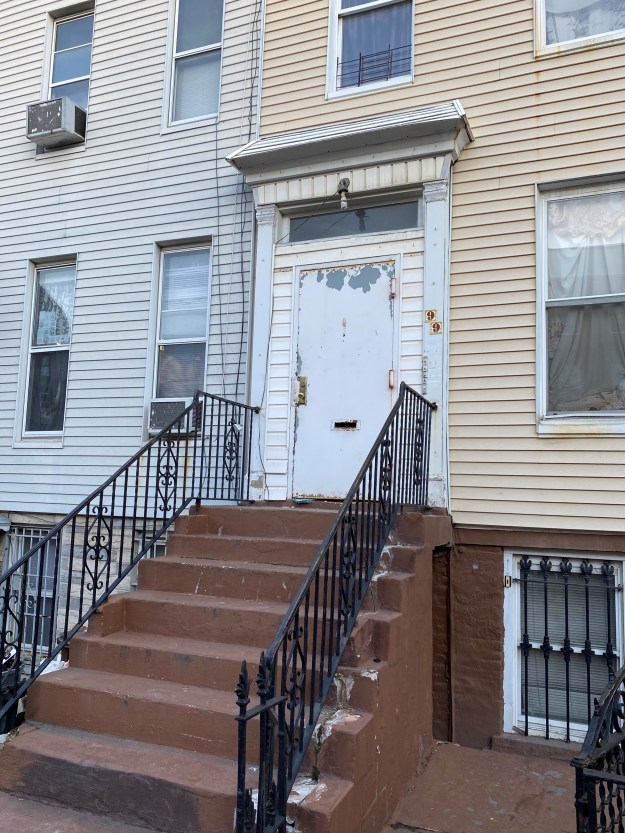
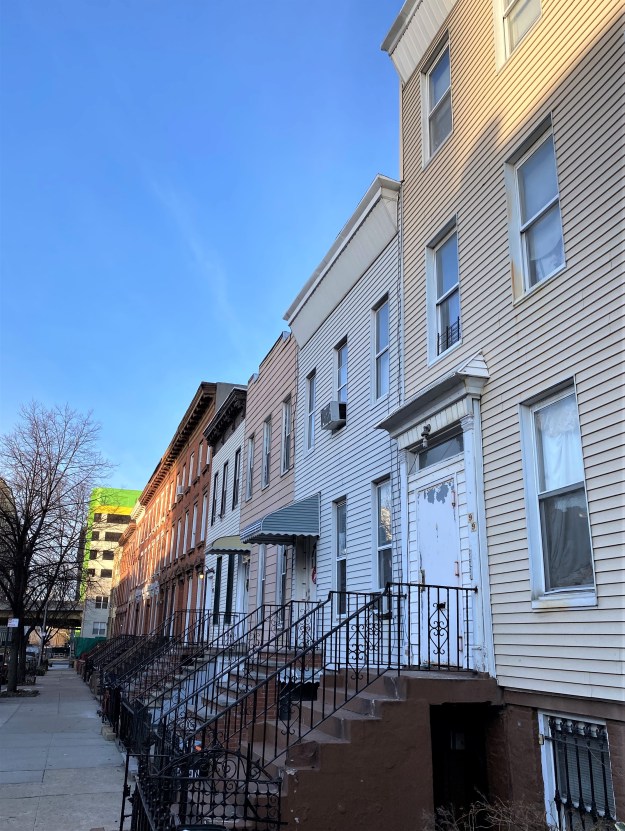
former Whitman home, 99 Ryerson Street, Brooklyn (Clinton Hill Section)

99 Ryerson Street


*****************************************************

See:

“Should Walt Whitman’s House Be Landmarked? It’s Complicated: The city does not think so, and the building’s owner agrees. Then there’s the matter of whether the poet should be honored in such a diverse neighborhood.,” By Jane Margolies,  The New York Times, December 24, 2019


‘Should Walt Whitman House Be Landmarked’ – NY Times 12-24-2019


— posted by Roger W. Smith


*****************************************************

Addendum:

In 2017, University of Iowa Press published a lost Whitman novel (its existence was unknown to scholars):  Life and Adventures of Jack Engle, which was originally published by Whitman in 1852 under a pseudonym and was serialized in a New York newspaper, the Sunday Dispatch. Zachary Turpin, who wrote an introduction to the 2017 edition, made this remarkable discovery.

If one reads the novel, which is set in Manhattan at around the time of Whitman’s boyhood — i.e., the early nineteenth century —  one can readily perceive Whitman’s familiarity with the City, which provides a setting and backdrop for the events and gives the story verisimilitude.


It’s gone.


It’s gone.

They’re gone.

The past. Our lived history. Past times. The particulars. What made them unique.

This past, our past, dies with people. As they pass away. Dies as well as the people themselves.

An era. A generation. Gone irretrievably.


*****************************************************

My friend Bill Dalzell.

I think of him often. Of New York as he knew it.

When the City was affordable, actually cheap. When it was hospitable to artists, writers, and editors; to independent types who loved culture, the arts, and the life of the mind and who didn’t want the buttoned down life.

The New York of art film houses, the Automat, McSorley’s Old Ale House, and the Blarney Stones; of the Metropolitan Museum of Art when admission was free; of the New York Public Library when it was open 365 days a year. When First Avenue bars held Sunday afternoon poetry readings.

When the subway fare was a dime, a glass of beer was twenty cents, and flats in the Lower East Side rented in the 30 to 50 dollar a month range.

Dr. Ralph Colp, Jr., my therapist.

He practiced when psychiatrists did talk therapy and were intellectuals rather than pill pushers; when (as was the case with me) they charged 30 dollars for a session scheduled for 50 minutes that usually lasted an hour; when a writer such as Dr. Colp used a Royal manual typewriter; when a Sunday afternoon or holiday recreation for him and many Manhattanites, such as myself, involved seeing a foreign film.


*****************************************************

This melancholy, mournful train of thoughts occurred to me today when for some reason or other I thought of Bill, when something reminded me of him.


— Roger W. Smith

   May 22, 2019

another Manhattan jaunt


“A City Walk-Just a list of all that is seen in a walk through the streets of Brooklyn and New York and crossing the Ferry.”

— Walt Whitman, idea for a poem (published in Walt Whitman: Notebooks and Unpublished Prose Manuscripts, Volume IV: Notes, edited by Edward F. Grier, New York University Press 1984, pg. 1292)


*****************************************************

On Friday, April 12, I walked from one end of Manhattan to the another — from bottom to top — and another five miles back downtown before getting tired and giving up.

The photos below were taken by me during different stages of my walk, beginning in Battery Park in the early morning, continuing to 218 Street at midday, and ending in the Columbia University neighborhood in the early evening.

I would like to make a few points about walking that have occurred to me from time to time, and which seemed to be confirmed by this long walk of between twenty and twenty-five miles.


*****************************************************

First, contrary to what one might expect, walking, counterintuitively, seems to decrease appetite. I had eaten very lightly the day before; I woke up hungry. I walked about three miles before having a light breakfast at around 8:30 a.m., two and a half hours after I had started.

At around five-thirty, I stopped to eat a late afternoon, early evening lunch/dinner. I felt very hungry. But I quickly got filled up and couldn’t finish.

Secondly, walking seems (as I have stated before) to be a perfect form of exercise which does not unduly tax the body while contributing to wellbeing. I have not walked as much as usual lately — this was true in the winter months. Yet, on Sunday, April 7, I walked something like fifteen or sixteen miles, and on April 12, as noted above, I walked another eight miles or so further than on my previous jaunt. I experienced little tiredness at different stages of my walk, did not need to warm up or feel the need to take breaks.

Without being an expert, I would be inclined to say that we are made for walking, evolutionarily speaking. For most of human existence, until recently, people were accustomed to walk constantly, and it is undoubtable that they walked on average a lot more than we do now.

Thirdly, I have noticed that, when I start walking frequently, my “brother body” (a term used by the sociologist Pitirim A. Sorokin, apparently adopting the phrase from words of St. Francis) seems to want more and more of the same. I will wake up a day or two later feeling, I want to do that again. Today!


— Roger W. Smith

   April 2019


*****************************************************

photographs by Roger W. Smith
 

Battery Park 6-11 a.m. 4-12-2019

Battery Park, 6:11 a.m.

New York Harbor 6-39 a.m. 4-12-2019

New York Harbor viewed from Hudson River Park, 6:39 a.m.

Hudson River Park 8-12 a.m. 4-12-2019

Hudson River Park, 8:12 a.m.

coffee shop.jpg

coffeehouse, Ninth Avenue and 44th Street, 8:51 a.m.

Broadway and 103rd St 10-55 a.m. 4-12-2019

Broadway and 103rd Street, 10:55 a.m.

IMG_3667.JPG

Broadway near 155th Street, 11:52 a.m.

Broadway near 195 St 12-48 p.m. 4-12-2019

Broadway near 195th Street, 12:48 p.m.

IMG_3736.JPG

Inwood Hill Park, 2:08 p.m.

Inwood Hill Park 2-23 p.m. 4-12-2019.JPG

Inwood Hil Park, 2:23 p.m.

218th Street and Broadway.JPG

218 Street (the last in Manhattan) and Broadway

IMG_3815.JPG

Broadway, Inwood, 3:15 p.m.


*****************************************************

See also my posts:


on walking (and exercise)

on walking (and exercise)


Manhattan Island from Bottom to Top; Walking as Exercise

Manhattan Island from Bottom to Top; Walking as Exercise

a Sunday jaunt; Hudson Yards and the City


On Sunday, April 7, I walked from Battery Park in Manhattan to Dyckman Street (200th Street; the last Manhattan street is 218th Street). The walk took me all day. With zigzagging, I probably walked sixteen miles.

I walked uptown from Battery Park along the so-called Hudson River Park until I reached the 30’s, when I decided to take a look at the New Hudson Yards development. Hudson Yards has just opened. It was built over a railroad yard on the Far West Side.


*****************************************************

Hudson Yards has not been getting good press from architectural critics.
from The Washington Post:

“Architecture critics have been almost unanimous in their hatred of New York ’s new Hudson Yards development, a generic pop-up landscape of soulless glass towers and high-end retail built over the wasteland of midtown Manhattan’s west-side rail yard. Longtime New Yorkers, and transplants with taste, are inclined to agree: It’s as ugly as Dubai, it reeks of greed and mammon, and it only exacerbates the worst tendencies of a city that seems hellbent on erasing anything distinctive or humane in its built environment.”

— “The Shed is the only reason to go to Hudson Yards, New York’s most hated new development.”, By Philip Kennicott, Art and architecture critic, The Washington Post, April 3, 2019

from The New York Times:

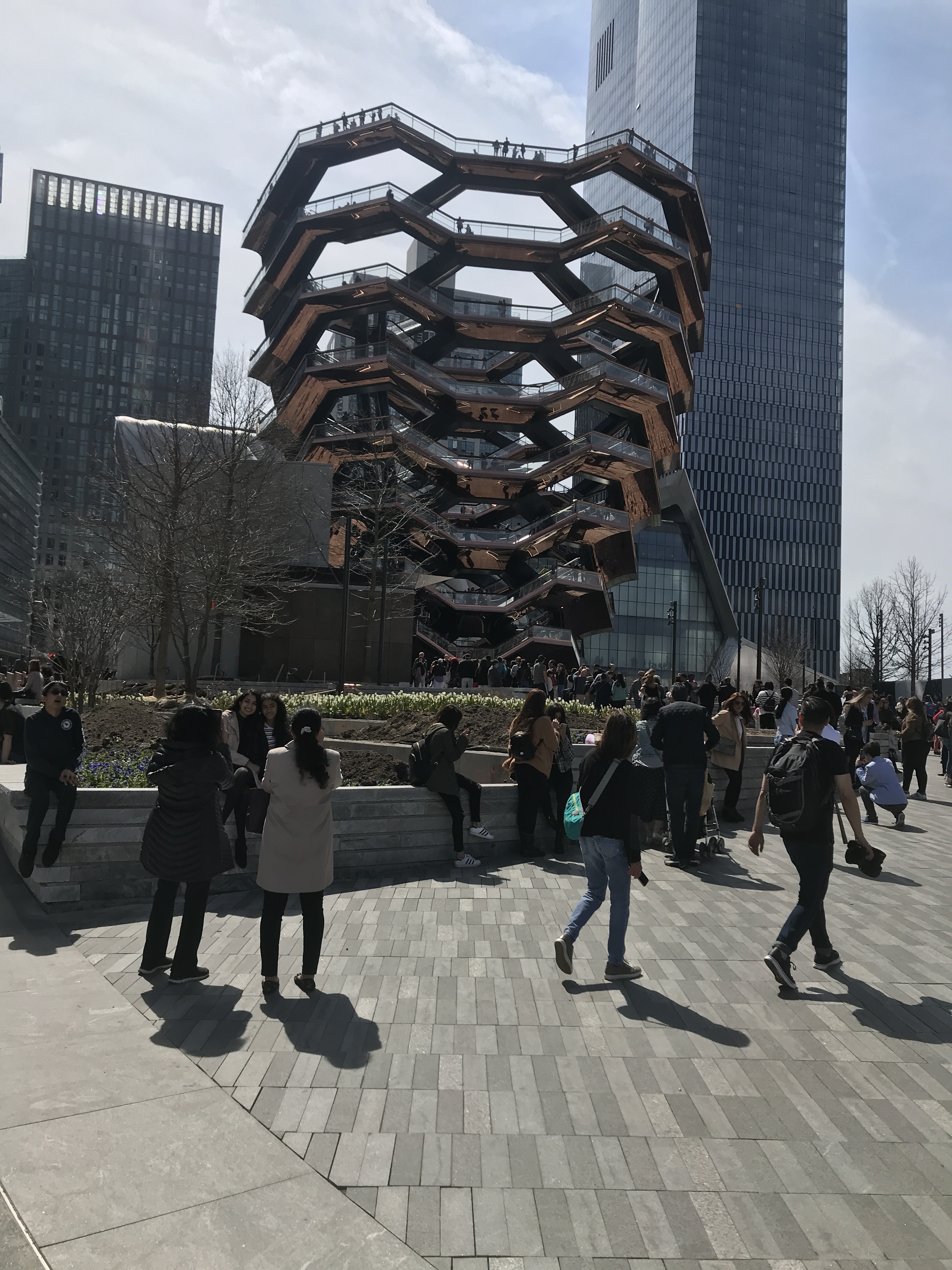
The first massive tower emerged at the apex of the High Line, looming over it, a shingled, spiky, reflective blue-glass behemoth [The Vessel], shaped by eccentric cuts and angles, as if sheared by a giant Ginsu knife.

The largest mixed-use private real estate venture in American history. …, it is called Hudson Yards. … at jaw-dropping magnitudes you can’t begin to grasp until you are actually standing there, Hudson Yards has sprouted a seven-story, 720,000-square-foot shopping mall. There are also four more supertall skyscrapers as well as a $500 million city-sponsored arts center called the Shed.

… [The Vessel, a climbable 15-story sculpture which stands out as a defining architectural symbol/motif is] a 50-foot-high, $200 million, latticed, waste-basket-shaped stairway to nowhere, sheathed in a gaudy, copper-cladded steel. …

For its advocates, the $25 billion development is a shining new city ex nihilo, a wellspring of future tax revenues and evidence of a miraculous, post-9/11 civic volte-face. …

It is, at heart, a supersized suburban-style office park, with a shopping mall and a quasi-gated condo community targeted at the 0.1 percent.

A relic of dated 2000s thinking, nearly devoid of urban design, it declines to blend into the city grid.

It offers 14 acres of public open space in return for privatizing the last precious undeveloped parcel of significant size in Manhattan. But the open space looks like it may end up being mostly a fancy drive-through drop-off for the shopping mall, a landscaped plaza overshadowed by office towers and, for the coming western yards, a scattering of high-rise apartment buildings around a lawn — in effect, a version of a 1950s towers-in-the-park housing complex, except designed by big-name architects. … the whole site lacks any semblance of human scale. With its focus on the buildings’ shiny envelopes, on the monotony of reflective blue glass and the sheen of polished wood, brass, leather, marble and stone, Hudson Yards glorifies a kind of surface spectacle — as if the peak ambitions of city life were consuming luxury goods and enjoying a smooth, seductive, mindless materialism. …

Over all, Hudson Yards epitomizes a skin-deep view of architecture as luxury branding. Each building exists to act like a logo for itself. The assortment suggests so many crowded perfume bottles vying for attention in a department store window display.

— “Hudson Yards Is Manhattan’s Biggest, Newest, Slickest Gated Community: Is This the Neighborhood New York Deserves?” By Michael Kimmelman, Architecture critic, The New York Times, March 14, 2019

Kimmelman goes on to say, perceptively:

The obvious precedent here is Rockefeller Center, completed during the 1930s, the last comparable development in Midtown Manhattan. … [It was] an object lesson in urban design and a landmark of modern art and architecture, a development ingeniously, democratically woven into the fabric of the street grid.”

At a glance, Rockefeller Center looks unified because of all the masonry construction and Art Deco details. But the real source of its coherence is its plan. … All the parts work in harmony to create a singular place inseparable from the rest of the city.” [Raymond] Hood [Rockefeller Center’s chief architect] grasped the difference between scale and size — how a site with multiple entrances needs to be orchestrated from many angles, how architecture without urban design is just sculpture, how true art enhances the dignity of a place, and how the success of a neighborhood and its retail businesses come down to what’s happening at street level.

Hudson Yards barely acknowledges any of these things.


*****************************************************

The sage observations of one Roger W. Smith (while walking on Sunday):

Hudson Yards deserves the criticisms it’s getting. From critics who know a lot more about architecture and cityscapes than I ever will.

Its stores are for rich people and tourists. The new concert hall/arts venue (The Shed) does not look appealing or inviting.

But the place is thronged (was thronged when I went there on Sunday).

With ordinary people. Congregating, milling about. Mingling. Gawking.

Sitting on benches on a spring day.

Because it’s a place to go. In what was a storage yard for railroad cars. The number 7 subway line has been extended to go there. A new urban space has been created ex nihilo.

People like to be in the midst of other people. People hate isolation, hate to be cooped up. (Pity the poor, inhumanely and cruelly treated inmates in our prisons.) This is very true of New Yorkers.

NYC invites its apartment dwellers OUTDOORS. On a beautiful early spring day in April. Streets and thoroughfares for walkers and bicyclists everywhere. People out on Sunday. Congregating in parks seemingly everywhere. Walkers predominating and defining the streetscape (on a lazy non-business day), like you see nowhere else in America.

Many interesting looking people. Snatches of conservation overheard. Attractive young women. Attractive young couples. People sunbathing themselves on the grass. People in crowded bars and cafes, jammed with customers.

Young ladies walking dogs. Parents with kids. A father free from work for the day taking his son or daughter for a walk, presumably heading to the park, or in the park. Mothers with strollers. Kids frolicking and kicking a soccer ball in the park, with the utter abandonment characteristic of kids at a play.

New York is wonderful.

Rockefeller Center is accessible in a way that Hudson Yards isn’t. Michael Kimmelman makes an excellent point. But Hudson Yards is another place to go. New York keeps changing, sometimes not for the better, but it’s hard to destroy its vitality and appeal to common humanity, despite cement and steel.


– Roger W. Smith

   April 2019


*****************************************************

photographs by Roger W. Smith

IMG_3233.JPG

The Vessel, Hudson Yards; an ugly, monolithic “artwork”

Hudson Yards 1-53 p.m. 4-7-2019.JPG

Hudson Yards, April 7, 2019

Hudson Yards 1-53 p.m. 4-7-2019 (2).jpg

Hudson Yards, April 7, 2019

Hudson Yards 1-54 p.m. 4-7-2019.JPG

Hudson Yards, April 7, 2019

park at West and West 11th Streets 12-53 p.m. 4-7-2019

Hudson River Park at West and West Eleventh Streets, April 7, 2019
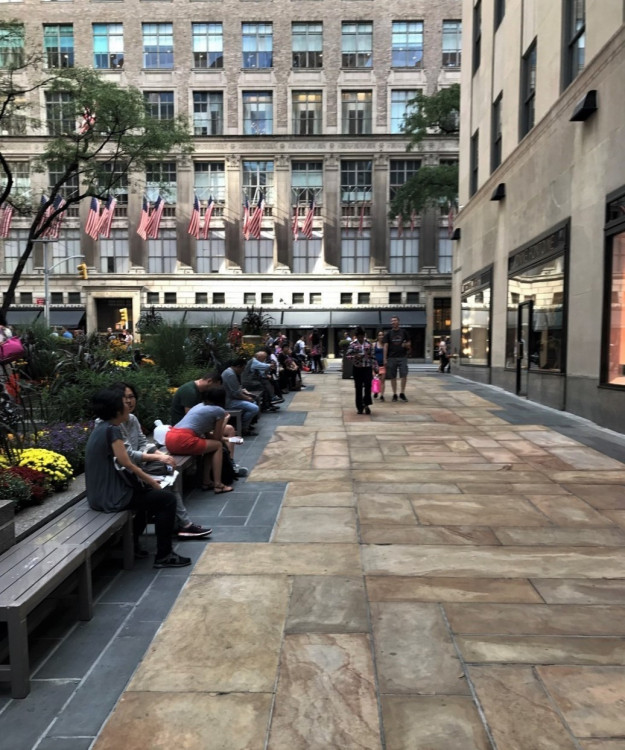
Rockefeller Center 4-01 p.m.-9-26-2017

Rockefeller Center on a weekday afternoon; September 26, 2017


Kirk Douglas on the “glories” of New York


“I find myself in Albuquerque. No work, no money. …. No Lindy’s. No Madison Square Garden. No Yogi Berra. …

“You know what’s wrong with New Mexico? Too much outdoors. Give me those eight spindly trees in front of Rockefeller Center any day. That’s enough outdoors for me. No subway smelling sweet, sour. … No more beautiful roar from eight million ants fighting, cursing, loving. No shows. No South Pacific No chic little dames across a crowded bar.”

— Chuck Tatum (Kirk Douglas), Ace In the Hole


*****************************************************

Ace in the Hole is a 1951 American film noir starring Kirk Douglas as a hard boiled, cynical reporter who stops at nothing to try to regain a job on a major newspaper. He has come west to New Mexico from New York City, out of money and options. He talks his way into a reporting job with a newspaper in Albuquerque.

Lindy’s was a restaurant chain in New York City famous for its cheesecake.


— posted by Roger W. Smith

   March 2019