Category Archives: my city and neighborhood

“I went to the school of New York.”


“A whale ship was my Yale College and my Harvard.”

— Herman Melville, Moby-Dick


*****************************************************

I was talking on the phone today with my longtime friend from my first days in New York, Bill Dalzell. He told me something that his dear friend Edwin Treitler once said to him. Ed Treitler, who recently passed away, was an artist, writer, and spiritual counselor/healer.

The quote, which struck me forcibly and rung true, was short and pithy: “I went to the school of New York.”

The school of New York. Herman Melville would have perceived instantly what this meant.

It rings so true when I consider my own experience.


*****************************************************

I had a very good education, for which I am very grateful. Then, I went further.

I moved to New York City right after graduating from college, and my education really began. Or was on a new plane. Something like that.

I had never seen a really good film. Had never, I believe, patronized an art film house. Had often frequented bookstores, but had never seen so many used bookstores cheek by jowl with so many interesting books, including many by avant-garde writers who were usually not taught in college.

I had never read so intensely and deeply before in such weighty works. I had never met such intellectually stimulating people. Many of them, most of them, I met in totally offhanded and unanticipated ways, in places where you would not expect to find someone smart and interesting, often in the workplace. (It reminded me of Theodore Dreiser’s friends in his early Chicago days; see below.)

I met many such persons in my early days in Manhattan: a poet who it seemed had read the whole corpus of great poetry — and knew all those currently active, including the New York School of poets (and who took me with him to poetry readings in Manhattan) — and practically every important work of literature from time immemorial, ranging from Roman poets such as Juvenal and Sextus Propertius to the most recent and challenging fiction by writers such as Thomas Pynchon … a printer who was thoroughly immersed in mysticism and the visual arts (and whom I tagged along with to the Metropolitan Museum of Art and the Whitney; from him I became acquainted with painters such as Edward Hopper, whom I had never heard of) … and so many people whose ideas piqued me and who submerged me in new areas of thought and “mental adventure” and who introduced me to books, painters exhibited in the City’s museums and galleries, filmmakers, and such that I would probably never have learned about.

The true intellectuals, I find, are often buried in the woodwork, are in the back office or hunkered down over a desk doing drudge clerical work (as was I).

I had such stimulating conversations with people I met at random in taverns and at work, or with their friends. Almost none of them were well off, and most were at a stage in their lives where they were starting out and did not have impressive credentials, or were perhaps older but had never become credentialed. They were barely making it. But they had a deep passion for ideas, the arts, and culture.

I instinctively took to such a milieu as a duck to water. I bathed in it, drank of it. I grew immeasurably intellectually. I became sophisticated culturally and intellectually. I became a hundred percent better informed, better read, better educated.


*****************************************************

It has been said that New York is like no other city in the world. For me, this was true. There is an openness to ideas there, a wonderful tolerance, an acceptance of people without any expectation that one must conform. Loners are accepted. (I was afraid I might be perceived as a loner when I first came to New York knowing no one.) Eccentrics are accepted. People of all ideologies and belief systems are accepted, and of all backgrounds. Stimulating conversation by highly aware, well informed, intellectually alive, and intelligent people is the norm.

Cultural sophistication comes with the territory. The arts are almost upon you, so to speak, are omnipresent. It’s almost impossible to be in New York and not to be aware of them and influenced, liberated, and exhilarated by them. New York broadens you, stimulates you, educates you anew. And keeps right on stimulating and educating you.


— Roger W. Smith

   November 3, 2017


*****************************************************

Addendum:

In his autobiographical work Dawn, Theodore Dreiser portrays an individual he met as a young worker in Chicago during the 1890’s. Dreiser was employed in the warehouse of Hibbard, Spencer, Bartlett & Company, a wholesale hardware firm, at a salary of five dollars a week, as a “box-rustler” and “stock-piler.” A coworker whom Dreiser befriended and who fascinated him was Christian Aaberg, a Dane. Dreiser describes him as a “little rickety, out-at-the elbows, shambling man, with a wrinkled, emaciated, obviously emotion-scarred face, who at forty or forty-five and after God knows what storms and rages of physical and mental dissipation, still had about him that indescribable something which for want of a better word I must speak of as breeding.”

Aaberg was of little or no value to the firm, for he could do no hard work and the powers that were could not trust him with the more complicated, though less strenuous, task of filling orders. As he himself admitted, he drank and dissipated here as in the past and often wondered aloud why it was that … the firm stood for him. … He was shabby and sickly to look upon. Yet … there was that strong, seeking, vital light in his eye at times. … within two or three weeks we were fast friends intellectually, and there followed a series of conversations on life and character, the import of which has endured to this day.

He had read—God knows what! —everything! And he it was who talked to me of Ibsen, Strindberg, Grieg, Goethe, Wagner, Schopenhauer. He would talk to me by the hour, as we piled pots and pans or buckets of bolts or rivets. of the French Revolution and the great figures in it, of Napoleon, Wellington, Tsar Alexander, Also of Peter the Great and Catharine of Russia, Frederick the Great and Voltaire, whom he admired enormously. But not the silly, glossed, emasculated data of the school histories [italics added] with which I had been made familiar, but with the harsh, jagged realities and savageries of the too real world in which all of them moved. And, again, of Greece, of the age of philosophers, logicians, playwrights, sculptors, architects, statesmen, warriors. He revealed as much as any history could—why it was that Aristotle was the first of the organic and realistic thinkers; why Heraclitus would always be remembered. He also told me why Socrates had been compelled to drink the hemlock; that the cross was originally a phallic symbol; elucidated for me the mysteries of the Egyptian temples, the religious festivals of the Parsees, Chaldeans, Assyrians, Persians. … When I told him that that our family was Catholic and I still went to church, he smiled. “You will come out of that,” he said. “You are already out and don’t know it?”

— Theodore Dreiser, Dawn: An Autobiography of Early Youth, Chapter 61

“New York can be lived as a small town”


“Even with that sprawl of humanity, New York can be lived as a small town, familiar and compact.”

— “Immigrants Are Not the Enemy, They Are Us,” by Jim Dwyer, The New York Times, November 2, 2017


*****************************************************

So true. I was walking around the City the day before yesterday and had just this feeling. With the exception of a very few neighborhoods, one being Times Square, one can amble about the City and feel that one is in a cozy neighborhood where all are welcome, everything is accessible to you, business establishments are inviting and customer friendly, and people are laid back. (Besides being friendly; one wouldn’t expect this in a big city which is supposed to be cold and impersonal and full of Sammy Glick types, but it’s true.)

I was on Amsterdam Avenue in the West 70’s; it was a sunny day. People were strolling about leisurely or chatting in local pubs and restaurants. There was an undeniable air of tranquility and an unhurried pace which seemed to prevail. I made my way down Broadway to Columbus Circle and then to Carnegie Hall at 57th Street and Seventh Avenue and stood there, first talking to a friend on a cell phone and then studying the advertisements for upcoming concerts as strollers passed by. One would have thought one was on Main Street in Smallville, USA.


— Roger W. Smith

   November 3, 2017


*****************************************************

Note: Sammy Glick is the main character in Budd Schulberg’s novel What Makes Sammy Run?

an island … a city surrounded by WATER


photographs by Roger W. Smith


*****************************************************

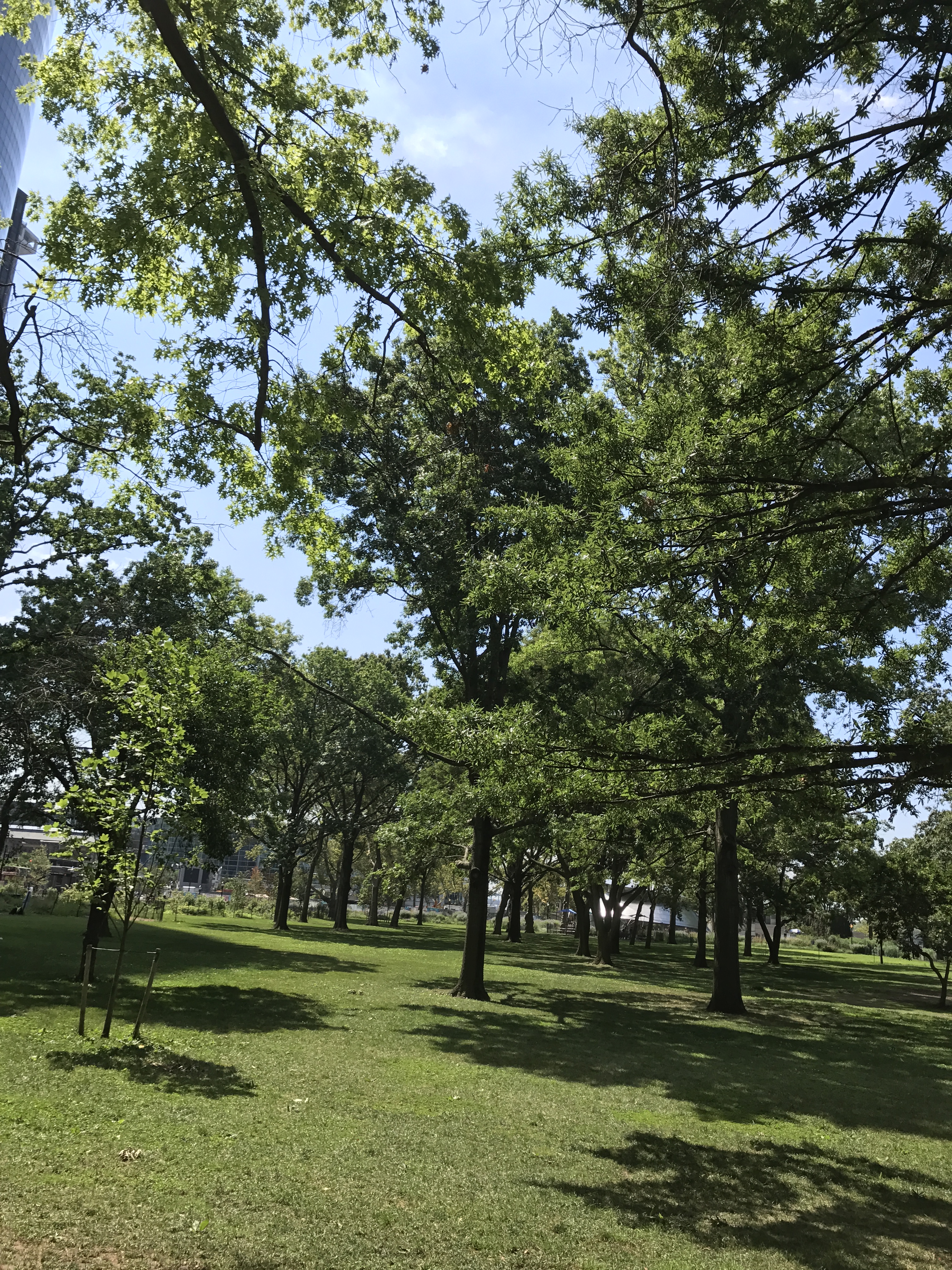
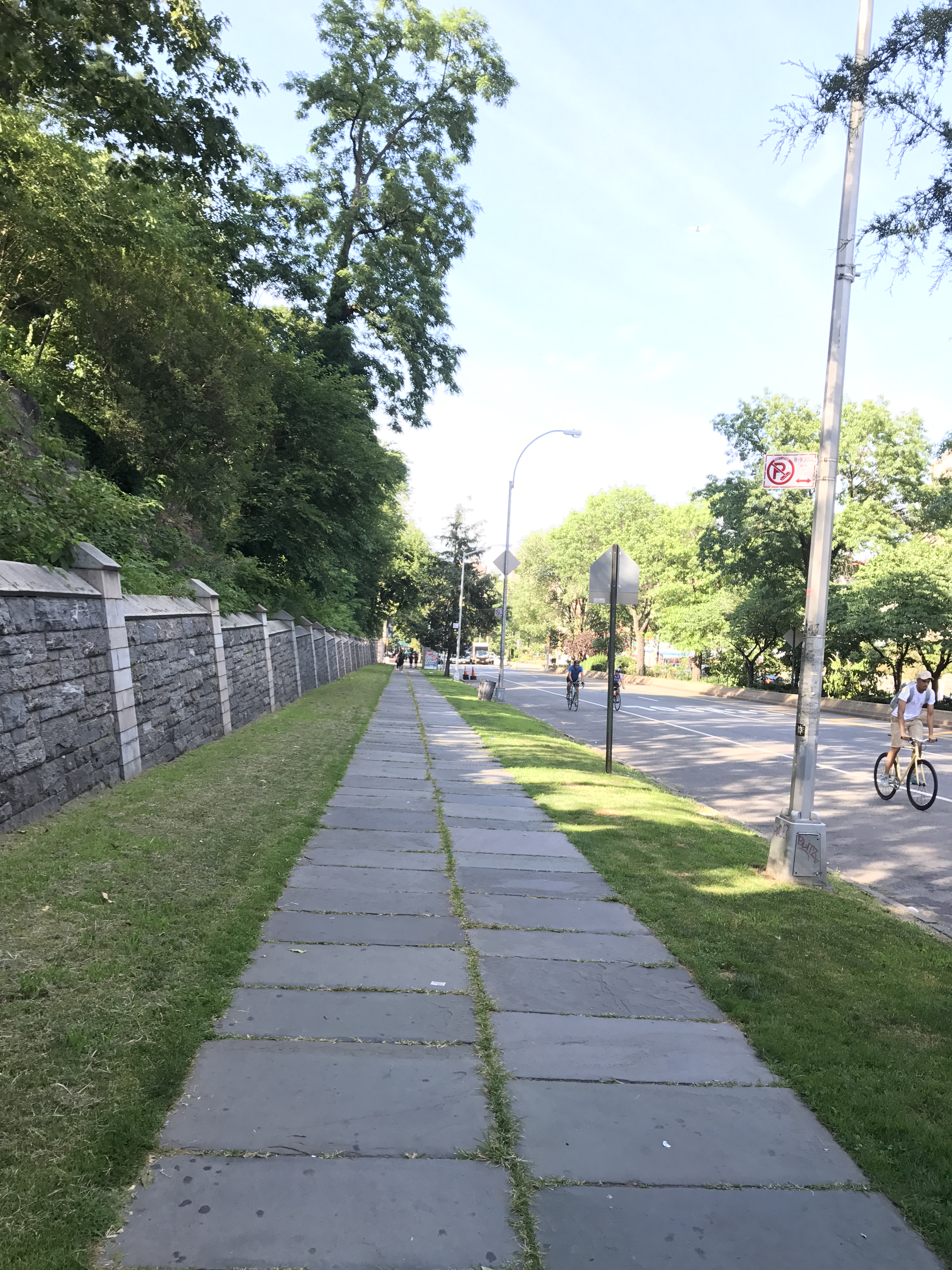
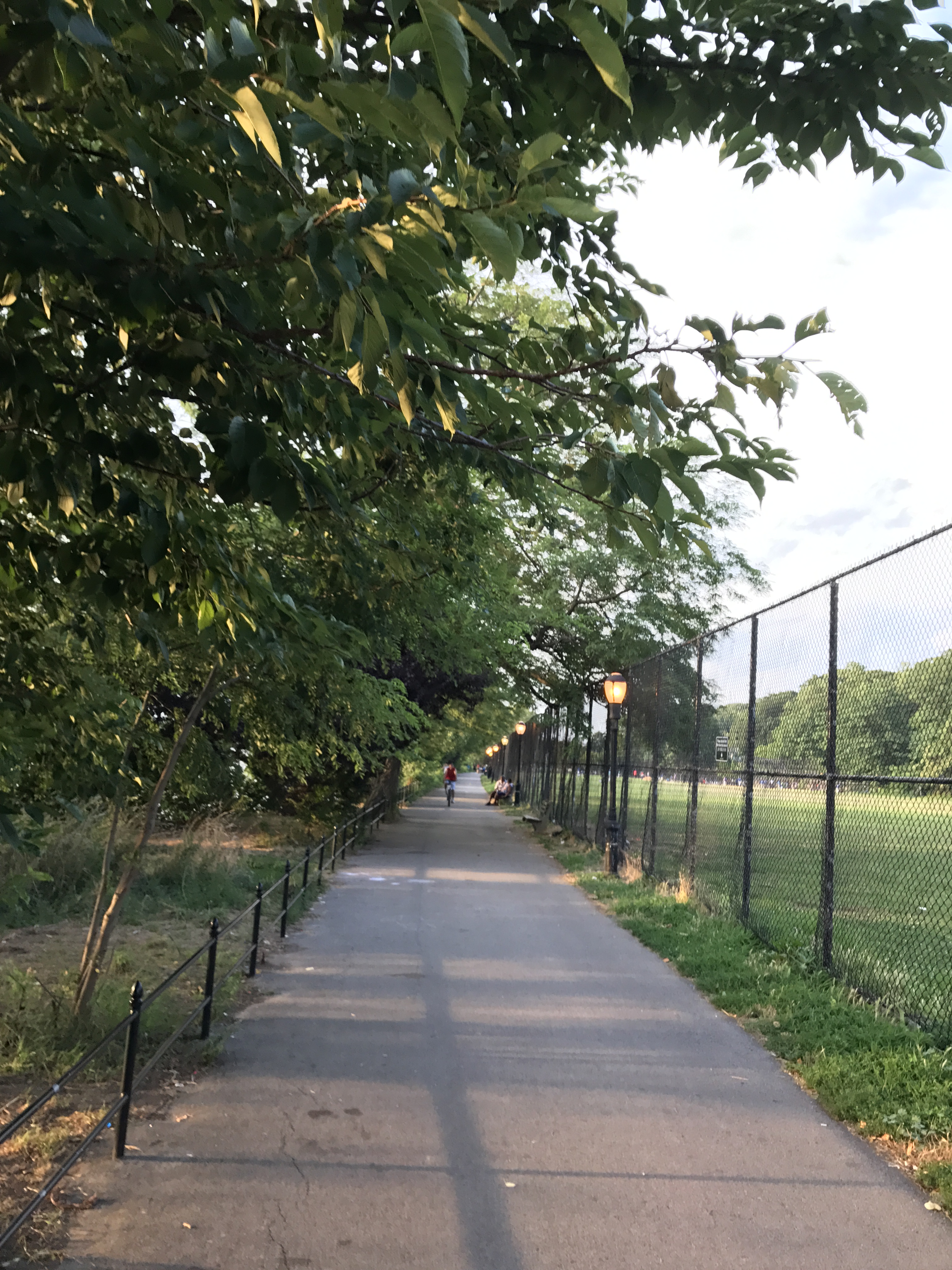
The photographs posted here above were all taken by me within the past few months in Manhattan, Brooklyn, and Queens, NYC.

I love skylines, love dense clouds. New York City has wonderful skylines. You can’t really see them from Manhattan, but you can from the waterside and from the outer boroughs, which have lower buildings.

It is wonderful that Manhattan is an island bounded by water: the ocean (New York Harbor), the East River, the Hudson River, the Harlem River.

One thing this does is prevent urban sprawl and the development of a megalopolis ending nowhere.

It also gives the city an almost enchanted quality or aspect.

As Herman Melville put it in Moby-Dick (Chapter 1, ‘Loomings”):

There now is your insular city of the Manhattoes, belted round by wharves as Indian isles by coral reefs—commerce surrounds it with her surf. Right and left, the streets take you waterward. Its extreme downtown is the battery, where that noble mole is washed by waves, and cooled by breezes, which a few hours previous were out of sight of land. Look at the crowds of water-gazers there.

Circumambulate the city of a dreamy Sabbath afternoon. Go from Corlears Hook to Coenties Slip, and from thence, by Whitehall, northward. What do you see?—Posted like silent sentinels all around the town, stand thousands upon thousands of mortal men fixed in ocean reveries. Some leaning against the spiles; some seated upon the pier-heads; some looking over the bulwarks of ships from China; some high aloft in the rigging, as if striving to get a still better seaward peep. But these are all landsmen; of week days pent up in lath and plaster—tied to counters, nailed to benches, clinched to desks. How then is this? Are the green fields gone? What do they here?

But look! here come more crowds, pacing straight for the water, and seemingly bound for a dive. Strange! Nothing will content them but the extremest limit of the land; loitering under the shady lee of yonder warehouses will not suffice. No. They must get just as nigh the water as they possibly can without falling in. And there they stand—miles of them—leagues. Inlanders all, they come from lanes and alleys, streets and avenues—north, east, south, and west. Yet here they all unite. Tell me, does the magnetic virtue of the needles of the compasses of all those ships attract them thither? … There is magic in it. Let the most absent-minded of men be plunged in his deepest reveries—stand that man on his legs, set his feet a-going, and he will infallibly lead you to water. … Yes, as every one knows, meditation and water are wedded for ever.


— Roger W. Smith

   October 2017

epiphany II


The following is an email of mine.


— Roger W. Smith

   September 28, 2017


*****************************************************

Janet and Scott —

In my blog post

“epiphany”

epiphany

from a month or so ago, I described how I had a mystical experience while walking in Manhattan in the early evening that day after leaving the library.

I experienced this again this evening under similar circumstances.

I had just taken the Staten Island ferry back and forth for pleasure. At rush hour.

It wasn’t that crowded, especially returning to Manhattan.

Everyone in a good mood, as usual.

Gorgeous sunset … other passengers and I were saying to one another how beautiful it was: the sky, the crimson clouds, the sinking sun shimmering on the water, the harbor.

I got off at around 7:00 and walked about three blocks to an Au Bon Pain on Broad Street.

Sat down and plugged my phone in to charge it.

Place more or less empty; two young women at an adjacent table were having a friendly, animated discussion.

The place is self-serve. I poured myself a large coffee from an urn … went to the counter where you pay; no one there … finally concluded, looks like this coffee is free.

I sat nursing my coffee for a while … and musing.

No one ever bothers you in the City; in Manhattan, in the midst of frenzied activity (though not at this moment) going on constantly around you and people everywhere, one can, paradoxically, attain great peace.

I walked uptown a couple of blocks to catch the number 4 train … in those moments, I experienced the epiphany.

It had cooled down and there was a wonderfully refreshing sea breeze on the sidewalks.

There are relatively few people in the Financial District (Wall Street area) at that time of day … what people there were, were sauntering along, with pairs conversing happily.

I had a feeling, surge, of profound happiness, serenity, and inner peace.

Roger

Fifth Avenue, Wednesday afternoon (where are the cars?)


IMG_3143 (2)

Fifth Avenue, NYC; 1:40 p.m.; Wednesday, September 20, 2017

I took the above photo yesterday (September 20, 2017) on Fifth Avenue at 1:40 p.m. The photo was taken on a Wednesday afternoon on the avenue near 45th Street. In other words, in the heart of the Manhattan on a business day.

It can be plainly seen that there is little traffic. Certainly, no traffic jam.

And yet, social engineers — revered by Manhattan based yuppies who hate cars — want to implement a so called “congestion pricing” plan (already in effect in London), under which automobiles entering central sections of Manhattan on weekdays would be charged a fee.

Wouldn’t you know it, the New York Times editorial board is all for the plan. (See “A Solution to New York City’s Gridlock,” editorial, September 19, 2017.)

One thing the Times editorial writers lack is common sense, or any kind of feeling for life as it is actually experienced by the average person. If they would just look around them (see my photo), they would see that the “problem” they are wringing their hands about is NOT a problem. Public transit is remarkably efficient, despite problems which regularly occur. Traffic of the vehicular sort moves well, for the most part, especially when taking into account the concentration of economic, entertainment, and recreational activities and the population density in Manhattan. Pedestrian traffic flows beautifully — another thing the Times bemoans (the state of pedestrian traffic, that is), stating, incredibly, that the case is just the opposite, when everyone who walks knows that this is not true.

I myself like (love) to walk in the City. But, I have nothing against automobiles. There is plenty of room for cars, buses, and pedestrians, thank you!

As one Times reader noted (letter to the editor, May 31, 2016), congestion pricing “is a good way to hasten the transformation of southern Manhattan into an island for only the gilded rich, a process already occurring.”


— Roger W. Smith

  September 21, 2017


*****************************************************

See also:

“A Plan to Destroy Fifth Avenue”

posted here at

A Plan to Destroy Fifth Avenue

“3rd Ave. El”


My good friend Bill Dalzell, who introduced me to art films, recently called my attention to a film he loved from his early days in New York City in the 1950’s: 3rd Ave. El, directed by Carson (Kit) Davidson. The film comprises a portrait of the Third Avenue Elevated Railway in New York City, filmed in 1955. A rare print was preserved by the Academy Film Archive.

The music, as my friend Bill pointed out, is Haydn’s Concerto in D, played by harpsichordist Wanda Landowska.

The film is on YouTube. (See link to YouTube clip below.)

I was disappointed that the footage is grainy. But, the film, which lasts for something like twelve minutes, gives a wonderful feeling for New York City in the 1950’s. It conveys what I love about the City and is still, despite gentrification, true: its grittiness and its authenticity; the people; their authenticity; the open display by New Yorkers of a sort of primal enjoyment of life despite seeming to be wearing a “mask” of anonymity.

With the music, the film gives me a high. It, NYC, bubbles up.

The film has a Whitmanesque (that’s Walt Whitman) feeling about it. Great joyousness. It inspires the same feelings Whitman had for his beloved Mannahatta: its people, its pavements and buildings, its sheer energy.


— Roger W. Smith

   September 2017


“3rd Ave. El”


*****************************************************

addenda:

After three years involved with World War II and four involved with Antioch College, Carson Davidson arrived in New York bent on making films. Usual story — washing dishes at a Bickford’s Cafeteria by night, knocking on producers’ doors by day. Finally, a job with a jaunty outfit called Dynamic Films, doing whatever needed doing. Nobody actually taught him anything, but they answered questions cheerfully, and that’s all that’s really needed.

Fascinated by the 3rd Ave El, he borrowed a company camera and started shooting in his spare time. The resultant film was turned down by every distributor in New York except the last on the list, a crazy Russian who then owned the Paris Theater. He paid for blowing it up to 35 mm and played it for seven months along with an Alec Guinness feature. Actually put the short subject on the marquee — unheard of then or now.

http://www.afana.org/davidsoncarson.htm


*****************************************************

The IRT Third Avenue Line, commonly known as the Third Avenue El and the Bronx El, was an elevated railway in Manhattan and the Bronx, New York City. Originally operated by the New York Elevated Railway, … it was acquired by the Interborough Rapid Transit Company (IRT) and eventually became part of the New York City subway system.

The first segment of the line, with service at most stations, opened from South Ferry to Grand Central Depot on August 26, 1878. Service was extended to Harlem in Manhattan on December 30 of the same year. Service in Manhattan was phased out in the early 1950’s and closed completely on May 12, 1955. It ended in the Bronx on April 29, 1973.

The Third Avenue El was the last elevated line to operate in Manhattan, other than the number 1 train on the IRT Broadway–Seventh Avenue Line, which has elevated sections between 122nd and 135th Streets and north of Dyckman Street. Service on the Second, Sixth and Ninth Avenue El lines was terminated in 1942, 1938, and 1940, respectively.

source: Wikipedia

epiphany


Scott and Janet —

It’s almost 7:30 p.m. The library is about to close, and I’m heading uptown on Lexington Avenue to 47th Street.

It was another beautiful day. I love summer evenings.

I’ve been having a mystical experience during my short walk.

The air, the breeze, feels so nice and cool — Walt Whitman would call it delicious.

People on the sidewalk — people everywhere — seem different at this hour. There are less of them. They don’t seem to be in a hurry; the work day is over.

Whitman got a charge from being part of a pedestrian throng, from exchanging looks with passersby.

The women! They never seem to look uptight or fearful of being accosted; instead, they look contented, relaxed. There’s an openness about them. This seems to be true in general of the swell of humanity as they appear to someone like myself “jaunting” in the City.

I passed a chartered bus parked on the west side of Lexington Avenue in the mid-30’s. People were getting off with suitcases. It looked like they were returning from an excursion to the country. A woman was rolling her suitcase along the sidewalk. She looked contented and very relaxed. Living in Manhattan, you can have the best of both worlds.

There’s something special about early summer evenings. Time seems to stand still. There is such a feeling of tranquility, of peace and serenity.

It must be what the poet felt when he wrote: “God’s in His heaven— / All’s right with the world!”


— Roger W. Smith

   August 23, 2017

Manhattan Island from Bottom to Top; Walking as Exercise


In the spirit of Alice’s Adventures in Wonderland, I will begin with the conclusion, followed by evidence to prove my point.

Walking is a naturally beneficial form of exercise habitual since human origins. It is perfectly suited to the human body and is a form of physical activity from which it seems personal injury cannot come; hence, one can justly say that it is one hundred percent beneficial.

The body welcomes such exercise. In fact, when it is undertaken, the body seems to be saying, “give me more!” It seems to cure all kinds of nagging (but not serious) physical complaints, discomforts, and ills, such as aches and pains, and actually seems to restore energy as much if not more than depleting it.


*****************************************************

I love to walk, as was noted by me in a previous post on this blog:

“on walking (and exercise)”

https://rogersgleanings.com/2016/03/20/roger-w-smith-on-walking/

I like to think of new places and routes to walk in the City (i.e., New York City, including Manhattan and the “outer boroughs” of Brooklyn and Queens).

I keep finding new places to explore — in Brooklyn, for example. It could be a neighborhood, such as Williamsburg, or a park, such as Brooklyn Bridge Park, which I only found out about recently. I like to call my walks, playfully, “jaunts,” a favorite term used by the poet Walt Whitman.

The other day, while writing a post, “Walt Whitman on Manhattan”

Walt Whitman on Manhattan (plus my own impressions and thoughts)

I noticed that in his poem “Mannahatta,” Whitman describes Manhattan as “an island sixteen miles long.”

Yes, I thought to myself, sixteen miles long, from the southernmost point of Manhattan, Battery Park (which overlooks New York Harbor and from which boats depart regularly for the Statue of Liberty, which can be viewed from the park), to Inwood at the northernmost point of Manhattan.

Then, on Thursday evening (July 20), I saw a documentary film at the Morgan Library in Manhattan: Henry David Thoreau, Surveyor of the Soul, directed by Huey Coleman. In the film, it is noted that when Thoreau first attended a lecture by Ralph Waldo Emerson, he walked seventeen miles from Concord, Massachusetts to Boston to attend.

I had been thinking of taking such a walk myself. If Thoreau can do it, I can, I thought. I would like to see how such a long walk feels.


*****************************************************

Yesterday I walked, in around 90 degree weather, from Bowling Green, at the southern tip of Manhattan, to the northernmost point of Manhattan Island, Inwood Hill Park, where the Henry Hudson Bridge and the Spuyten Duyvil Bridge link Manhattan to the Bronx.

It took me about ten hours with a couple of pit stops.

I got up in the morning feeling sluggish and achy. I took the subway to Bowling Green, then started walking, taking a few photographs of the harbor and then starting to walk uptown.

I felt sluggish and unsteady on my feet. The heat felt oppressive. I had a pain in my right foot that had persisted for a day or two. But gradually, as my walk and the day progressed, I started feeling better.

At 3:45 p.m., I texted a friend:

have reached 96th St and Broadway

wouldn’t u know it

I seem to have more energy than when I started

my toe is not hurting any more

I feel much less achy and better overall

A couple of hours later, from 155th and Broadway, I texted my friend again, saying “I am getting tired.” I had probably walked over 15 miles already. But, I kept going. It took me over an hour more to reach Inwood Hill Park. The park is entered via Dyckman Street, which is located precisely where West 200th Street would be, were it a numbered street. I walked along the western end of the park, which skirts the Hudson, to the northern end of the park, then back to the subway.

Riding home on the subway, I felt exhausted. I was relieved to get home and after a short while fell into a deep sleep.

I woke up very early after only a few hours of sleep feeling refreshed and very energetic. I haven’t felt so good in a long time. I felt very alert and refreshed. (It is my belief that pleasurable, mentally relaxing exercise such as walking obviates neurasthenia and chronic fatigue.)


*****************************************************

Conclusion

I already said it! The body welcomes exercise. It craves it. I can often hear my “brother body” (a term used by Pitirim A. Sorokin, which he undoubtedly got from Saint Francis) telling me, “thank you; give me more.” It is not uncommon after a five to seven mile walk for me to find myself saying to myself, I could do another five miles more. And, I am not a fitness addict or fanatic.


— Roger W. Smith

   July 22, 2017


*****************************************************

IMG_7451.JPG

Battery Park

DSCN0006.JPG

New York Harbor viewed from Battery Park

IMG_7480.JPG

Sixth Avenue, Greenwich Village

IMG_7494.JPG

Broadway, Upper Manhattan

IMG_7528.JPG

Inwood Hill Park

IMG_7550.JPG

Hudson River, late evening, viewed from Inwood Hill Park

IMG_7659 (2).JPG

Inwood Hill Park, overlooking Hudson River

DSCN0032.JPG

northern tip of Inwood Hill Park, overlooking Hudson River and Spuyten Duyvil Bridge

photos by Roger W. Smith


****************************************************

Addendum: On Sunday, August 6, 2017, I reversed myself and walked from the top (northernmost point) of Manhattan Island to the bottom (Battery Park). I found that Manhattan actually ends at Broadway and 218th Street — not at 207th Street, as I had thought.

I did it faster this time. It took me about seven and a half hours.

The weather was cool for August, and I did not experience appreciable fatigue. I felt as if I could have kept going should I have had cause to.


IMG_9090.JPG

Broadway at 218th Street, 1:34 p.m.; Manhattan’s northern border

DSCN0165.JPG

Broadway at entrance to Battery Park, 8:44 p.m.; Manhattan’s southern tip; end of my Sunday walk

Walt Whitman on Manhattan (plus my own impressions and thoughts)


MANNAHATTA.

I WAS asking for something specific and perfect for my city,
Whereupon lo! upsprang the aboriginal name.

Now I see what there is in a name, a word, liquid, sane, unruly,
musical, self-sufficient,
I see that the word of my city is that word from of old,
Because I see that word nested in nests of water-bays, superb,
Rich, hemm’d thick all around with sailships and steamships, an
island sixteen miles long, solid-founded,
Numberless crowded streets, high growths of iron, slender, strong,
light, splendidly uprising toward clear skies,
Tides swift and ample, well-loved by me, toward sundown,
The flowing sea-currents, the little islands, larger adjoining islands,
the heights, the villas,
The countless masts, the white shore-steamers, the lighters, the
ferry-boats, the black sea-steamers well-model’d,
The down-town streets, the jobbers’ houses of business, the houses
of business of the ship-merchants and money-brokers, the river-streets,
Immigrants arriving, fifteen or twenty thousand in a week,
The carts hauling goods, the manly race of drivers of horses, the
brown-faced sailors,
The summer air, the bright sun shining, and the sailing clouds
aloft,
The winter snows, the sleigh-bells, the broken ice in the river,
passing along up or down with the flood-tide or ebb-tide,
The mechanics of the city, the masters, well-form’d, beautiful-
faced, looking you straight in the eyes,
Trottoirs throng’d, vehicles, Broadway, the women, the shops and
shows,
A million people—manners free and superb—open voices—
hospitality—the most courageous and friendly young men,
City of hurried and sparkling waters! city of spires and masts!
City nested in bays! my city!


*****************************************************

Broadway.

What hurrying human tides, or day or night!
What passions, winnings, losses, ardors, swim
thy waters!
What whirls of evil, bliss and sorrow stem, thee!
What curious questioning glances—glints of
love!
Leer, envy, scorn, contempt, hope, aspiration!
Thou portal—thou arena—thou of the myriad
long-drawn lines and groups!
(Could but thy flagstones, curbs, facades tell
their inimitable tales);
Thy windows, rich and huge hotels—thy side-
walks wide;
Thou of the endless sliding, mincing, shuffling
feet!
Thou, like the parti-colored world itself—like
infinite, teeming, mocking life!
Thou visor’d, vast, unspeakable show and
lesson!


****************************************************

addendum:

The following are some present day thoughts of my own occasioned by the above two poems of Walt Whitman. “Mannahatta” was Whitman’s stomping grounds during what was probably the most creative period of his life. It is my adopted city; my feelings parallel Whitman’s.

“Mannahatta”: Mannahatta is derived from the aboriginal name for the place, most likely meaning island of many hills. Whitman chose to sometimes call Manhattan “Mannahatta” and to call Long Island “Paumanok,” also derived from a Native American word.

“nested in nests of water-bays, superb,
Rich”

The fact of Manhattan’s being surrounded by water is one of its greatest and most appealing attributes. (This is also stressed by Herman Melville in the opening chapters of Moby-Dick). The rivers and bays act as a natural counterweight to urban sprawl.

“hemm’d thick all around with sailships and steamships”

Not true anymore, for the most part. Too bad. But, Manhattan Island, being bounded on all sides by water, retains a unique appeal because of this.

“an island sixteen miles long”

Sixteen miles from Battery Park (the southern tip of Manhattan Island) to Spuyten Duyvil (the northern end of the island).

“Numberless crowded streets”

Still true. Crowded, which is a blessing. You don’t find lonely, deserted spots or forsaken places. Crowed, yes, but the crowds usually aren’t oppressive.

“high growths of iron, slender, strong,
light, splendidly uprising toward clear skies”

Space is limited in Manhattan. Tall buildings reaching to the skies create a sense of awe.

“Tides swift and ample, well-loved by me, toward sundown,
The flowing sea-currents, the little islands, larger adjoining islands,
the heights, the villas”

Still true. There are islands, rivers with eddies, great vistas. All can still be seen by someone who strolls along the East River, the Battery, the banks of the Hudson, or the rarely visited but wonderful stretches of parkland at the upper tip of the island.

“the lighters, the ferry-boats”

Ferries still run, to the delight and for the convenience of many. A lighter is a barge used in unloading or loading ships. In one of Whitman’s greatest poems, “Crossing Brooklyn Ferry,” there is a reference to a “belated lighter.”

“The down-town streets, the jobbers’ houses of business, the houses
of business of the ship-merchants and money-brokers, the river-streets”

The small businesses are mostly gone, but there are still “river-streets.” Yet, access to the rivers is not so convenient anymore, since highways on the East and West Sides impede (but do not entirely prevent) access.

“Immigrants arriving, fifteen or twenty thousand in a week”

New York is still a city of immigrants, thank God. Mostly immigrants speaking, it seems, practically every imaginable tongue.

“The carts hauling goods, the manly race of drivers of horses”

Whitman loved to ride with and become acquainted with the drivers of horse drawn omnibuses on the main thoroughfares of Manhattan.

“The summer air, the bright sun shining, and the sailing clouds aloft”

So true, still. See photo below.

Central Park 11-36 a.m. 5-14-2017 (4).jpg

Central Park; photograph by Roger W. Smith

The winter snows, the sleigh-bells, the broken ice in the river,
passing along up or down with the flood-tide or ebb-tide”

Herman Melville, in Moby-Dick (Chapter LXXXVII), also mentions ice breaking up on the Hudson: “A low advancing hum was soon heard; and then like to the tumultuous masses of block-ice when the great river Hudson breaks up in Spring, the entire host of whales came tumbling upon their inner center. …” I myself have observed this (once) during wintertime on the Hudson. The river froze over, and I can remember the hissing and popping sounds as the ice was breaking up slowly.

“The mechanics of the city, the masters, well-form’d, beautiful-
faced, looking you straight in the eyes”

People in Manhattan — pedestrians passing — still look at you, often, with friendly eyes, not averting their gaze. There is a wonderful openness about them. The City fosters it.

Trottoirs throng’d, vehicles, Broadway”

It is still the case that the streets are thronged, with cars, pushcarts, bicycles. I love it. It drives the city traffic engineers crazy.

Trottoir is the French word for sidewalk. Whitman, who was not well versed in foreign languages, loved to use foreign words, on occasion, mostly French ones. He has been faulted for this. Some people can’t realize that one is not required to always say “sidewalk” when another word might be substituted. For various reasons, including a delight in language.

“the women, the shops and shows”

Manhattan is a wonderful place for shopping and window shopping. The “shows” continue to go on. And on. The women — a friend of mine, Charles Pierre, once remarked — are Manhattan’s “last great natural resource.” They range from classic beauties to exotic looking women with natural beauty of all backgrounds and races.

“A million people—manners free and superb—open voices—
hospitality—the most courageous and friendly young men”

This is all so true. The concentration of humanity is wonderful. The people are open and friendly.

“City of hurried and sparkling waters! city of spires and masts!
City nested in bays! my city!”

All still true, except for the “masts.” The current in the rivers is swift; they do indeed sparkle in the sunlight.


*****************************************************

Broadway.

Whitman’s Broadway would have, in the mid-1850’s, meant an area of the city below 14th Street.

“What hurrying human tides, or day or night!”

“thy side-walks wide;”
“Thou of the endless sliding, mincing, shuffling
feet!”

The sidewalks in Manhattan are indeed wide and welcoming. No thoroughfare lacks them. The pedestrian is not shunted aside or forced to walk (as is the case in the suburbs) on a faux sidewalk. The sidewalks in the City are always full of trampers, day and night.

Note: “Broadway” was originally published in the New York Herald of April 10, 1888. “Mannahatta” exists in a couple of versions published in Leaves of Grass.


— Roger W. Smith

   July 2017