Category Archives: my city and neighborhood

“3rd Ave. El”


My good friend Bill Dalzell, who introduced me to art films, recently called my attention to a film he loved from his early days in New York City in the 1950’s: 3rd Ave. El, directed by Carson (Kit) Davidson. The film comprises a portrait of the Third Avenue Elevated Railway in New York City, filmed in 1955. A rare print was preserved by the Academy Film Archive.

The music, as my friend Bill pointed out, is Haydn’s Concerto in D, played by harpsichordist Wanda Landowska.

The film is on YouTube. (See link to YouTube clip below.)

I was disappointed that the footage is grainy. But, the film, which lasts for something like twelve minutes, gives a wonderful feeling for New York City in the 1950’s. It conveys what I love about the City and is still, despite gentrification, true: its grittiness and its authenticity; the people; their authenticity; the open display by New Yorkers of a sort of primal enjoyment of life despite seeming to be wearing a “mask” of anonymity.

With the music, the film gives me a high. It, NYC, bubbles up.

The film has a Whitmanesque (that’s Walt Whitman) feeling about it. Great joyousness. It inspires the same feelings Whitman had for his beloved Mannahatta: its people, its pavements and buildings, its sheer energy.


— Roger W. Smith

   September 2017


“3rd Ave. El”


*****************************************************

addenda:

After three years involved with World War II and four involved with Antioch College, Carson Davidson arrived in New York bent on making films. Usual story — washing dishes at a Bickford’s Cafeteria by night, knocking on producers’ doors by day. Finally, a job with a jaunty outfit called Dynamic Films, doing whatever needed doing. Nobody actually taught him anything, but they answered questions cheerfully, and that’s all that’s really needed.

Fascinated by the 3rd Ave El, he borrowed a company camera and started shooting in his spare time. The resultant film was turned down by every distributor in New York except the last on the list, a crazy Russian who then owned the Paris Theater. He paid for blowing it up to 35 mm and played it for seven months along with an Alec Guinness feature. Actually put the short subject on the marquee — unheard of then or now.

http://www.afana.org/davidsoncarson.htm


*****************************************************

The IRT Third Avenue Line, commonly known as the Third Avenue El and the Bronx El, was an elevated railway in Manhattan and the Bronx, New York City. Originally operated by the New York Elevated Railway, … it was acquired by the Interborough Rapid Transit Company (IRT) and eventually became part of the New York City subway system.

The first segment of the line, with service at most stations, opened from South Ferry to Grand Central Depot on August 26, 1878. Service was extended to Harlem in Manhattan on December 30 of the same year. Service in Manhattan was phased out in the early 1950’s and closed completely on May 12, 1955. It ended in the Bronx on April 29, 1973.

The Third Avenue El was the last elevated line to operate in Manhattan, other than the number 1 train on the IRT Broadway–Seventh Avenue Line, which has elevated sections between 122nd and 135th Streets and north of Dyckman Street. Service on the Second, Sixth and Ninth Avenue El lines was terminated in 1942, 1938, and 1940, respectively.

source: Wikipedia

epiphany


Scott and Janet —

It’s almost 7:30 p.m. The library is about to close, and I’m heading uptown on Lexington Avenue to 47th Street.

It was another beautiful day. I love summer evenings.

I’ve been having a mystical experience during my short walk.

The air, the breeze, feels so nice and cool — Walt Whitman would call it delicious.

People on the sidewalk — people everywhere — seem different at this hour. There are less of them. They don’t seem to be in a hurry; the work day is over.

Whitman got a charge from being part of a pedestrian throng, from exchanging looks with passersby.

The women! They never seem to look uptight or fearful of being accosted; instead, they look contented, relaxed. There’s an openness about them. This seems to be true in general of the swell of humanity as they appear to someone like myself “jaunting” in the City.

I passed a chartered bus parked on the west side of Lexington Avenue in the mid-30’s. People were getting off with suitcases. It looked like they were returning from an excursion to the country. A woman was rolling her suitcase along the sidewalk. She looked contented and very relaxed. Living in Manhattan, you can have the best of both worlds.

There’s something special about early summer evenings. Time seems to stand still. There is such a feeling of tranquility, of peace and serenity.

It must be what the poet felt when he wrote: “God’s in His heaven— / All’s right with the world!”


— Roger W. Smith

   August 23, 2017

Manhattan Island from Bottom to Top; Walking as Exercise


In the spirit of Alice’s Adventures in Wonderland, I will begin with the conclusion, followed by evidence to prove my point.

Walking is a naturally beneficial form of exercise habitual since human origins. It is perfectly suited to the human body and is a form of physical activity from which it seems personal injury cannot come; hence, one can justly say that it is one hundred percent beneficial.

The body welcomes such exercise. In fact, when it is undertaken, the body seems to be saying, “give me more!” It seems to cure all kinds of nagging (but not serious) physical complaints, discomforts, and ills, such as aches and pains, and actually seems to restore energy as much if not more than depleting it.


*****************************************************

I love to walk, as was noted by me in a previous post on this blog:

“on walking (and exercise)”

https://rogersgleanings.com/2016/03/20/roger-w-smith-on-walking/

I like to think of new places and routes to walk in the City (i.e., New York City, including Manhattan and the “outer boroughs” of Brooklyn and Queens).

I keep finding new places to explore — in Brooklyn, for example. It could be a neighborhood, such as Williamsburg, or a park, such as Brooklyn Bridge Park, which I only found out about recently. I like to call my walks, playfully, “jaunts,” a favorite term used by the poet Walt Whitman.

The other day, while writing a post, “Walt Whitman on Manhattan”

Walt Whitman on Manhattan (plus my own impressions and thoughts)

I noticed that in his poem “Mannahatta,” Whitman describes Manhattan as “an island sixteen miles long.”

Yes, I thought to myself, sixteen miles long, from the southernmost point of Manhattan, Battery Park (which overlooks New York Harbor and from which boats depart regularly for the Statue of Liberty, which can be viewed from the park), to Inwood at the northernmost point of Manhattan.

Then, on Thursday evening (July 20), I saw a documentary film at the Morgan Library in Manhattan: Henry David Thoreau, Surveyor of the Soul, directed by Huey Coleman. In the film, it is noted that when Thoreau first attended a lecture by Ralph Waldo Emerson, he walked seventeen miles from Concord, Massachusetts to Boston to attend.

I had been thinking of taking such a walk myself. If Thoreau can do it, I can, I thought. I would like to see how such a long walk feels.


*****************************************************

Yesterday I walked, in around 90 degree weather, from Bowling Green, at the southern tip of Manhattan, to the northernmost point of Manhattan Island, Inwood Hill Park, where the Henry Hudson Bridge and the Spuyten Duyvil Bridge link Manhattan to the Bronx.

It took me about ten hours with a couple of pit stops.

I got up in the morning feeling sluggish and achy. I took the subway to Bowling Green, then started walking, taking a few photographs of the harbor and then starting to walk uptown.

I felt sluggish and unsteady on my feet. The heat felt oppressive. I had a pain in my right foot that had persisted for a day or two. But gradually, as my walk and the day progressed, I started feeling better.

At 3:45 p.m., I texted a friend:

have reached 96th St and Broadway

wouldn’t u know it

I seem to have more energy than when I started

my toe is not hurting any more

I feel much less achy and better overall

A couple of hours later, from 155th and Broadway, I texted my friend again, saying “I am getting tired.” I had probably walked over 15 miles already. But, I kept going. It took me over an hour more to reach Inwood Hill Park. The park is entered via Dyckman Street, which is located precisely where West 200th Street would be, were it a numbered street. I walked along the western end of the park, which skirts the Hudson, to the northern end of the park, then back to the subway.

Riding home on the subway, I felt exhausted. I was relieved to get home and after a short while fell into a deep sleep.

I woke up very early after only a few hours of sleep feeling refreshed and very energetic. I haven’t felt so good in a long time. I felt very alert and refreshed. (It is my belief that pleasurable, mentally relaxing exercise such as walking obviates neurasthenia and chronic fatigue.)


*****************************************************

Conclusion

I already said it! The body welcomes exercise. It craves it. I can often hear my “brother body” (a term used by Pitirim A. Sorokin, which he undoubtedly got from Saint Francis) telling me, “thank you; give me more.” It is not uncommon after a five to seven mile walk for me to find myself saying to myself, I could do another five miles more. And, I am not a fitness addict or fanatic.


— Roger W. Smith

   July 22, 2017


*****************************************************

IMG_7451.JPG

Battery Park

DSCN0006.JPG

New York Harbor viewed from Battery Park

IMG_7480.JPG

Sixth Avenue, Greenwich Village

IMG_7494.JPG

Broadway, Upper Manhattan

IMG_7528.JPG

Inwood Hill Park

IMG_7550.JPG

Hudson River, late evening, viewed from Inwood Hill Park

IMG_7659 (2).JPG

Inwood Hill Park, overlooking Hudson River

DSCN0032.JPG

northern tip of Inwood Hill Park, overlooking Hudson River and Spuyten Duyvil Bridge

photos by Roger W. Smith


****************************************************

Addendum: On Sunday, August 6, 2017, I reversed myself and walked from the top (northernmost point) of Manhattan Island to the bottom (Battery Park). I found that Manhattan actually ends at Broadway and 218th Street — not at 207th Street, as I had thought.

I did it faster this time. It took me about seven and a half hours.

The weather was cool for August, and I did not experience appreciable fatigue. I felt as if I could have kept going should I have had cause to.


IMG_9090.JPG

Broadway at 218th Street, 1:34 p.m.; Manhattan’s northern border

DSCN0165.JPG

Broadway at entrance to Battery Park, 8:44 p.m.; Manhattan’s southern tip; end of my Sunday walk

Walt Whitman on Manhattan (plus my own impressions and thoughts)


MANNAHATTA.

I WAS asking for something specific and perfect for my city,
Whereupon lo! upsprang the aboriginal name.

Now I see what there is in a name, a word, liquid, sane, unruly,
musical, self-sufficient,
I see that the word of my city is that word from of old,
Because I see that word nested in nests of water-bays, superb,
Rich, hemm’d thick all around with sailships and steamships, an
island sixteen miles long, solid-founded,
Numberless crowded streets, high growths of iron, slender, strong,
light, splendidly uprising toward clear skies,
Tides swift and ample, well-loved by me, toward sundown,
The flowing sea-currents, the little islands, larger adjoining islands,
the heights, the villas,
The countless masts, the white shore-steamers, the lighters, the
ferry-boats, the black sea-steamers well-model’d,
The down-town streets, the jobbers’ houses of business, the houses
of business of the ship-merchants and money-brokers, the river-streets,
Immigrants arriving, fifteen or twenty thousand in a week,
The carts hauling goods, the manly race of drivers of horses, the
brown-faced sailors,
The summer air, the bright sun shining, and the sailing clouds
aloft,
The winter snows, the sleigh-bells, the broken ice in the river,
passing along up or down with the flood-tide or ebb-tide,
The mechanics of the city, the masters, well-form’d, beautiful-
faced, looking you straight in the eyes,
Trottoirs throng’d, vehicles, Broadway, the women, the shops and
shows,
A million people—manners free and superb—open voices—
hospitality—the most courageous and friendly young men,
City of hurried and sparkling waters! city of spires and masts!
City nested in bays! my city!


*****************************************************

Broadway.

What hurrying human tides, or day or night!
What passions, winnings, losses, ardors, swim
thy waters!
What whirls of evil, bliss and sorrow stem, thee!
What curious questioning glances—glints of
love!
Leer, envy, scorn, contempt, hope, aspiration!
Thou portal—thou arena—thou of the myriad
long-drawn lines and groups!
(Could but thy flagstones, curbs, facades tell
their inimitable tales);
Thy windows, rich and huge hotels—thy side-
walks wide;
Thou of the endless sliding, mincing, shuffling
feet!
Thou, like the parti-colored world itself—like
infinite, teeming, mocking life!
Thou visor’d, vast, unspeakable show and
lesson!


****************************************************

addendum:

The following are some present day thoughts of my own occasioned by the above two poems of Walt Whitman. “Mannahatta” was Whitman’s stomping grounds during what was probably the most creative period of his life. It is my adopted city; my feelings parallel Whitman’s.

“Mannahatta”: Mannahatta is derived from the aboriginal name for the place, most likely meaning island of many hills. Whitman chose to sometimes call Manhattan “Mannahatta” and to call Long Island “Paumanok,” also derived from a Native American word.

“nested in nests of water-bays, superb,
Rich”

The fact of Manhattan’s being surrounded by water is one of its greatest and most appealing attributes. (This is also stressed by Herman Melville in the opening chapters of Moby-Dick). The rivers and bays act as a natural counterweight to urban sprawl.

“hemm’d thick all around with sailships and steamships”

Not true anymore, for the most part. Too bad. But, Manhattan Island, being bounded on all sides by water, retains a unique appeal because of this.

“an island sixteen miles long”

Sixteen miles from Battery Park (the southern tip of Manhattan Island) to Spuyten Duyvil (the northern end of the island).

“Numberless crowded streets”

Still true. Crowded, which is a blessing. You don’t find lonely, deserted spots or forsaken places. Crowed, yes, but the crowds usually aren’t oppressive.

“high growths of iron, slender, strong,
light, splendidly uprising toward clear skies”

Space is limited in Manhattan. Tall buildings reaching to the skies create a sense of awe.

“Tides swift and ample, well-loved by me, toward sundown,
The flowing sea-currents, the little islands, larger adjoining islands,
the heights, the villas”

Still true. There are islands, rivers with eddies, great vistas. All can still be seen by someone who strolls along the East River, the Battery, the banks of the Hudson, or the rarely visited but wonderful stretches of parkland at the upper tip of the island.

“the lighters, the ferry-boats”

Ferries still run, to the delight and for the convenience of many. A lighter is a barge used in unloading or loading ships. In one of Whitman’s greatest poems, “Crossing Brooklyn Ferry,” there is a reference to a “belated lighter.”

“The down-town streets, the jobbers’ houses of business, the houses
of business of the ship-merchants and money-brokers, the river-streets”

The small businesses are mostly gone, but there are still “river-streets.” Yet, access to the rivers is not so convenient anymore, since highways on the East and West Sides impede (but do not entirely prevent) access.

“Immigrants arriving, fifteen or twenty thousand in a week”

New York is still a city of immigrants, thank God. Mostly immigrants speaking, it seems, practically every imaginable tongue.

“The carts hauling goods, the manly race of drivers of horses”

Whitman loved to ride with and become acquainted with the drivers of horse drawn omnibuses on the main thoroughfares of Manhattan.

“The summer air, the bright sun shining, and the sailing clouds aloft”

So true, still. See photo below.

Central Park 11-36 a.m. 5-14-2017 (4).jpg

Central Park; photograph by Roger W. Smith

The winter snows, the sleigh-bells, the broken ice in the river,
passing along up or down with the flood-tide or ebb-tide”

Herman Melville, in Moby-Dick (Chapter LXXXVII), also mentions ice breaking up on the Hudson: “A low advancing hum was soon heard; and then like to the tumultuous masses of block-ice when the great river Hudson breaks up in Spring, the entire host of whales came tumbling upon their inner center. …” I myself have observed this (once) during wintertime on the Hudson. The river froze over, and I can remember the hissing and popping sounds as the ice was breaking up slowly.

“The mechanics of the city, the masters, well-form’d, beautiful-
faced, looking you straight in the eyes”

People in Manhattan — pedestrians passing — still look at you, often, with friendly eyes, not averting their gaze. There is a wonderful openness about them. The City fosters it.

Trottoirs throng’d, vehicles, Broadway”

It is still the case that the streets are thronged, with cars, pushcarts, bicycles. I love it. It drives the city traffic engineers crazy.

Trottoir is the French word for sidewalk. Whitman, who was not well versed in foreign languages, loved to use foreign words, on occasion, mostly French ones. He has been faulted for this. Some people can’t realize that one is not required to always say “sidewalk” when another word might be substituted. For various reasons, including a delight in language.

“the women, the shops and shows”

Manhattan is a wonderful place for shopping and window shopping. The “shows” continue to go on. And on. The women — a friend of mine, Charles Pierre, once remarked — are Manhattan’s “last great natural resource.” They range from classic beauties to exotic looking women with natural beauty of all backgrounds and races.

“A million people—manners free and superb—open voices—
hospitality—the most courageous and friendly young men”

This is all so true. The concentration of humanity is wonderful. The people are open and friendly.

“City of hurried and sparkling waters! city of spires and masts!
City nested in bays! my city!”

All still true, except for the “masts.” The current in the rivers is swift; they do indeed sparkle in the sunlight.


*****************************************************

Broadway.

Whitman’s Broadway would have, in the mid-1850’s, meant an area of the city below 14th Street.

“What hurrying human tides, or day or night!”

“thy side-walks wide;”
“Thou of the endless sliding, mincing, shuffling
feet!”

The sidewalks in Manhattan are indeed wide and welcoming. No thoroughfare lacks them. The pedestrian is not shunted aside or forced to walk (as is the case in the suburbs) on a faux sidewalk. The sidewalks in the City are always full of trampers, day and night.

Note: “Broadway” was originally published in the New York Herald of April 10, 1888. “Mannahatta” exists in a couple of versions published in Leaves of Grass.


— Roger W. Smith

   July 2017

The Ecchoing Green


Central Park, April 10, 2017

photo by Roger W. Smith


Central Park 6-02 p.m. 4-10-2017


The sun does arise,
And make happy the skies.
The merry bells ring
To welcome the Spring.
The sky-lark and thrush,
The birds of the bush,
Sing louder around,
To the bells’ cheerful sound.
While our sports shall be seen
On the Ecchoing Green.

— William Blake, “The Ecchoing Green”

New York City; advice for a first time visitor


(to a friend)

Like most people, I am a “transplanted” New Yorker. I have lived here for a long time and love the City.

The following are some of the things I love about my adopted city.

WALKING

Walk Fifth Avenue, from, say the 40’s, up to the Metropolitan Museum, which is at around 81st Street. The stretch of Fifth Avenue from 59th Street to around 96th Street is beautiful. It is residential and borders Central Park.

Walk downtown via Park Avenue South; get onto Broadway at around 14th Street and keep going downtown, thru the East Village and Soho. Go all the way down to City Hall. Right next to City Hall is the Brooklyn Bridge. Walk over it; it’s cool. There is a boardwalk and there will be lots of happy people. Great view.

Visit SoHo (a neighborhood in Lower Manhattan).

Walk up Broadway on the West Side, past Lincoln Center, to Broadway in the 70’s and 80’s.

Go to Central Park! A must.

Stay away from Times Square — sucks.

CULTURAL INSTITUTIONS

The Morgan Library (a museum at 36th Street and Madison Avenue). They currently have an Emily Dickinson exhibit. They feature art and old manuscripts. A very nice place.

The Metropolitan Museum of Art. Hang out there. You can relax in the cafeteria in the basement.

A visit to the New York Public Library is a must; it is located at Fifth Avenue between 40th and 42nd Street. Beautiful building. Great cultural institution.

I would say avoid the Modern Museum of Art — nothing great; overpriced.

The Metropolitan Museum of Art is open on Friday and Saturday evenings until 9 p.m. It’s best time to visit, is not crowded at those times. Most people do not know that you do not have to pay the “suggested” admission price of $25. The official museum policy is that visitors can pay whatever they wish as an entrance fee. A dollar, twenty-five cents. No problem.

SHOPPING

If you like to shop, Lord and Taylor’s at 38th and Fifth Avenue is a very nice store. Nice snack bar on the sixth floor. Clothing is pricey, but not that expensive. Most of the other clothing stores in the City are rip-offs. I would advise staying away from Herald Square and Macy’s. Herald Square is not in a nice neighborhood.

I don’t like Bloomingdale’s.

FOOD

Try the Oyster Bar if you like seafood. It is located on the lower level of Grand Central Station at 42nd and Lexington Avenue. Walk around Grand Central; awesome building.

Also, El Quijote (continental Spanish cuisine) on 23rd Street between Seventh and Eighth avenues. Order the paella.

TRANSPORTATION

Subways are the best way to get around. Or walking.

The subways can be confusing (an understatement) because there are so many lines and such a variety of connections. But, ask someone for help. You would be surprised how willing New Yorkers are to help strangers find their way. I discovered this myself many years ago.

CINEMA

Film Forum (West Village) — the best.

Angelika on Houston Street.

Lincoln Plaza Cinemas (Broadway at 62nd Street).

BOOKS

If you want to get great cheap used books, visit the Strand Bookstore at Broadway and 12th Street. There’s no other bookstore like it.

ALSO

Some people like the High Line. It’s okay; it’s is fun to walk it once. It runs from 14th Street West to the West 30’s. Good view of Manhattan from an elevated perspective.

Some parts of Brooklyn have become trendy – e.g., Williamsburg. Greenpoint is fairly close to Manhattan; it provides an interesting change of pace.

— Roger W. Smith

   April 2017


********************************************************

Addendum:

Bill Dalzell of Salem, MA, a longtime friend of mine who read this post, reminded me of one of his and also my favorite things to do in New York City in the past: take the Staten Island Ferry to Staten Island and back.

My friend Bill used to live in Manhattan, but no longer does. He was one of the first people I got to know after moving here, and he would often suggest New York things to do, such as taking the ferry.

Indeed, it was a wonderful trip. It cost only a nickel each way then (in the late 1960’s).

You would have a great view of New York Harbor and the Statue of Liberty. You could stand outside on the deck and get not only a close up view, but also experience a refreshing breeze, welcome in New York City summers.

I told my friend Bill that I haven’t taken the ferry in a while. I’ll have to do it again. But, from the last few times I took it (and I used to do it quite often), which was at least ten years ago, the boasts had changed — it was a disappointment. The new style boats (which did not LOOK so new) had little or no deck space and it was no longer an option to stand outside. Well, you could, sort of, but the only available deck space, so to speak, was a very small area at the prow. It did not provide a good vantage point and it was a very tight space that could accommodate only five or six people. The design of the boats having changed, the ferry is less fun to take nowadays. Or, so it seems to me.

A footnote: In 1953, when I was age seven, my parents took me on a three day trip to Manhattan, which was a thrill. It was oppressively hot summer weather. Among other things we did was take the Staten Island Ferry to cool off.


********************************************************

Addendum:

Sadly, the Metropolitan Museum of Art’s admissions fee, discussed above, may be changing. The museum, which has tried in the past to deceive visitors about the fee, is said to be contemplating a change its policy which would mean that out of town visitors would be required to pay a fee. See

“Visit to the Met Could Cost You, if You Don’t Live in New York,” The New York Times, April 26, 2017

Walt Whitman’s watering hole


whitman-in-pfaffs


Pfaff’s beer cellar, a bohemian watering hole and a center of literary life in Manhattan in the mid-nineteenth century, was located at 647 Broadway in what is now called Lower Manhattan.  (At the time, most of Manhattan was below 14th Street.)

The building in which Pfaff’s was located still stands. It is now occupied by a deli (see photograph below) and is on Broadway between Bleecker and Bond Streets.  Access to the cramped cellar where Pfaff’s was located is still possible.

— Roger W. Smith

   February 2017; updated June 2019


*************************************************

–The vault at Pfaffs where the drinkers and laughers meet to eat and drink and carouse
While on the walk immediately overhead pass the myriad feet of Broadway
As the dead in their graves are underfoot hidden
And the living pass over them, recking not of them,
Laugh on laughers!
Drink on drinkers!
Bandy the jest!
Toss the theme from one to another!
Beam up–Brighten up, bright eyes of beautiful young men!
Eat what you, having ordered, are pleased to see placed before you–after the work of the day, now, with appetite eat,
Drink wine–drink beer–raise your voice,
Behold! your friend, as he arrives–Welcome him, where, from the upper step, he looks down upon you with a cheerful look
Overhead rolls Broadway–the myriad rushing Broadway
The lamps are lit–the shops blaze–the fabrics vividly are seen through the plate glass windows
The strong lights from above pour down upon them and are shed outside,
The thick crowds, well-dressed–the continual crowds as if they would never end
The curious appearance of the faces–the glimpse just caught of the eyes and expressions, as they flit along,
(You phantoms! oft I pause, yearning, to arrest some one of you!
Oft I doubt your reality–whether you are real–I suspect all is but a pageant.)
The lights beam in the first vault–but the other is entirely dark
In the first

— “The Two Vaults,” unpublished poem by Walt Whitman

*************************************************

A GLIMPSE through an interstice caught,
Of a crowd of workmen and drivers in a bar-room around the
stove late of a winter night, and I unremark’d seated in a
corner,
Of a youth who loves me and whom I love, silently approaching
and seating himself near, that he may hold me by the hand,
A long while amid the noises of coming and going, of drinking
and oath and smutty jest,
There we two, content, happy in being together, speaking little,
perhaps not a word.

— Walt Whitman, “A Glimpse”

*****************************************************

I am glad to see you are engaged in such good work at Washington. It must be even more refreshing than to sit by Pfaff’s privy and eat sweet-breads and drink coffee, and listen to the intolerable wit of the crack-brains. I happened in there the other night, and the place smelt as atrociously as ever. Pfaff looked as of yore

— John Swinton to Walt Whitman, February 25, 1863

*****************************************************

“After the publication of “Leaves of Grass” Mr. Whitman became acquainted with most all of the younger generation of literary men across the river in New York, and especially with those who eventually enrolled themselves under the good fellowship of old Henry Clapp, who had been living a free and easy life in Paris and longed to establish a Bohemia in New York like Henry Murger’s “Vie de Boheme” in Paris. The headquarters — still well remembered — was at Pfaff’s restaurant in Broadway, near Bond st.

“I used to go to Pfaff’s nearly every night,” Mr. Whitman went on. “It used to be a pleasant place to go in the evening after taking a bath and finishing the work of the day. When it began to grow dark Pfaff would politely invite everybody who happened to be sitting in the cave he had under the sidewalk to some other part of the restaurant. There was a long table extending the length of this cave; and as soon as the Bohemians put in an appearance Henry Clapp would take a seat at the head of this table. I think there was as good talk around that table as took place anywhere in the world. Clapp was a very witty man. Fitz James O’Brien was very bright. Ned Wilkins, who used to be the dramatic critic of the Herald, was another bright man. There were between twenty-five and thirty journalists, authors, artists and actors who made up the company that took possession of the cave under the sidewalk. Pfaff himself I took a dislike to the first time I ever saw him. But my subsequent acquaintance with him taught me not to be too hasty in making up my mind about people on first sight. He turned out to be a very agreeable, kindly man in many ways. He was always kind to beggars and gave them food freely. Then he was easily moved to sympathise with any one who was in trouble and was generous with his money. I believe he was at that time the best judge of wine of anybody in this country.”

— interview with Walt Whitman by F.B.S., Brooklyn Eagle, July 11, 1886

*****************************************************

hans-deli-grocery-july-2016 (3)

The former Pfaff’s was located in this deli on Broadway near Bleecker Street. Photo by Roger W. Smith.

Han’s Deli Grocery, 645 Broadway,  New York, NY, through within which one can can gain access to the former beer cellar (photograph by Roger W. Smith).


“Trump Takes Manhattan”


re:

“How Fifth Avenue Is Coping,” by Matthew Schneier, The New York Times, November 23, 2016

How Fifth Avenue Is Coping


*******************************************************

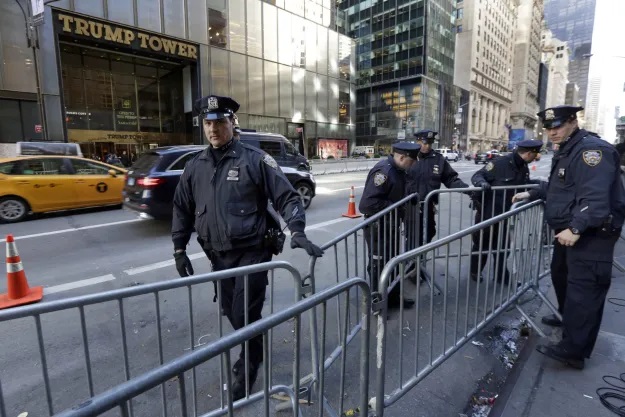
The above referenced New York Times article is about the massive traffic headaches that have already been created – and which are looming – mainly on Fifth Avenue and on streets and other avenues in Manhattan in the vicinity of Trump Tower. Trump Tower, the main residence, for the time being, of President-elect Donald Trump, is located on the east side of Fifth Avenue between 56th and 57th Streets.

A couple of points that I would like to make before discussing the contents of this particular article, which thoroughly describes the problem.

— New York City, it goes without saying, has always attracted people with star power: celebrities and magnates. Yet I have always thought and felt that it’s the sort of place which nobody can dominate. It is such a huge and such a great city that it cuts everyone down to size. I know that when I first moved to New York, as a young adult, I was awed by it. It seems to have that effect on everyone. It’s a welcoming place in many respects in that the atmosphere is so tolerant, of different races, lifestyles, ethnicities, persons high and low, and so forth. It’s welcoming, it’s also overwhelming. It seems to have that effect on everyone. It attracts; it excites; and, it intimidates. It has a way of cutting people with big egos down to size.

— New York is one of the world’s greatest cities for walking. Fifth Avenue is among the best places to walk. Stretches of Fifth Avenue include some of the most expensive residences in the world and luxury stores. Yet, the avenue is accessible to all. The sidewalks are wide, the pedestrian traffic is not limited by any means to one social class, and it’s a just plain fun avenue to stroll on. It is aesthetically pleasing, rarely gets overcrowded (to the point where passage is difficult; an exception might be right in front of Rockefeller Center, where there is a giant tree on display during Christmastime; crowds are found there at this particular time of the year at certain times on certain days). The glamor, elegance, and upbeat quality of the avenue and its denizens from around the 30’s to around 100th Street seem to rub off on everyone; the pedestrians always seem to be cheerful and unstressed. You rarely seem to see something depressing.

It looks like this is changing. It makes me very unhappy. Actually, angry.


*******************************************************

What the Times article says:

— The “festive spirit” normally observed on Fifth Avenue during the holiday shopping season has been “dampened a bit by the long guns of stationed police officers and the regular presence of bomb-sniffing dogs.”

— Famous stores on the avenue have been blocked by police barricades.

— Anti-Trump protests have shut down traffic. (Perhaps the protests are abating now.)

— Gawkers loitering on the sidewalk outside Trump Tower have presented a problem, both for pedestrians and security.

— Pedestrian access to the east side of Fifth Avenue between 56th and 57th Streets, where Trump Tower is located, has been restricted.

— When Trump moves to the White House, the situation is not likely to ease. It is expected that he will still be spending considerable time at his Trump Tower residence. And, Trump’s wife, Melania Trump, and the couple’s son, Barron, are to stay in New York in the near term.


*******************************************************

Last week, I had an appointment at the Apple Store at Fifth Avenue and 59th Street to have my iPhone battery checked. It was raining hard. I was doing a shopping errand for my wife at a department store at Fifth Avenue and 39th Street.

I love to walk in Manhattan, and having to go from one place to another gives me a reason and incentive to walk. So, I headed north on Fifth Avenue, my preferred route and the most direct one. An alternate route would not make sense, and I much prefer Fifth Avenue to Madison or Park.

But, I had to make a detour at Fifth Avenue and 56th Street. There were barriers on both sides of the avenue (east and west) which served the purpose of a sort of funnel. Pedestrians were lined up on either side of the avenue, awaiting an ID check that would enable them to pass. A depressing sight. I have never seen this before in New York.

I was thinking what are they lining up for? It’s not worth it. Probably they wanted to be able to walk past Trump Tower and get a glimpse of it. Big thrill!


*******************************************************

I was reminded of an experience I had somewhere between fifteen and twenty years ago. I was walking during midday in Bryant Park, which is right behind the New York Public Library. The park runs between Fifth and Sixth Avenues and between 40th and 42nd Streets.

I was on a gravel pathway right behind the library which abuts the park. There were few people around, and my path crossed that of ex-mayor Ed Koch, who was strolling the other way on the same pathway. Neither of us was in a hurry.

We made eye contact.

I did not speak to Mr. Koch. I probably should have said, “Good day, Mr. Mayor.” But I kept going without speaking.

I had the distinct feeling that he knew that I knew who he was – in short, recognized him.

He peered at me. I had the feeling, intuition that he was thinking to himself, looks like an interesting face, an intelligent person (me).

We exchanged congenial glances.

I was reminded about something I read about Walt Whitman when Whitman was working and living in Washington, DC during the Civil War. Whitman often spotted President Lincoln riding by on horseback for business or pleasure. “I see the President almost every day. We have got so that we exchange bows, and very cordial ones,” Whitman wrote in 1863.

Mayor Koch, when I encountered him on my stroll, similar to the experience Whitman had when he saw President Lincoln riding by, seemed to be an ordinary citizen, no different than any other New Yorker. That’s the way it should be. Donald Trump is not larger than life. He should not be allowed to shut down Manhattan.

— Roger W. Smith

   December 2016


*******************************************************

Addendum:

See also

“With Trump Using Tower as Base, Fifth Avenue Grinds to a Halt,” The New York Times, November 16, 2016

“Donald Trump Loves New York. But It Doesn’t Love Him Back,” The New York Times, December 9, 2016

“Businesses Near Trump Tower Say Security Is Stealing Their Christmas,” The New York Times, December 23, 2016

“One-Man Traffic Jam Will Hit City When Trump Visits,” The New York Times, January 27, 2017

Is the Brooklyn Bridge boardwalk too crowded?


walking the Brooklyn Bridge.JPEG

walkers on Brooklyn Bridge, August 2016; photo by Roger W. Smith

IMG_8250.JPG

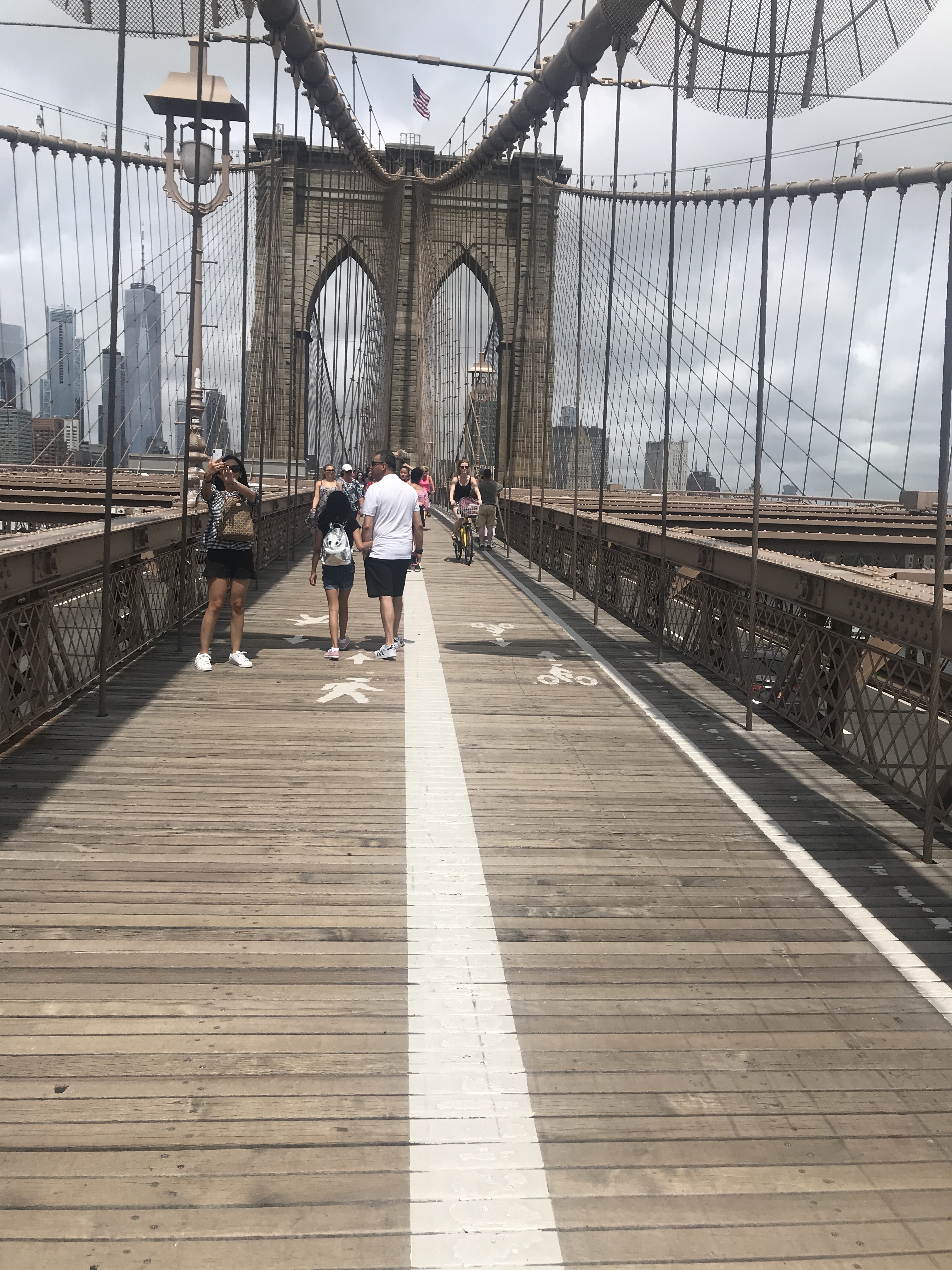
Brooklyn Bridge boardwalk at 11:36 a.m. on a beautiful summer day; Tuesday, July 24, 2018. This is too crowded?


****************************************************

re:

Brooklyn Bridge, the ‘Times Square in the Sky,’ May Get an Expansion

by Winnie Hu

The New York Times

August 8, 2016


In the above referenced article re pedestrian traffic on the Brooklyn Bridge, New York Times reporter Winnie Hu notes:

New York City has commissioned a $370,000 engineering study of the bridge’s walking and biking promenade to address crowding.

An unnecessary study and a waste of money.

The Brooklyn Bridge promenade is very crowded. As noted in the article, the pedestrian walkway is thronged with walkers, including lots of tourists, who (along with the locals), besides walking, often at leisurely pace, are often loitering to take in the view, fraternize, take photos, and so forth. Aggressive bikers on what is supposed to be a separate pathway are often ringing their bells or shouting for pedestrians to get out of the way.

Sound chaotic and unruly? Indeed, it is. But this is not a problem, nor is it a cause for alarm, in my opinion. It’s actually kind of fun. The fact that the bridge is thronged with cheerful pedestrians — besides its aesthetic appeal and “walker friendly” construction (the boardwalk, which is raised above the traffic lanes; the benches) — is what make walking over the Brooklyn Bridge such fun.

Cities are crowded places by definition. Don’t like it? There are smaller cities, exurbs, suburbs, small towns, and so forth where, I would imagine, one can find uncrowded streets and thoroughfares to walk on.

To get back to the stampede on the Brooklyn Bridge that the Times reporter describes (accurately): I like it — I should say, LOVE it. I am not alone among walking enthusiasts who love the experience of walking across the bridge.

If one wants seclusion or a place to walk without hardly anyone else around — in the City, that is — such places can be found. Central Park, believe it or not, often feels uncrowded — in some spots is virtually empty — during many times: weekdays, for example.

I frequent a park in Queens that is one of the most beautiful in the City. It is in a residential neighborhood, is quiet, and is almost always uncrowded. Not just uncrowded, but practically empty. (And, yet it is not a scary place to be in; on the contrary, it feels safe and always has a core of dog walkers and neighborhood residents.)

I frequently walk across the Queensboro Bridge to Manhattan and back because is it is the shortest route for me to walk to Manhattan. The Queensboro Bridge is not a scenic or fun walkway. There are no good views. There is no boardwalk. There are no benches. There are few pedestrians. Sometimes, I don’t care. I am lost in my own thoughts. But, on “aesthetic” and “experiential” grounds — as a walker who loves walking for its own sake — I prefer the Brooklyn Bridge by far. It’s no contest. And, I like the crowds. One gets such good vibes from them. Everyone seems cheerful and friendly.

A final point: pedestrian crowding on the Brooklyn Bridge is a seasonal thing. The bridge is thronged with pedestrians mainly on the nicest days and during the warmest times of the year. At other times, it is less crowded. Not that crowding during the good weather is a problem. It’s anything but, in my opinion, as I have argued above.

Depend upon it. The “traffic engineers,” pedestrian traffic engineers, besides pocketing a hefty fee, will mess things up. They will make the experience of walking the bridge worse at the minimum — whatever “solution” they come up with to address the “problem” of pedestrian overcrowding — and could ruin it.

The boardwalk has been there since the bridge was originally opened in 1883. Leave it alone!


— Roger W. Smith

    August 2016


***********************************************************

See also

Walking the Brooklyn Bridge