Tag Archives: Bill Dalzell

the museum … the library


The late William S. (Bill) Dalzell was a very important and valued friend to me, beginning in my twenties when I first came to New York.

We worked at the same place, 218 East 18th Street — technically not for the same employer, since Bill was a self-employed printer.

We hit it off immediately. Bill (as I turned out to be) was a lover of his adopted city. He grew up in Williamsburg, a suburb of Pittsburgh.

He had many pregnant thoughts. We had such interesting conversations.

He was a confirmed bachelor and a creature of habit.

He never worked on weekends.

On Saturday mornings, he would go to the Metropolitan Museum of Art. He would begin in the cafeteria, nursing a cup of coffee and lost in thought.

He said that for him the museum was like a cathedral. It had that effect on him mentally. Either explicitly or implicitly, he was also thinking of Norte Dame Cathedral. He had been there several times and said it was “the holiest place” he had ever visited.

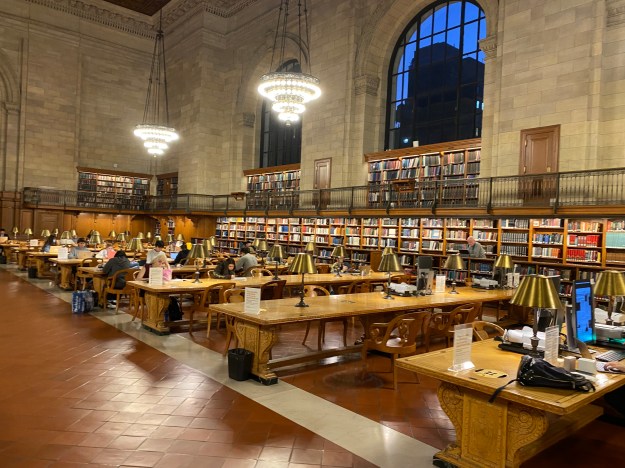
Which brings to mind the New York Public Library on Fifth Avenue.

It has that effect on me. The beautiful building. The interior. The high ceilings and sunlight streaming through. The staff. The “serious,” “dedicated” sense of purpose and calm quietness. The calming and focusing effect it has on me mentally.


— posted by Roger W. Smith

   October 2022


an island … a city surrounded by WATER II (update of a previous post)


There now is your insular city of the Manhattoes, belted round by wharves as Indian isles by coral reefs–commerce surrounds it with her surf. Right and left, the streets take you waterward. Its extreme downtown is the battery, where that noble mole is washed by waves, and cooled by breezes, which a few hours previous were out of sight of land. Look at the crowds of water-gazers there.

Circumambulate the city of a dreamy Sabbath afternoon. Go from Corlears Hook to Coenties Slip, and from thence, by Whitehall, northward. What do you see?–Posted like silent sentinels all around the town, stand thousands upon thousands of mortal men fixed in ocean reveries. Some leaning against the spiles; some seated upon the pier-heads; some looking over the bulwarks of ships from China; some high aloft in the rigging, as if striving to get a still better seaward peep. But these are all landsmen; of week days pent up in lath and plaster–tied to counters, nailed to benches, clinched to desks. How then is this? Are the green fields gone? What do they here?

But look! here come more crowds, pacing straight for the water, and seemingly bound for a dive. Strange! Nothing will content them but the extremest limit of the land; loitering under the shady lee of yonder warehouses will not suffice. No. They must get just as nigh the water as they possibly can without falling in. And there they stand–miles of them–leagues. Inlanders all, they come from lanes and alleys, streets and avenues–north, east, south, and west. Yet here they all unite. Tell me, does the magnetic virtue of the needles of the compasses of all those ships attract them thither? … There is magic in it. Let the most absent-minded of men be plunged in his deepest reveries–stand that man on his legs, set his feet a-going, and he will infallibly lead you to water. … Yes, as every one knows, meditation and water are wedded for ever.

— Herman Melville, Moby-Dick; Chapter 1 (“Loomings”)

*****************************************************

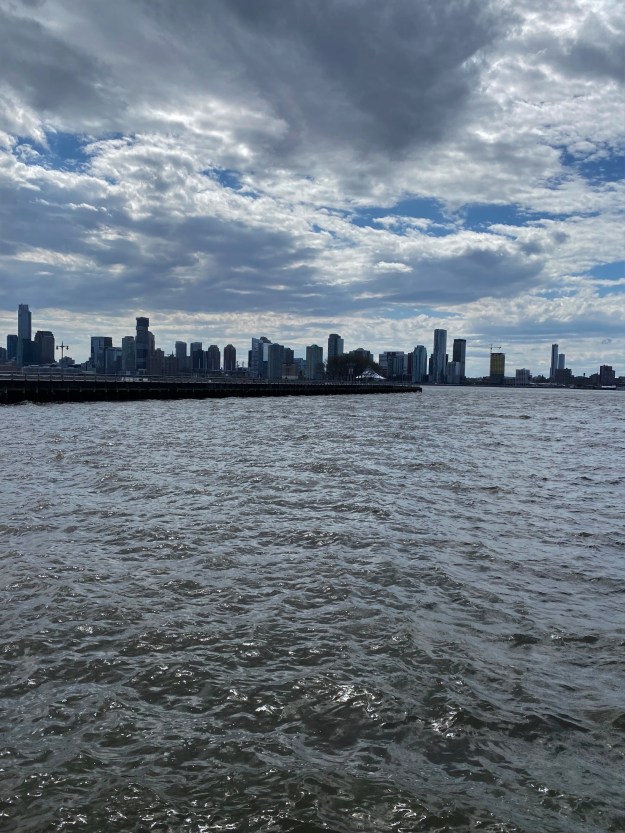
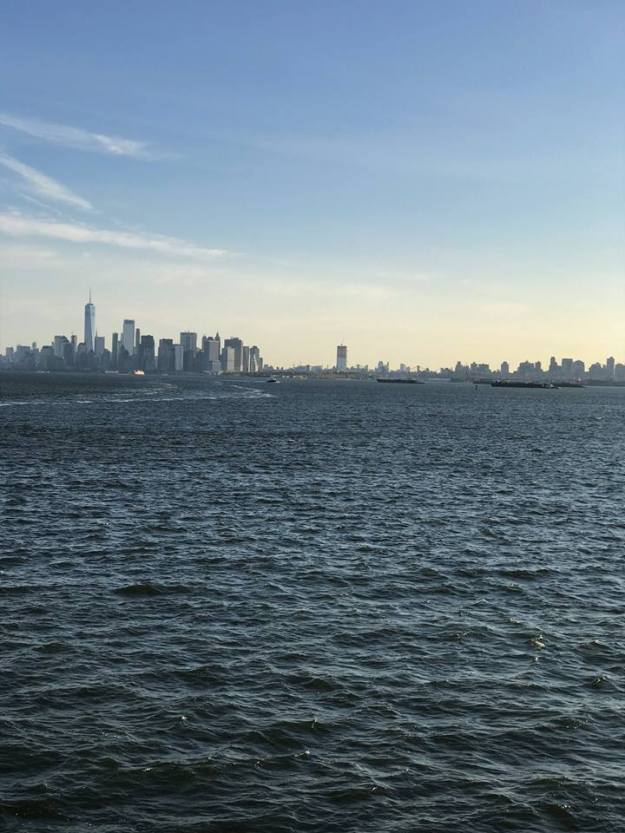
I love skylines, love dense clouds. New York City has wonderful skylines. You can’t really see them from Manhattan, but you can from the waterside and from the outer boroughs, which have lower buildings.

It is wonderful that Manhattan is an island bounded by water: the ocean (New York Harbor), the East River, the Hudson River, the Harlem River.

One thing this does is prevent urban sprawl and the development of a megalopolis ending nowhere.

It also gives the city an almost enchanted quality or aspect. It leads to dreamy speculation and reflection, as Herman Melville noted.

My departed friend Bill Dalzell alerted me to this special aspect of New York City some fifty years ago.

I love the curve of the bay at the bottom of Manhattan Island. Such a beautiful harbor.

Today, I walked along the water’s edge from 14th Street to the Battery. Such a wonderful stiff breeze off the river. Such a wonderful walk at a time of despair,

— Roger W. Smith

   May 4, 2020


*****************************************************

photographs by Roger W. Smith

New York Harbor 11-42 a.m. 10-7-2019

New York Harbor 11-11 a.m. 5-29-2018

New York Harbor 4-54 p.m. 5-4-2020

New York Harbor 3-28 p.m. 3-17-2020

Hudson River 2-52 p.m. 5-4-2020


211925055274824

good riddance to urban renewal


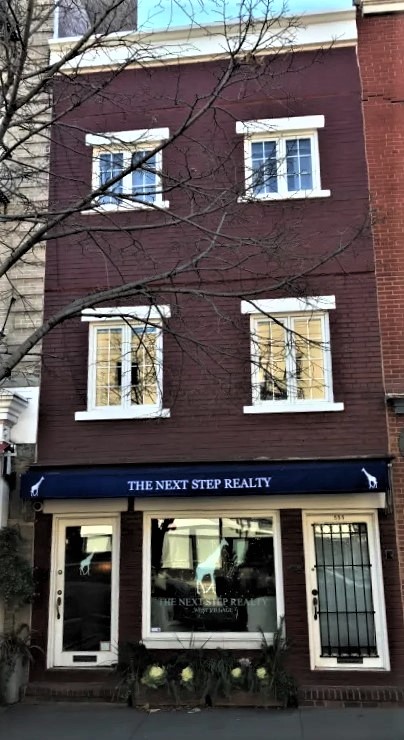
former residence of Jane Jacobs, 555 Hudson Street, New York, NY; photo by Roger W. Smith

The following is an email of mime from today to Lizabeth Cohen, a professor of American Studies at Harvard University.


Dear Professor Cohen,

I read the review in The New York Times Book Review of your Saving America’s Cities: Ed Logue and the Struggle to Renew Urban America in the Suburban Age. As I said to my wife, it looks like an excellent and very informative book.

I appreciate what was said about it by the reviewer: that it is an even-handed treatment of Logue.

If I may, I would like to share a few thoughts, memories, etc. with you.

I grew up in Cambridge. We lived on Mellen Street near Harvard Square. My parents moved us to the suburb of Canton on the South Shore in my adolescent years, which was in the late 1950s.

In the 1960s, I recall seeing articles in the papers about Logue all the time. As the reviewer notes that your book notes, Logue was revered and received almost unvarying praise. At that age, being the son of liberal, educated parents, I thought that slum clearance was, unquestionably, desirable.

I was an avid Red Sox fan, I regularly read the sports pages in the Boston Herald. I read many articles stating that it was high time Boston had a new park. It was regarded as not even worth or needing proof that Fenway Park was too small (mainly in terms of seating capacity), old, and shabby. The endless refrain was, when are we going to get our new stadium?

No one remembers this, and Friendly Fenway is regarded by one and all as a jewel of a ballpark. A landmark that will never be torn down.

I moved to New York City for good in my young adulthood. After some adjustment, I grew to love it. I made a good friend who was a nonconformist and lived an alternative lifestyle. He was cultured and articulate but lived very modestly in a walkup apartment with a bathroom in the hall on East Fifth Street between Avenues A and B. He helped me to appreciate Manhattan and to begin to think differently. He was prescient. He said to me, at a time when urban renewal and slum clearance were in the air: “I live in a slum and I like it.” He pointed out that PEOPLE were living in these buildings. (And could afford them.)

I am attaching a photo I took on one of my walks recently of Jane Jacobs’s former residence on Hudson Street in Manhattan. I became familiar with her writings in my adult years after moving to Manhattan. I think she is an example of someone whose plain writing and lifestyle, and lack of academic credentials, may make it likely that she gets less recognition than she deserves (which is not to say that her importance and genius are not acknowledged; and I think she was actually a genius). In my opinion, she is up there with some of the great thinkers and writers who very simply take a fresh look at prevailing opinions and wisdom, go back to square one — or “first principles” — and, in plain language, without overtheorizing — looking with their own eyes — get us to see the world anew. It’s sort of like an Emperor’s New Clothes phenomenon.

How did she manage to defeat Robert Moses? At the outset, I am sure it would have been regarded as quixotic to try. If Moses had rammed an expressway through the Village and Soho, it would have ruined Manhattan — is the word rape too strong?

Jane Jacobs did not like Lincoln Center. I don’t like it either. I recall when I was in high school and Jacqueline Kennedy and others on television were providing a virtual tour of our “wonderful” new arts center, Lincoln Center. I assumed it must have been so, and who cared about the gritty (then) West Side neighborhood where Jets and Sharks did battle? I hate to go to Lincoln Center now. Aside from the concert halls, which I find dark and unwelcoming, the whole center is a horrible place to hang out in, should anyone care to. The buildings are ugly.

Usually, the plaza with its fountain is pretty much deserted, and it’s unwelcoming, as is the Center. The surrounding neighbored now has no life; there are a few rip off restaurants across the street. The few blocks behind the Center (between it and the river) are deadly, or better said, dead.

I go back to Boston occasionally. I was too young to remember Scollay Square before Government Center was built (though people often mentioned it). The Government Center complex has a Lincoln Center-like feel, and I found it very unpleasant and unenjoyable to walk or spend time in or around it.

Sincerely,

Roger W. Smith, Maspeth, Queens, NY


— posted by  Roger W. Smith

   November 17, 2019

It’s gone.


It’s gone.

They’re gone.

The past. Our lived history. Past times. The particulars. What made them unique.

This past, our past, dies with people. As they pass away. Dies as well as the people themselves.

An era. A generation. Gone irretrievably.


*****************************************************

My friend Bill Dalzell.

I think of him often. Of New York as he knew it.

When the City was affordable, actually cheap. When it was hospitable to artists, writers, and editors; to independent types who loved culture, the arts, and the life of the mind and who didn’t want the buttoned down life.

The New York of art film houses, the Automat, McSorley’s Old Ale House, and the Blarney Stones; of the Metropolitan Museum of Art when admission was free; of the New York Public Library when it was open 365 days a year. When First Avenue bars held Sunday afternoon poetry readings.

When the subway fare was a dime, a glass of beer was twenty cents, and flats in the Lower East Side rented in the 30 to 50 dollar a month range.

Dr. Ralph Colp, Jr., my therapist.

He practiced when psychiatrists did talk therapy and were intellectuals rather than pill pushers; when (as was the case with me) they charged 30 dollars for a session scheduled for 50 minutes that usually lasted an hour; when a writer such as Dr. Colp used a Royal manual typewriter; when a Sunday afternoon or holiday recreation for him and many Manhattanites, such as myself, involved seeing a foreign film.


*****************************************************

This melancholy, mournful train of thoughts occurred to me today when for some reason or other I thought of Bill, when something reminded me of him.


— Roger W. Smith

   May 22, 2019

New York sunlight (and New York joys)


“The grass that grows by absorbing the life-giving energy of the sun becomes [in Walt Whitman’s Leaves of Grass] a metaphor of ‘the ceaseless springing forth of life from death.’” — David S. Reynolds, Walt Whitman: A Cultural Biography (New York: Alfred A. Knopf, 1995), pg. 240


*****************************************************

My longtime friend Bill Dalzell, who for many years lived in New York City, introduced me to so many things when I first came to New York in the late 1960’s.

Among other things, Bill introduced me to cinema and art. We made several trips together to the Metropolitan Museum of Art.

Bill, a New York transplant from a suburb of Pittsburgh, where he grew up, was — like many having adopted New York City as their home, including myself — an enthusiast of all New York had to offer. He knew all the inexpensive, interesting things to see and do in the City.

Bill used to say: “Would you care to hear me sing the praises of New York?” He used to marvel at the fact that so many people of all races and nationalities lived cheek by jowl in harmony. At the richness of culture. At the convenience of things such as getting around. At how much the City had to offer at what were then modest prices.

Admission to the Metropolitan Museum of Art was free. The main branch of the New York Public Library was open 365 days a year. The subway and bus fares were 20 cents. So was the Staten Island ferry, one of the fun, vivifying, and inexpensive things he enjoyed doing. (We would get off on the Staten Island side, walk around a bit, have a cup of coffee, and take the ferry back to Manhattan.) A meal of wholesome, plain food at the Automat (where Bill used to love to sit and drink coffee while lost in thought) could be had for less than a dollar. A glass of beer in a bar was 20 cents, and usually every third beer was on the house. Films cost less than two dollars. Rents were cheap. Bill paid twenty-nine dollars a month for a one-bedroom apartment on East 5th Street.


*****************************************************

Bill introduced me to the paintings of Edward Hopper, one of his favorite painters. (Hopper’s paintings are, for the most part, exhibited in New York museums.) Bill and I, at his suggestion, made a one-day excursion to Nyack, NY to view Hopper’s birthplace.

During our museum trips, he pointed out how Hopper made use of light.

“The light is different in America,” Bill would say. (He had traveled practically everywhere in the world on a limited budget.) By “different,” Bill meant brighter. More brilliant. Yes. Brilliant light. An observation which I do believe to be true. I have observed and thought about this often.

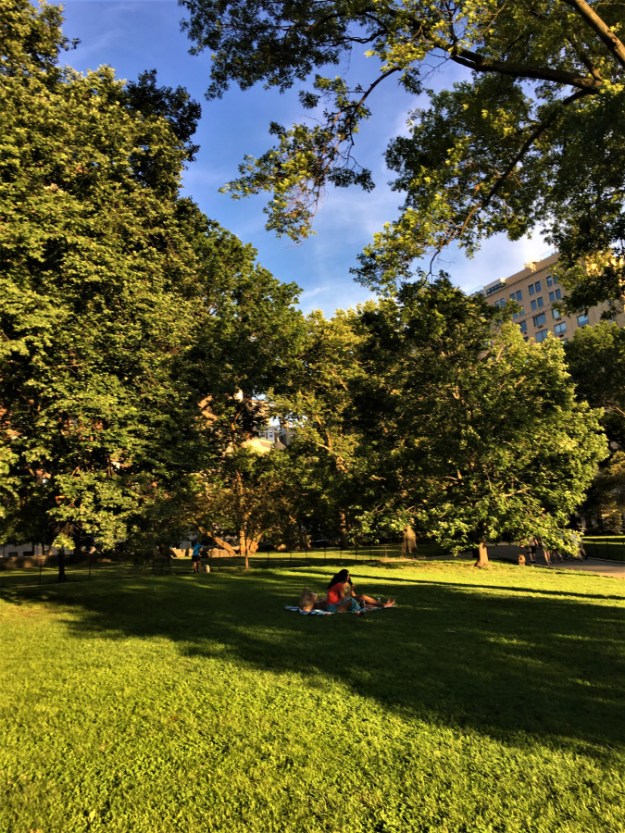
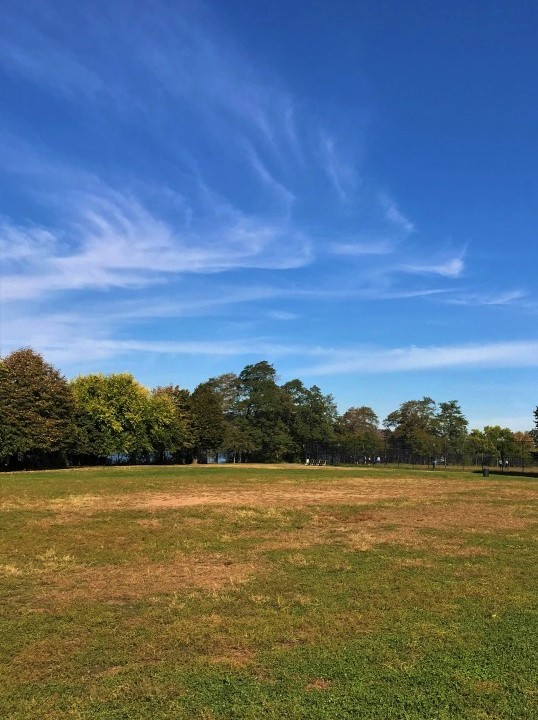
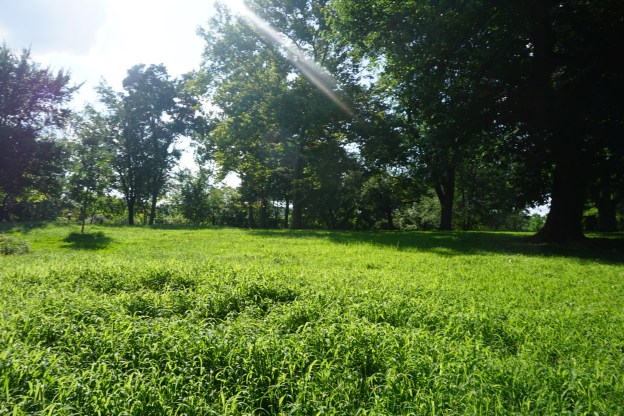
I have come over the years to be myself fascinated by light. Early morning light, daylight, late afternoon light. The light hitting the grass. Different shades of light and degrees of brightness. Summer light. Autumn light. Winter light.

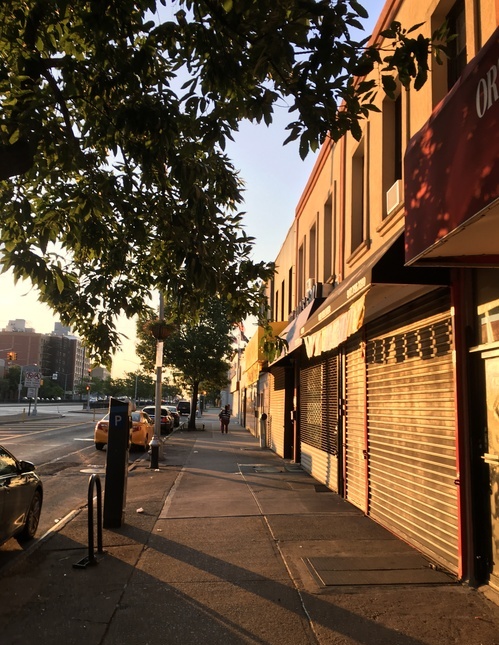
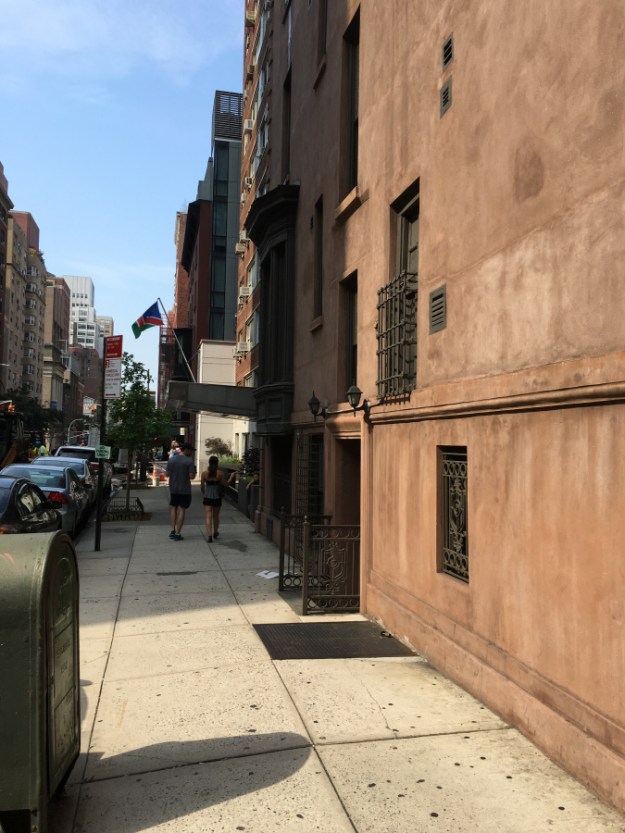
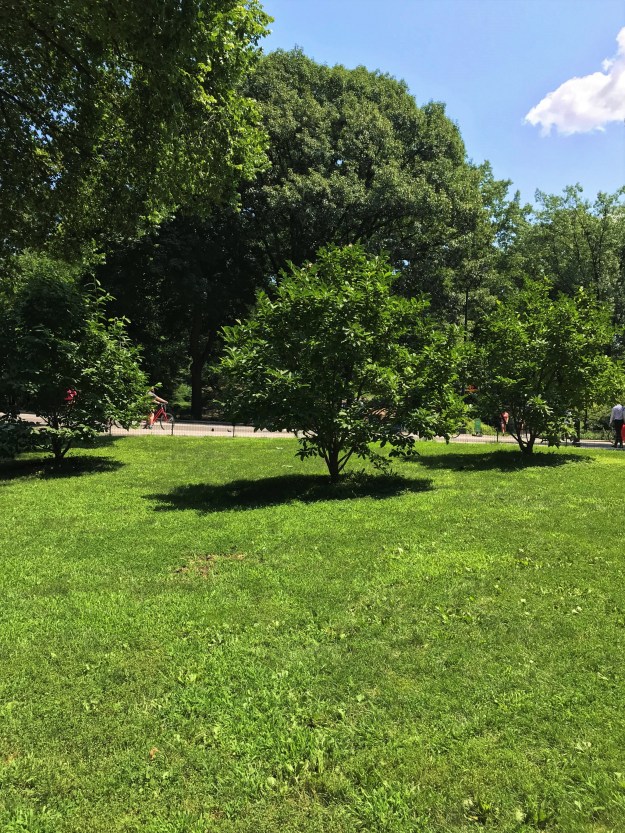
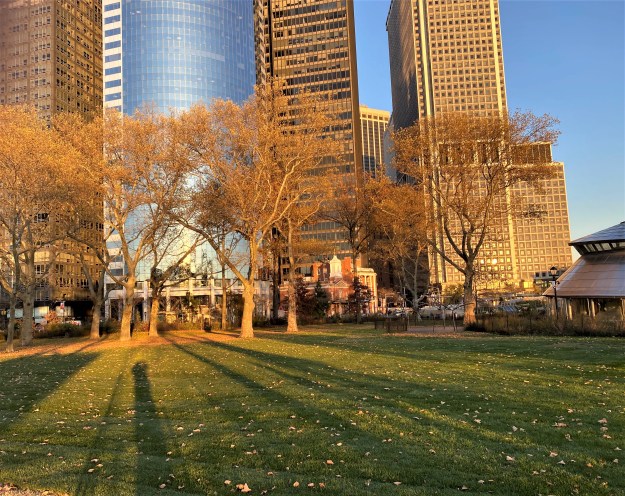
While I would and could never aspire to be an artist — I have no innate talent and only a limited appreciation of the visual arts — I have been taking photographs in the City in parks, on the shorelines, and of houses and streets on my walks, I have posted below some photographs of mine in which an appreciation of sunlight as viewed from ground level is expressed in the photo. I am fascinated by the quality of sunlight in different seasons and at different times of the day.

— Roger W. Smith

   July 2018


*****************************************************

Addendum:

Some relevant information about Edward Hopper.

Most of Hopper’s figure paintings focus on the subtle interaction of human beings with their environment-–carried out with solo figures, couples, or groups. His primary emotional themes are solitude, loneliness, regret, boredom, and resignation. He expresses the emotions in various environments, including the office, in public places, in apartments, on the road, or on vacation. … In many Hopper paintings, the interaction is minimal.

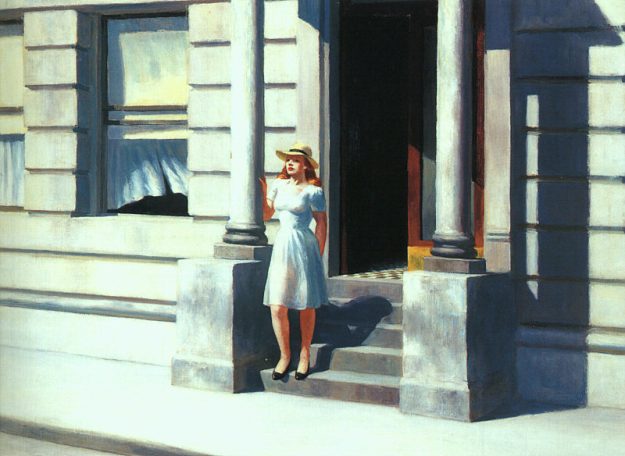
The effective use of light and shadow to create mood is central to Hopper’s methods. Bright sunlight (as an emblem of insight or revelation), and the shadows it casts, also play symbolically powerful roles in Hopper paintings such as “Early Sunday Morning” (1930), “Summertime” (1943), “Seven A.M.” (1948), and “Sun in an Empty Room” (1963).

Hopper always said that his favorite thing was “painting sunlight on the side of a house.”

Although critics and viewers interpret meaning and mood in his cityscapes, Hopper insisted “I was more interested in the sunlight on the buildings and on the figures than any symbolism.” As if to prove the point, his late painting “Sun in an Empty Room” (1963) is a pure study of sunlight.

“Edward Hopper,” Wikipedia

https://en.wikipedia.org/wiki/Edward_Hopper

It should be noted that the American landscape painter Winslow Homer did similar things with sunlight in his remarkable paintings.


*****************************************************

photographs by Roger W. Smith

1 - Woodside, Queens

Woodside, Queens

2 - Murray Hill

Murray Hill

3- Madison Square Park

Madison Square Park

Madison Square Park 2-23 p.m. 7-27-2018

Madison Square Park

4 - Central Park

Central Park

Central Park 11-44 a.m. 11-6-2019.jpg

Central Park

Central Park 12-38 p.m. 8-5-2018.JPG

Central Park

Battery Park on a November afternoon

fall light, Central Park

5 - Riverside Park

Riverside Park

6 - Inwood Hill Park

Inwood Hill Park

7 - Inwood Hill Park

Inwood Hill Park

Isham Park 4-43 p.m. 8-9-2018.JPG

Isham Park, Indwood

All of these photos were taken in New York City.

*****************************************************

Posted here below are some famous paintings of Edward Hopper that show his preoccupation with light and his mastery of representing it visually.

1-hopper-early-sunday2 - Cape Cod3 - stoop, summertime4- Cape Cod evening5- seven am6 - house by sea


*****************************************************

Edward Hopper’s birthplace

Hopper's birthplace.jpg

Edward Hopper birthplace, Nyack, NY


when a man is tired of New York …


“I suggested a doubt, that if I were to reside in London, the exquisite zest with which I relished it in occasional visits might go off, and I might grow tired of it. JOHNSON. ‘Why, Sir, you find no man, at all intellectual, who is willing to leave London. No, Sir, when a man is tired of London, he is tired of life; for there is in London all that life can afford.’ ”

— James Boswell, The Life of Samuel Johnson, LL.D.


*****************************************************

Does repetition imply, mean, or equate to: Boredom? Weariness? Dullness?

By which I mean repeated experiences under known circumstances, such as what one experiences when one lives somewhere for a long time, or a lifetime.

Some people think that variety is the sine qua non. (“Been there, done that.”) They are constantly seeking excitement in new venues.

This is not necessarily, or not always, wrong.

But consider the following reflections of mine, based upon my own experience in New York City, where I have lived for nearly fifty years.


*****************************************************

I have my favorite haunts: the New York Public Library (the research library) at 42nd and Fifth; Central Park; the Staten Island Ferry; the Strand Bookstore; Grand Central Station; Carnegie Hall. I discovered these places — and also discovered how much I liked them over time — through word of mouth though my own peregrinations and repeated visits.

I know the best routes to walk. Just which ones produce the most pleasant “jaunting experience.” Which Manhattan avenue to take, for example, depending upon my mood and other circumstances. The best ways to get from Queens or Brooklyn to Manhattan by foot, with the most pleasant (and, conversely, least pleasant) avenues, neighborhoods, or bridges to walk on or through.

I know who are the most helpful reference librarians at the New York Public Library. I know that the main reading room is the place for me and have a favorite place to sit there. I know which entrance is best to use and where the elevators are.

I know the best items to choose on the menu at one of my and my wife’s favorite restaurants (which, of course, reflects my own preferences).

I know how often and at what times Staten Island ferries run.

I have other favorite places and establishments. Continually going to them works for me, and it will work for you.


*****************************************************

I first met my lifelong friend Bill Dalzell, who recently passed away, in the late 1960’s when I was employed in Manhattan. I was new to the City, and it was one of my first jobs.

Bill, like most Manhattanites, had been born and raised elsewhere. He had come to New York City in the 1950’s, at around the same age as I was when we met.

Bill absolutely loved New York. (He did, at a later age, move elsewhere.) He was always singing its praises.

The things that appealed to him about the City also appealed to me. The sense of freedom — no one watching you and (possibly) expressing disapproval of your activities; the fact that you could live alone or be alone — that it would not be considered abnormal* and you could find plenty of things to do alone and keep you interested even if you had no one else to do them with; the walkable streets; the awesome cultural resources (films, theaters, museums, and libraries).

Bill had his favorite haunts: The Metropolitan Museum of Art, the Thalia and Elgin movie houses, the Staten Island ferry, the automat. Years later, having lived in New York almost continuously since then, I have my own favorite places and things to do.

Bill loved to go to The Metropolitan Museum of Art on weekends. Admission was free back then. Upon arrival, he would go to the cafeteria and sit there for a couple of hours with a cup of coffee, in contemplation. Then he would visit his favorite exhibits. He said that the museum seemed like a cathedral to him and that going there was his equivalent of going to church.

He exulted over the fact that the New York Public Library’s main branch was open (then) 365 days a year, even on Christmas Day!


*****************************************************

Inner peace. Contemplation. That’s what you experience when you are comfortable somewhere (such as the Met Museum cafeteria or some other place, such as a park bench or an automat), as was the case with Bill musing over his cup of coffee; when you feel you belong. Being comfortable with the externals, from repeated experience, you can relax and not worry about them. And, in New York one often gets this feeling: that you belong there as much as anyone else. Besides a feeling of belonging, the comfort comes from knowing what to expect. And being able to anticipate pleasure, which is almost a given.

What is it about such places that makes one want to return again and again?

One thing I would assert is that it’s an automatic thing — sort of like (to use a buzzword) being on autopilot. Once you start going someplace a lot, you feel, naturally, at home there. You know how to get the most out of it. You know just what things about it you like best and how to savor and enjoy to the fullest those things.

Let’s say it’s the library. You will have your favorite divisions and rooms (in a large library like the main branch of the New York Public). You may know of certain staffers who are particularly helpful. You may like certain places to sit or even certain corridors and stairwells to use.

Say it’s the Oyster Bar Restaurant in Grand Central Station. You know which entrees you like the most and which of the available draft beers, and what they cost. You have your favorite waiters. You know where and in which room you like to be seated, and whether at a table or a counter (and then, which counter? there are more than one). You know which point of entry from the labyrinthine Grand Central Station is most convenient.

In Central Park, there are certain walkways and paths I like to take.

I know which points along the Brooklyn Bridge I like the best (the boardwalk, for example); the best ways to approach it as a pedestrian walking in Manhattan; the most fun things to do (talk with people or just observe them having a good time, which one can enjoy vicariously; take pictures; sit on a bench on the boardwalk, etc.).

The Strand Bookstore? I know where I want to browse. I know when it is open. I know how the books are arranged and in what sections.

The New York City subways? (I didn’t mention them before.) I know the best routes which involve the least hassle, the stations and lines to avoid and those that I prefer.

So, FAMILIARITY is a big factor.

As is REPETITION.


— Roger W. Smith

   May 2018


* Regarding the delicious sense of anonymity associated with living in New York — of being part of a crowd but not singled out — an experience I once had when living elsewhere seems relevant. I worked for about a year and a half at a psychiatric hospital in Stamford, Connecticut, a city not far from New York. One spring day, when walking home from work, I stopped in a park that was on my route. I sat there for a while — I think it was on a park bench — in contemplation. It was a leisurely walk home. The park was not crowded, as a New York City park usually would be, but it was not empty by any means.

A couple of days later, the head nurse on my ward said to me, “I saw you in the park the other day.” The park was about a half mile from the hospital and she had probably passed it on the way home. I could tell that her remark amounted to mild “disapproval.” She felt it was odd to see me sitting by myself in a park. If I had been with a friend or coworker, she would not have had thought anything unusual.

“I went to the school of New York.”


“A whale ship was my Yale College and my Harvard.”

— Herman Melville, Moby-Dick


*****************************************************

I was talking on the phone today with my longtime friend from my first days in New York, Bill Dalzell. He told me something that his dear friend Edwin Treitler once said to him. Ed Treitler, who recently passed away, was an artist, writer, and spiritual counselor/healer.

The quote, which struck me forcibly and rung true, was short and pithy: “I went to the school of New York.”

The school of New York. Herman Melville would have perceived instantly what this meant.

It rings so true when I consider my own experience.


*****************************************************

I had a very good education, for which I am very grateful. Then, I went further.

I moved to New York City right after graduating from college, and my education really began. Or was on a new plane. Something like that.

I had never seen a really good film. Had never, I believe, patronized an art film house. Had often frequented bookstores, but had never seen so many used bookstores cheek by jowl with so many interesting books, including many by avant-garde writers who were usually not taught in college.

I had never read so intensely and deeply before in such weighty works. I had never met such intellectually stimulating people. Many of them, most of them, I met in totally offhanded and unanticipated ways, in places where you would not expect to find someone smart and interesting, often in the workplace. (It reminded me of Theodore Dreiser’s friends in his early Chicago days; see below.)

I met many such persons in my early days in Manhattan: a poet who it seemed had read the whole corpus of great poetry — and knew all those currently active, including the New York School of poets (and who took me with him to poetry readings in Manhattan) — and practically every important work of literature from time immemorial, ranging from Roman poets such as Juvenal and Sextus Propertius to the most recent and challenging fiction by writers such as Thomas Pynchon … a printer who was thoroughly immersed in mysticism and the visual arts (and whom I tagged along with to the Metropolitan Museum of Art and the Whitney; from him I became acquainted with painters such as Edward Hopper, whom I had never heard of) … and so many people whose ideas piqued me and who submerged me in new areas of thought and “mental adventure” and who introduced me to books, painters exhibited in the City’s museums and galleries, filmmakers, and such that I would probably never have learned about.

The true intellectuals, I find, are often buried in the woodwork, are in the back office or hunkered down over a desk doing drudge clerical work (as was I).

I had such stimulating conversations with people I met at random in taverns and at work, or with their friends. Almost none of them were well off, and most were at a stage in their lives where they were starting out and did not have impressive credentials, or were perhaps older but had never become credentialed. They were barely making it. But they had a deep passion for ideas, the arts, and culture.

I instinctively took to such a milieu as a duck to water. I bathed in it, drank of it. I grew immeasurably intellectually. I became sophisticated culturally and intellectually. I became a hundred percent better informed, better read, better educated.


*****************************************************

It has been said that New York is like no other city in the world. For me, this was true. There is an openness to ideas there, a wonderful tolerance, an acceptance of people without any expectation that one must conform. Loners are accepted. (I was afraid I might be perceived as a loner when I first came to New York knowing no one.) Eccentrics are accepted. People of all ideologies and belief systems are accepted, and of all backgrounds. Stimulating conversation by highly aware, well informed, intellectually alive, and intelligent people is the norm.

Cultural sophistication comes with the territory. The arts are almost upon you, so to speak, are omnipresent. It’s almost impossible to be in New York and not to be aware of them and influenced, liberated, and exhilarated by them. New York broadens you, stimulates you, educates you anew. And keeps right on stimulating and educating you.


— Roger W. Smith

   November 3, 2017


*****************************************************

Addendum:

In his autobiographical work Dawn, Theodore Dreiser portrays an individual he met as a young worker in Chicago during the 1890’s. Dreiser was employed in the warehouse of Hibbard, Spencer, Bartlett & Company, a wholesale hardware firm, at a salary of five dollars a week, as a “box-rustler” and “stock-piler.” A coworker whom Dreiser befriended and who fascinated him was Christian Aaberg, a Dane. Dreiser describes him as a “little rickety, out-at-the elbows, shambling man, with a wrinkled, emaciated, obviously emotion-scarred face, who at forty or forty-five and after God knows what storms and rages of physical and mental dissipation, still had about him that indescribable something which for want of a better word I must speak of as breeding.”

Aaberg was of little or no value to the firm, for he could do no hard work and the powers that were could not trust him with the more complicated, though less strenuous, task of filling orders. As he himself admitted, he drank and dissipated here as in the past and often wondered aloud why it was that … the firm stood for him. … He was shabby and sickly to look upon. Yet … there was that strong, seeking, vital light in his eye at times. … within two or three weeks we were fast friends intellectually, and there followed a series of conversations on life and character, the import of which has endured to this day.

He had read—God knows what! —everything! And he it was who talked to me of Ibsen, Strindberg, Grieg, Goethe, Wagner, Schopenhauer. He would talk to me by the hour, as we piled pots and pans or buckets of bolts or rivets. of the French Revolution and the great figures in it, of Napoleon, Wellington, Tsar Alexander, Also of Peter the Great and Catharine of Russia, Frederick the Great and Voltaire, whom he admired enormously. But not the silly, glossed, emasculated data of the school histories [italics added] with which I had been made familiar, but with the harsh, jagged realities and savageries of the too real world in which all of them moved. And, again, of Greece, of the age of philosophers, logicians, playwrights, sculptors, architects, statesmen, warriors. He revealed as much as any history could—why it was that Aristotle was the first of the organic and realistic thinkers; why Heraclitus would always be remembered. He also told me why Socrates had been compelled to drink the hemlock; that the cross was originally a phallic symbol; elucidated for me the mysteries of the Egyptian temples, the religious festivals of the Parsees, Chaldeans, Assyrians, Persians. … When I told him that that our family was Catholic and I still went to church, he smiled. “You will come out of that,” he said. “You are already out and don’t know it?”

— Theodore Dreiser, Dawn: An Autobiography of Early Youth, Chapter 61

“3rd Ave. El”


My good friend Bill Dalzell, who introduced me to art films, recently called my attention to a film he loved from his early days in New York City in the 1950’s: 3rd Ave. El, directed by Carson (Kit) Davidson. The film comprises a portrait of the Third Avenue Elevated Railway in New York City, filmed in 1955. A rare print was preserved by the Academy Film Archive.

The music, as my friend Bill pointed out, is Haydn’s Concerto in D, played by harpsichordist Wanda Landowska.

The film is on YouTube. (See link to YouTube clip below.)

I was disappointed that the footage is grainy. But, the film, which lasts for something like twelve minutes, gives a wonderful feeling for New York City in the 1950’s. It conveys what I love about the City and is still, despite gentrification, true: its grittiness and its authenticity; the people; their authenticity; the open display by New Yorkers of a sort of primal enjoyment of life despite seeming to be wearing a “mask” of anonymity.

With the music, the film gives me a high. It, NYC, bubbles up.

The film has a Whitmanesque (that’s Walt Whitman) feeling about it. Great joyousness. It inspires the same feelings Whitman had for his beloved Mannahatta: its people, its pavements and buildings, its sheer energy.


— Roger W. Smith

   September 2017


“3rd Ave. El”


*****************************************************

addenda:

After three years involved with World War II and four involved with Antioch College, Carson Davidson arrived in New York bent on making films. Usual story — washing dishes at a Bickford’s Cafeteria by night, knocking on producers’ doors by day. Finally, a job with a jaunty outfit called Dynamic Films, doing whatever needed doing. Nobody actually taught him anything, but they answered questions cheerfully, and that’s all that’s really needed.

Fascinated by the 3rd Ave El, he borrowed a company camera and started shooting in his spare time. The resultant film was turned down by every distributor in New York except the last on the list, a crazy Russian who then owned the Paris Theater. He paid for blowing it up to 35 mm and played it for seven months along with an Alec Guinness feature. Actually put the short subject on the marquee — unheard of then or now.

http://www.afana.org/davidsoncarson.htm


*****************************************************

The IRT Third Avenue Line, commonly known as the Third Avenue El and the Bronx El, was an elevated railway in Manhattan and the Bronx, New York City. Originally operated by the New York Elevated Railway, … it was acquired by the Interborough Rapid Transit Company (IRT) and eventually became part of the New York City subway system.

The first segment of the line, with service at most stations, opened from South Ferry to Grand Central Depot on August 26, 1878. Service was extended to Harlem in Manhattan on December 30 of the same year. Service in Manhattan was phased out in the early 1950’s and closed completely on May 12, 1955. It ended in the Bronx on April 29, 1973.

The Third Avenue El was the last elevated line to operate in Manhattan, other than the number 1 train on the IRT Broadway–Seventh Avenue Line, which has elevated sections between 122nd and 135th Streets and north of Dyckman Street. Service on the Second, Sixth and Ninth Avenue El lines was terminated in 1942, 1938, and 1940, respectively.

source: Wikipedia

New York City; advice for a first time visitor


(to a friend)

Like most people, I am a “transplanted” New Yorker. I have lived here for a long time and love the City.

The following are some of the things I love about my adopted city.

WALKING

Walk Fifth Avenue, from, say the 40’s, up to the Metropolitan Museum, which is at around 81st Street. The stretch of Fifth Avenue from 59th Street to around 96th Street is beautiful. It is residential and borders Central Park.

Walk downtown via Park Avenue South; get onto Broadway at around 14th Street and keep going downtown, thru the East Village and Soho. Go all the way down to City Hall. Right next to City Hall is the Brooklyn Bridge. Walk over it; it’s cool. There is a boardwalk and there will be lots of happy people. Great view.

Visit SoHo (a neighborhood in Lower Manhattan).

Walk up Broadway on the West Side, past Lincoln Center, to Broadway in the 70’s and 80’s.

Go to Central Park! A must.

Stay away from Times Square — sucks.

CULTURAL INSTITUTIONS

The Morgan Library (a museum at 36th Street and Madison Avenue). They currently have an Emily Dickinson exhibit. They feature art and old manuscripts. A very nice place.

The Metropolitan Museum of Art. Hang out there. You can relax in the cafeteria in the basement.

A visit to the New York Public Library is a must; it is located at Fifth Avenue between 40th and 42nd Street. Beautiful building. Great cultural institution.

I would say avoid the Modern Museum of Art — nothing great; overpriced.

The Metropolitan Museum of Art is open on Friday and Saturday evenings until 9 p.m. It’s best time to visit, is not crowded at those times. Most people do not know that you do not have to pay the “suggested” admission price of $25. The official museum policy is that visitors can pay whatever they wish as an entrance fee. A dollar, twenty-five cents. No problem.

SHOPPING

If you like to shop, Lord and Taylor’s at 38th and Fifth Avenue is a very nice store. Nice snack bar on the sixth floor. Clothing is pricey, but not that expensive. Most of the other clothing stores in the City are rip-offs. I would advise staying away from Herald Square and Macy’s. Herald Square is not in a nice neighborhood.

I don’t like Bloomingdale’s.

FOOD

Try the Oyster Bar if you like seafood. It is located on the lower level of Grand Central Station at 42nd and Lexington Avenue. Walk around Grand Central; awesome building.

Also, El Quijote (continental Spanish cuisine) on 23rd Street between Seventh and Eighth avenues. Order the paella.

TRANSPORTATION

Subways are the best way to get around. Or walking.

The subways can be confusing (an understatement) because there are so many lines and such a variety of connections. But, ask someone for help. You would be surprised how willing New Yorkers are to help strangers find their way. I discovered this myself many years ago.

CINEMA

Film Forum (West Village) — the best.

Angelika on Houston Street.

Lincoln Plaza Cinemas (Broadway at 62nd Street).

BOOKS

If you want to get great cheap used books, visit the Strand Bookstore at Broadway and 12th Street. There’s no other bookstore like it.

ALSO

Some people like the High Line. It’s okay; it’s is fun to walk it once. It runs from 14th Street West to the West 30’s. Good view of Manhattan from an elevated perspective.

Some parts of Brooklyn have become trendy – e.g., Williamsburg. Greenpoint is fairly close to Manhattan; it provides an interesting change of pace.

— Roger W. Smith

   April 2017


********************************************************

Addendum:

Bill Dalzell of Salem, MA, a longtime friend of mine who read this post, reminded me of one of his and also my favorite things to do in New York City in the past: take the Staten Island Ferry to Staten Island and back.

My friend Bill used to live in Manhattan, but no longer does. He was one of the first people I got to know after moving here, and he would often suggest New York things to do, such as taking the ferry.

Indeed, it was a wonderful trip. It cost only a nickel each way then (in the late 1960’s).

You would have a great view of New York Harbor and the Statue of Liberty. You could stand outside on the deck and get not only a close up view, but also experience a refreshing breeze, welcome in New York City summers.

I told my friend Bill that I haven’t taken the ferry in a while. I’ll have to do it again. But, from the last few times I took it (and I used to do it quite often), which was at least ten years ago, the boasts had changed — it was a disappointment. The new style boats (which did not LOOK so new) had little or no deck space and it was no longer an option to stand outside. Well, you could, sort of, but the only available deck space, so to speak, was a very small area at the prow. It did not provide a good vantage point and it was a very tight space that could accommodate only five or six people. The design of the boats having changed, the ferry is less fun to take nowadays. Or, so it seems to me.

A footnote: In 1953, when I was age seven, my parents took me on a three day trip to Manhattan, which was a thrill. It was oppressively hot summer weather. Among other things we did was take the Staten Island Ferry to cool off.


********************************************************

Addendum:

Sadly, the Metropolitan Museum of Art’s admissions fee, discussed above, may be changing. The museum, which has tried in the past to deceive visitors about the fee, is said to be contemplating a change its policy which would mean that out of town visitors would be required to pay a fee. See

“Visit to the Met Could Cost You, if You Don’t Live in New York,” The New York Times, April 26, 2017