Tag Archives: Herman Melville Moby-Dick

an island … a city surrounded by WATER II (update of a previous post)


There now is your insular city of the Manhattoes, belted round by wharves as Indian isles by coral reefs–commerce surrounds it with her surf. Right and left, the streets take you waterward. Its extreme downtown is the battery, where that noble mole is washed by waves, and cooled by breezes, which a few hours previous were out of sight of land. Look at the crowds of water-gazers there.

Circumambulate the city of a dreamy Sabbath afternoon. Go from Corlears Hook to Coenties Slip, and from thence, by Whitehall, northward. What do you see?–Posted like silent sentinels all around the town, stand thousands upon thousands of mortal men fixed in ocean reveries. Some leaning against the spiles; some seated upon the pier-heads; some looking over the bulwarks of ships from China; some high aloft in the rigging, as if striving to get a still better seaward peep. But these are all landsmen; of week days pent up in lath and plaster–tied to counters, nailed to benches, clinched to desks. How then is this? Are the green fields gone? What do they here?

But look! here come more crowds, pacing straight for the water, and seemingly bound for a dive. Strange! Nothing will content them but the extremest limit of the land; loitering under the shady lee of yonder warehouses will not suffice. No. They must get just as nigh the water as they possibly can without falling in. And there they stand–miles of them–leagues. Inlanders all, they come from lanes and alleys, streets and avenues–north, east, south, and west. Yet here they all unite. Tell me, does the magnetic virtue of the needles of the compasses of all those ships attract them thither? … There is magic in it. Let the most absent-minded of men be plunged in his deepest reveries–stand that man on his legs, set his feet a-going, and he will infallibly lead you to water. … Yes, as every one knows, meditation and water are wedded for ever.

— Herman Melville, Moby-Dick; Chapter 1 (“Loomings”)

*****************************************************

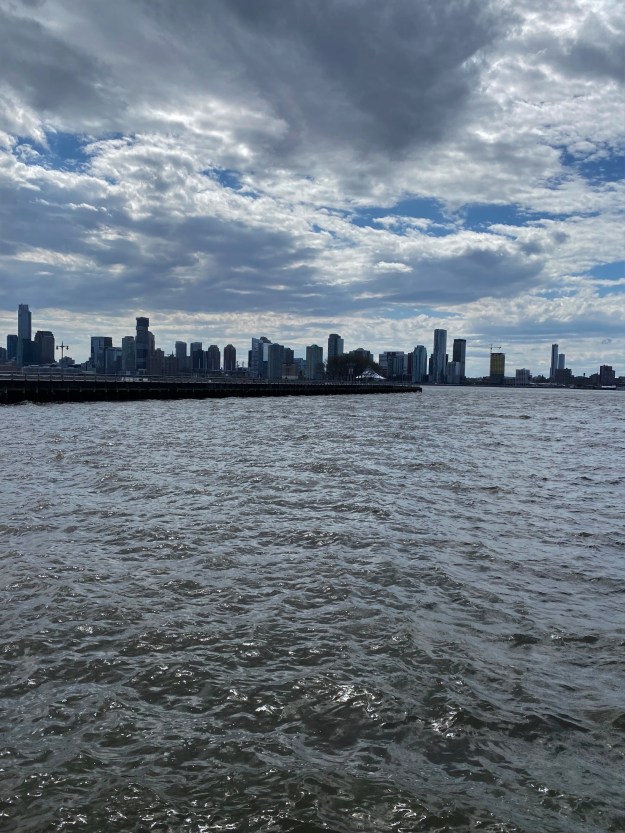
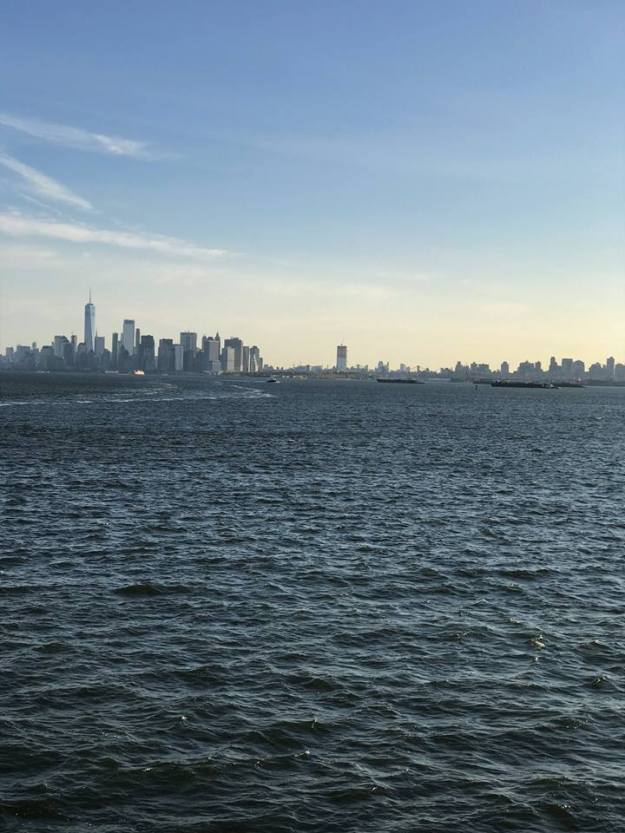
I love skylines, love dense clouds. New York City has wonderful skylines. You can’t really see them from Manhattan, but you can from the waterside and from the outer boroughs, which have lower buildings.

It is wonderful that Manhattan is an island bounded by water: the ocean (New York Harbor), the East River, the Hudson River, the Harlem River.

One thing this does is prevent urban sprawl and the development of a megalopolis ending nowhere.

It also gives the city an almost enchanted quality or aspect. It leads to dreamy speculation and reflection, as Herman Melville noted.

My departed friend Bill Dalzell alerted me to this special aspect of New York City some fifty years ago.

I love the curve of the bay at the bottom of Manhattan Island. Such a beautiful harbor.

Today, I walked along the water’s edge from 14th Street to the Battery. Such a wonderful stiff breeze off the river. Such a wonderful walk at a time of despair,

— Roger W. Smith

   May 4, 2020


*****************************************************

photographs by Roger W. Smith

New York Harbor 11-42 a.m. 10-7-2019

New York Harbor 11-11 a.m. 5-29-2018

New York Harbor 4-54 p.m. 5-4-2020

New York Harbor 3-28 p.m. 3-17-2020

Hudson River 2-52 p.m. 5-4-2020


211925055274824

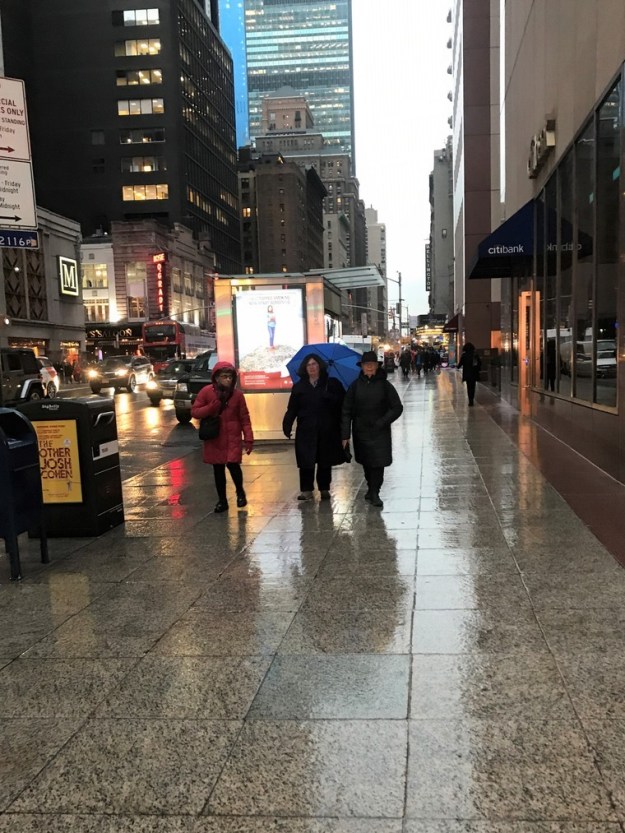
Sixth Avenue on a rainy afternoon; Herman Melville


Sixth Avenue 4-23 a.m. 11-30-2018

Sixth Avenue, New York City; Friday afternoon, November 30, 2018

I took this photo of Sixth Avenue on my way home on Friday afternoon.

It’s been raining a lot in the City this week.

Rain can be a slight inconvenience, like other weather phenomena, but I never really minded it. It can be “nice.”

When I was very young, my mother took me once to my eye doctor, Dr. Johnson, in Boston on a weekday. We went by subway.

The appointment lasted a long time. Going home in the late afternoon, it was dark and rainy. I didn’t mind. I loved having my mother all to myself. When we got home, she put me to bed. She was so kind. She kept saying that I was cold and wet and that I must be very tired: it had been such a long day and we got home late.

Re this photo of Sixth Avenue, this street scene, it reminds me of Herman Melville’s words (in Moby-Dick): “a damp, drizzly November in my soul.”

Thanks to the Good Lord that it came upon me once when I was first living in NYC to read Moby-Dick, in a library copy. What a book!

THE Great American Novel.

*****************************************************

Whenever I find myself growing grim about the mouth; whenever it is a damp, drizzly November in my soul; whenever I find myself involuntarily pausing before coffin warehouses, and bringing up the rear of every funeral I meet; and especially whenever my hypos get such an upper hand of me, that it requires a strong moral principle to prevent me from deliberately stepping into the street, and methodically knocking people’s hats off—then, I account it high time to get to sea as soon as I can.

— Herman Melville, Moby-Dick; CHAPTER 1. “Loomings.”


— Roger W. Smith

   December 2, 2018

an island … a city surrounded by WATER


photographs by Roger W. Smith


*****************************************************

The photographs posted here above were all taken by me within the past few months in Manhattan, Brooklyn, and Queens, NYC.

I love skylines, love dense clouds. New York City has wonderful skylines. You can’t really see them from Manhattan, but you can from the waterside and from the outer boroughs, which have lower buildings.

It is wonderful that Manhattan is an island bounded by water: the ocean (New York Harbor), the East River, the Hudson River, the Harlem River.

One thing this does is prevent urban sprawl and the development of a megalopolis ending nowhere.

It also gives the city an almost enchanted quality or aspect.

As Herman Melville put it in Moby-Dick (Chapter 1, ‘Loomings”):

There now is your insular city of the Manhattoes, belted round by wharves as Indian isles by coral reefs—commerce surrounds it with her surf. Right and left, the streets take you waterward. Its extreme downtown is the battery, where that noble mole is washed by waves, and cooled by breezes, which a few hours previous were out of sight of land. Look at the crowds of water-gazers there.

Circumambulate the city of a dreamy Sabbath afternoon. Go from Corlears Hook to Coenties Slip, and from thence, by Whitehall, northward. What do you see?—Posted like silent sentinels all around the town, stand thousands upon thousands of mortal men fixed in ocean reveries. Some leaning against the spiles; some seated upon the pier-heads; some looking over the bulwarks of ships from China; some high aloft in the rigging, as if striving to get a still better seaward peep. But these are all landsmen; of week days pent up in lath and plaster—tied to counters, nailed to benches, clinched to desks. How then is this? Are the green fields gone? What do they here?

But look! here come more crowds, pacing straight for the water, and seemingly bound for a dive. Strange! Nothing will content them but the extremest limit of the land; loitering under the shady lee of yonder warehouses will not suffice. No. They must get just as nigh the water as they possibly can without falling in. And there they stand—miles of them—leagues. Inlanders all, they come from lanes and alleys, streets and avenues—north, east, south, and west. Yet here they all unite. Tell me, does the magnetic virtue of the needles of the compasses of all those ships attract them thither? … There is magic in it. Let the most absent-minded of men be plunged in his deepest reveries—stand that man on his legs, set his feet a-going, and he will infallibly lead you to water. … Yes, as every one knows, meditation and water are wedded for ever.


— Roger W. Smith

   October 2017