Tag Archives: Roger Smith

epiphany II


The following is an email of mine.


— Roger W. Smith

   September 28, 2017


*****************************************************

Janet and Scott —

In my blog post

“epiphany”

epiphany

from a month or so ago, I described how I had a mystical experience while walking in Manhattan in the early evening that day after leaving the library.

I experienced this again this evening under similar circumstances.

I had just taken the Staten Island ferry back and forth for pleasure. At rush hour.

It wasn’t that crowded, especially returning to Manhattan.

Everyone in a good mood, as usual.

Gorgeous sunset … other passengers and I were saying to one another how beautiful it was: the sky, the crimson clouds, the sinking sun shimmering on the water, the harbor.

I got off at around 7:00 and walked about three blocks to an Au Bon Pain on Broad Street.

Sat down and plugged my phone in to charge it.

Place more or less empty; two young women at an adjacent table were having a friendly, animated discussion.

The place is self-serve. I poured myself a large coffee from an urn … went to the counter where you pay; no one there … finally concluded, looks like this coffee is free.

I sat nursing my coffee for a while … and musing.

No one ever bothers you in the City; in Manhattan, in the midst of frenzied activity (though not at this moment) going on constantly around you and people everywhere, one can, paradoxically, attain great peace.

I walked uptown a couple of blocks to catch the number 4 train … in those moments, I experienced the epiphany.

It had cooled down and there was a wonderfully refreshing sea breeze on the sidewalks.

There are relatively few people in the Financial District (Wall Street area) at that time of day … what people there were, were sauntering along, with pairs conversing happily.

I had a feeling, surge, of profound happiness, serenity, and inner peace.

Roger

Fifth Avenue, Wednesday afternoon (where are the cars?)


IMG_3143 (2)

Fifth Avenue, NYC; 1:40 p.m.; Wednesday, September 20, 2017

I took the above photo yesterday (September 20, 2017) on Fifth Avenue at 1:40 p.m. The photo was taken on a Wednesday afternoon on the avenue near 45th Street. In other words, in the heart of the Manhattan on a business day.

It can be plainly seen that there is little traffic. Certainly, no traffic jam.

And yet, social engineers — revered by Manhattan based yuppies who hate cars — want to implement a so called “congestion pricing” plan (already in effect in London), under which automobiles entering central sections of Manhattan on weekdays would be charged a fee.

Wouldn’t you know it, the New York Times editorial board is all for the plan. (See “A Solution to New York City’s Gridlock,” editorial, September 19, 2017.)

One thing the Times editorial writers lack is common sense, or any kind of feeling for life as it is actually experienced by the average person. If they would just look around them (see my photo), they would see that the “problem” they are wringing their hands about is NOT a problem. Public transit is remarkably efficient, despite problems which regularly occur. Traffic of the vehicular sort moves well, for the most part, especially when taking into account the concentration of economic, entertainment, and recreational activities and the population density in Manhattan. Pedestrian traffic flows beautifully — another thing the Times bemoans (the state of pedestrian traffic, that is), stating, incredibly, that the case is just the opposite, when everyone who walks knows that this is not true.

I myself like (love) to walk in the City. But, I have nothing against automobiles. There is plenty of room for cars, buses, and pedestrians, thank you!

As one Times reader noted (letter to the editor, May 31, 2016), congestion pricing “is a good way to hasten the transformation of southern Manhattan into an island for only the gilded rich, a process already occurring.”


— Roger W. Smith

  September 21, 2017


*****************************************************

See also:

“A Plan to Destroy Fifth Avenue”

posted here at

A Plan to Destroy Fifth Avenue

“3rd Ave. El”


My good friend Bill Dalzell, who introduced me to art films, recently called my attention to a film he loved from his early days in New York City in the 1950’s: 3rd Ave. El, directed by Carson (Kit) Davidson. The film comprises a portrait of the Third Avenue Elevated Railway in New York City, filmed in 1955. A rare print was preserved by the Academy Film Archive.

The music, as my friend Bill pointed out, is Haydn’s Concerto in D, played by harpsichordist Wanda Landowska.

The film is on YouTube. (See link to YouTube clip below.)

I was disappointed that the footage is grainy. But, the film, which lasts for something like twelve minutes, gives a wonderful feeling for New York City in the 1950’s. It conveys what I love about the City and is still, despite gentrification, true: its grittiness and its authenticity; the people; their authenticity; the open display by New Yorkers of a sort of primal enjoyment of life despite seeming to be wearing a “mask” of anonymity.

With the music, the film gives me a high. It, NYC, bubbles up.

The film has a Whitmanesque (that’s Walt Whitman) feeling about it. Great joyousness. It inspires the same feelings Whitman had for his beloved Mannahatta: its people, its pavements and buildings, its sheer energy.


— Roger W. Smith

   September 2017


“3rd Ave. El”


*****************************************************

addenda:

After three years involved with World War II and four involved with Antioch College, Carson Davidson arrived in New York bent on making films. Usual story — washing dishes at a Bickford’s Cafeteria by night, knocking on producers’ doors by day. Finally, a job with a jaunty outfit called Dynamic Films, doing whatever needed doing. Nobody actually taught him anything, but they answered questions cheerfully, and that’s all that’s really needed.

Fascinated by the 3rd Ave El, he borrowed a company camera and started shooting in his spare time. The resultant film was turned down by every distributor in New York except the last on the list, a crazy Russian who then owned the Paris Theater. He paid for blowing it up to 35 mm and played it for seven months along with an Alec Guinness feature. Actually put the short subject on the marquee — unheard of then or now.

http://www.afana.org/davidsoncarson.htm


*****************************************************

The IRT Third Avenue Line, commonly known as the Third Avenue El and the Bronx El, was an elevated railway in Manhattan and the Bronx, New York City. Originally operated by the New York Elevated Railway, … it was acquired by the Interborough Rapid Transit Company (IRT) and eventually became part of the New York City subway system.

The first segment of the line, with service at most stations, opened from South Ferry to Grand Central Depot on August 26, 1878. Service was extended to Harlem in Manhattan on December 30 of the same year. Service in Manhattan was phased out in the early 1950’s and closed completely on May 12, 1955. It ended in the Bronx on April 29, 1973.

The Third Avenue El was the last elevated line to operate in Manhattan, other than the number 1 train on the IRT Broadway–Seventh Avenue Line, which has elevated sections between 122nd and 135th Streets and north of Dyckman Street. Service on the Second, Sixth and Ninth Avenue El lines was terminated in 1942, 1938, and 1940, respectively.

source: Wikipedia

epiphany


Scott and Janet —

It’s almost 7:30 p.m. The library is about to close, and I’m heading uptown on Lexington Avenue to 47th Street.

It was another beautiful day. I love summer evenings.

I’ve been having a mystical experience during my short walk.

The air, the breeze, feels so nice and cool — Walt Whitman would call it delicious.

People on the sidewalk — people everywhere — seem different at this hour. There are less of them. They don’t seem to be in a hurry; the work day is over.

Whitman got a charge from being part of a pedestrian throng, from exchanging looks with passersby.

The women! They never seem to look uptight or fearful of being accosted; instead, they look contented, relaxed. There’s an openness about them. This seems to be true in general of the swell of humanity as they appear to someone like myself “jaunting” in the City.

I passed a chartered bus parked on the west side of Lexington Avenue in the mid-30’s. People were getting off with suitcases. It looked like they were returning from an excursion to the country. A woman was rolling her suitcase along the sidewalk. She looked contented and very relaxed. Living in Manhattan, you can have the best of both worlds.

There’s something special about early summer evenings. Time seems to stand still. There is such a feeling of tranquility, of peace and serenity.

It must be what the poet felt when he wrote: “God’s in His heaven— / All’s right with the world!”


— Roger W. Smith

   August 23, 2017

Walt Whitman, “Jaunt up the Hudson”


“Jaunt up the Hudson”

June 20th.—ON the “Mary Powell,” enjoy’d everything beyond precedent. The delicious tender summer day, just warm enough—the constantly changing but ever beautiful panorama on both sides of the river—(went up near a hundred miles)—the high straight walls of the stony Palisades—beautiful Yonkers, and beautiful Irvington—the never-ending hills, mostly in rounded lines, swathed with verdure,—the distant turns, like great shoulders in blue veils—the frequent gray and brown of the tall-rising rocks—the river itself, now narrowing, now expanding—the white sails of the many sloops, yachts, &c., some near, some in the distance—the rapid succession of handsome villages and cities, (our boat is a swift traveler, and makes few stops)—the Race—picturesque West Point, and indeed all along—the costly and often turreted mansions forever showing in some cheery light color, through the woods—make up the scene.

— Walt Whitman, Specimen Days


*****************************************************

This is vintage, typical Whitman. A man who loved every minute of his life — savored it. Reminds one of this as it applies to our own lives. Knew how to express this beautifully. Felt and appreciated things keenly as few do.

jaunt (noun) — a short excursion or journey for pleasure


— Roger W. Smith

   August 2017

Manhattan Island from Bottom to Top; Walking as Exercise


In the spirit of Alice’s Adventures in Wonderland, I will begin with the conclusion, followed by evidence to prove my point.

Walking is a naturally beneficial form of exercise habitual since human origins. It is perfectly suited to the human body and is a form of physical activity from which it seems personal injury cannot come; hence, one can justly say that it is one hundred percent beneficial.

The body welcomes such exercise. In fact, when it is undertaken, the body seems to be saying, “give me more!” It seems to cure all kinds of nagging (but not serious) physical complaints, discomforts, and ills, such as aches and pains, and actually seems to restore energy as much if not more than depleting it.


*****************************************************

I love to walk, as was noted by me in a previous post on this blog:

“on walking (and exercise)”

https://rogersgleanings.com/2016/03/20/roger-w-smith-on-walking/

I like to think of new places and routes to walk in the City (i.e., New York City, including Manhattan and the “outer boroughs” of Brooklyn and Queens).

I keep finding new places to explore — in Brooklyn, for example. It could be a neighborhood, such as Williamsburg, or a park, such as Brooklyn Bridge Park, which I only found out about recently. I like to call my walks, playfully, “jaunts,” a favorite term used by the poet Walt Whitman.

The other day, while writing a post, “Walt Whitman on Manhattan”

Walt Whitman on Manhattan (plus my own impressions and thoughts)

I noticed that in his poem “Mannahatta,” Whitman describes Manhattan as “an island sixteen miles long.”

Yes, I thought to myself, sixteen miles long, from the southernmost point of Manhattan, Battery Park (which overlooks New York Harbor and from which boats depart regularly for the Statue of Liberty, which can be viewed from the park), to Inwood at the northernmost point of Manhattan.

Then, on Thursday evening (July 20), I saw a documentary film at the Morgan Library in Manhattan: Henry David Thoreau, Surveyor of the Soul, directed by Huey Coleman. In the film, it is noted that when Thoreau first attended a lecture by Ralph Waldo Emerson, he walked seventeen miles from Concord, Massachusetts to Boston to attend.

I had been thinking of taking such a walk myself. If Thoreau can do it, I can, I thought. I would like to see how such a long walk feels.


*****************************************************

Yesterday I walked, in around 90 degree weather, from Bowling Green, at the southern tip of Manhattan, to the northernmost point of Manhattan Island, Inwood Hill Park, where the Henry Hudson Bridge and the Spuyten Duyvil Bridge link Manhattan to the Bronx.

It took me about ten hours with a couple of pit stops.

I got up in the morning feeling sluggish and achy. I took the subway to Bowling Green, then started walking, taking a few photographs of the harbor and then starting to walk uptown.

I felt sluggish and unsteady on my feet. The heat felt oppressive. I had a pain in my right foot that had persisted for a day or two. But gradually, as my walk and the day progressed, I started feeling better.

At 3:45 p.m., I texted a friend:

have reached 96th St and Broadway

wouldn’t u know it

I seem to have more energy than when I started

my toe is not hurting any more

I feel much less achy and better overall

A couple of hours later, from 155th and Broadway, I texted my friend again, saying “I am getting tired.” I had probably walked over 15 miles already. But, I kept going. It took me over an hour more to reach Inwood Hill Park. The park is entered via Dyckman Street, which is located precisely where West 200th Street would be, were it a numbered street. I walked along the western end of the park, which skirts the Hudson, to the northern end of the park, then back to the subway.

Riding home on the subway, I felt exhausted. I was relieved to get home and after a short while fell into a deep sleep.

I woke up very early after only a few hours of sleep feeling refreshed and very energetic. I haven’t felt so good in a long time. I felt very alert and refreshed. (It is my belief that pleasurable, mentally relaxing exercise such as walking obviates neurasthenia and chronic fatigue.)


*****************************************************

Conclusion

I already said it! The body welcomes exercise. It craves it. I can often hear my “brother body” (a term used by Pitirim A. Sorokin, which he undoubtedly got from Saint Francis) telling me, “thank you; give me more.” It is not uncommon after a five to seven mile walk for me to find myself saying to myself, I could do another five miles more. And, I am not a fitness addict or fanatic.


— Roger W. Smith

   July 22, 2017


*****************************************************

IMG_7451.JPG

Battery Park

DSCN0006.JPG

New York Harbor viewed from Battery Park

IMG_7480.JPG

Sixth Avenue, Greenwich Village

IMG_7494.JPG

Broadway, Upper Manhattan

IMG_7528.JPG

Inwood Hill Park

IMG_7550.JPG

Hudson River, late evening, viewed from Inwood Hill Park

IMG_7659 (2).JPG

Inwood Hill Park, overlooking Hudson River

DSCN0032.JPG

northern tip of Inwood Hill Park, overlooking Hudson River and Spuyten Duyvil Bridge

photos by Roger W. Smith


****************************************************

Addendum: On Sunday, August 6, 2017, I reversed myself and walked from the top (northernmost point) of Manhattan Island to the bottom (Battery Park). I found that Manhattan actually ends at Broadway and 218th Street — not at 207th Street, as I had thought.

I did it faster this time. It took me about seven and a half hours.

The weather was cool for August, and I did not experience appreciable fatigue. I felt as if I could have kept going should I have had cause to.


IMG_9090.JPG

Broadway at 218th Street, 1:34 p.m.; Manhattan’s northern border

DSCN0165.JPG

Broadway at entrance to Battery Park, 8:44 p.m.; Manhattan’s southern tip; end of my Sunday walk

Walt Whitman on Manhattan (plus my own impressions and thoughts)


MANNAHATTA.

I WAS asking for something specific and perfect for my city,
Whereupon lo! upsprang the aboriginal name.

Now I see what there is in a name, a word, liquid, sane, unruly,
musical, self-sufficient,
I see that the word of my city is that word from of old,
Because I see that word nested in nests of water-bays, superb,
Rich, hemm’d thick all around with sailships and steamships, an
island sixteen miles long, solid-founded,
Numberless crowded streets, high growths of iron, slender, strong,
light, splendidly uprising toward clear skies,
Tides swift and ample, well-loved by me, toward sundown,
The flowing sea-currents, the little islands, larger adjoining islands,
the heights, the villas,
The countless masts, the white shore-steamers, the lighters, the
ferry-boats, the black sea-steamers well-model’d,
The down-town streets, the jobbers’ houses of business, the houses
of business of the ship-merchants and money-brokers, the river-streets,
Immigrants arriving, fifteen or twenty thousand in a week,
The carts hauling goods, the manly race of drivers of horses, the
brown-faced sailors,
The summer air, the bright sun shining, and the sailing clouds
aloft,
The winter snows, the sleigh-bells, the broken ice in the river,
passing along up or down with the flood-tide or ebb-tide,
The mechanics of the city, the masters, well-form’d, beautiful-
faced, looking you straight in the eyes,
Trottoirs throng’d, vehicles, Broadway, the women, the shops and
shows,
A million people—manners free and superb—open voices—
hospitality—the most courageous and friendly young men,
City of hurried and sparkling waters! city of spires and masts!
City nested in bays! my city!


*****************************************************

Broadway.

What hurrying human tides, or day or night!
What passions, winnings, losses, ardors, swim
thy waters!
What whirls of evil, bliss and sorrow stem, thee!
What curious questioning glances—glints of
love!
Leer, envy, scorn, contempt, hope, aspiration!
Thou portal—thou arena—thou of the myriad
long-drawn lines and groups!
(Could but thy flagstones, curbs, facades tell
their inimitable tales);
Thy windows, rich and huge hotels—thy side-
walks wide;
Thou of the endless sliding, mincing, shuffling
feet!
Thou, like the parti-colored world itself—like
infinite, teeming, mocking life!
Thou visor’d, vast, unspeakable show and
lesson!


****************************************************

addendum:

The following are some present day thoughts of my own occasioned by the above two poems of Walt Whitman. “Mannahatta” was Whitman’s stomping grounds during what was probably the most creative period of his life. It is my adopted city; my feelings parallel Whitman’s.

“Mannahatta”: Mannahatta is derived from the aboriginal name for the place, most likely meaning island of many hills. Whitman chose to sometimes call Manhattan “Mannahatta” and to call Long Island “Paumanok,” also derived from a Native American word.

“nested in nests of water-bays, superb,
Rich”

The fact of Manhattan’s being surrounded by water is one of its greatest and most appealing attributes. (This is also stressed by Herman Melville in the opening chapters of Moby-Dick). The rivers and bays act as a natural counterweight to urban sprawl.

“hemm’d thick all around with sailships and steamships”

Not true anymore, for the most part. Too bad. But, Manhattan Island, being bounded on all sides by water, retains a unique appeal because of this.

“an island sixteen miles long”

Sixteen miles from Battery Park (the southern tip of Manhattan Island) to Spuyten Duyvil (the northern end of the island).

“Numberless crowded streets”

Still true. Crowded, which is a blessing. You don’t find lonely, deserted spots or forsaken places. Crowed, yes, but the crowds usually aren’t oppressive.

“high growths of iron, slender, strong,
light, splendidly uprising toward clear skies”

Space is limited in Manhattan. Tall buildings reaching to the skies create a sense of awe.

“Tides swift and ample, well-loved by me, toward sundown,
The flowing sea-currents, the little islands, larger adjoining islands,
the heights, the villas”

Still true. There are islands, rivers with eddies, great vistas. All can still be seen by someone who strolls along the East River, the Battery, the banks of the Hudson, or the rarely visited but wonderful stretches of parkland at the upper tip of the island.

“the lighters, the ferry-boats”

Ferries still run, to the delight and for the convenience of many. A lighter is a barge used in unloading or loading ships. In one of Whitman’s greatest poems, “Crossing Brooklyn Ferry,” there is a reference to a “belated lighter.”

“The down-town streets, the jobbers’ houses of business, the houses
of business of the ship-merchants and money-brokers, the river-streets”

The small businesses are mostly gone, but there are still “river-streets.” Yet, access to the rivers is not so convenient anymore, since highways on the East and West Sides impede (but do not entirely prevent) access.

“Immigrants arriving, fifteen or twenty thousand in a week”

New York is still a city of immigrants, thank God. Mostly immigrants speaking, it seems, practically every imaginable tongue.

“The carts hauling goods, the manly race of drivers of horses”

Whitman loved to ride with and become acquainted with the drivers of horse drawn omnibuses on the main thoroughfares of Manhattan.

“The summer air, the bright sun shining, and the sailing clouds aloft”

So true, still. See photo below.

Central Park 11-36 a.m. 5-14-2017 (4).jpg

Central Park; photograph by Roger W. Smith

The winter snows, the sleigh-bells, the broken ice in the river,
passing along up or down with the flood-tide or ebb-tide”

Herman Melville, in Moby-Dick (Chapter LXXXVII), also mentions ice breaking up on the Hudson: “A low advancing hum was soon heard; and then like to the tumultuous masses of block-ice when the great river Hudson breaks up in Spring, the entire host of whales came tumbling upon their inner center. …” I myself have observed this (once) during wintertime on the Hudson. The river froze over, and I can remember the hissing and popping sounds as the ice was breaking up slowly.

“The mechanics of the city, the masters, well-form’d, beautiful-
faced, looking you straight in the eyes”

People in Manhattan — pedestrians passing — still look at you, often, with friendly eyes, not averting their gaze. There is a wonderful openness about them. The City fosters it.

Trottoirs throng’d, vehicles, Broadway”

It is still the case that the streets are thronged, with cars, pushcarts, bicycles. I love it. It drives the city traffic engineers crazy.

Trottoir is the French word for sidewalk. Whitman, who was not well versed in foreign languages, loved to use foreign words, on occasion, mostly French ones. He has been faulted for this. Some people can’t realize that one is not required to always say “sidewalk” when another word might be substituted. For various reasons, including a delight in language.

“the women, the shops and shows”

Manhattan is a wonderful place for shopping and window shopping. The “shows” continue to go on. And on. The women — a friend of mine, Charles Pierre, once remarked — are Manhattan’s “last great natural resource.” They range from classic beauties to exotic looking women with natural beauty of all backgrounds and races.

“A million people—manners free and superb—open voices—
hospitality—the most courageous and friendly young men”

This is all so true. The concentration of humanity is wonderful. The people are open and friendly.

“City of hurried and sparkling waters! city of spires and masts!
City nested in bays! my city!”

All still true, except for the “masts.” The current in the rivers is swift; they do indeed sparkle in the sunlight.


*****************************************************

Broadway.

Whitman’s Broadway would have, in the mid-1850’s, meant an area of the city below 14th Street.

“What hurrying human tides, or day or night!”

“thy side-walks wide;”
“Thou of the endless sliding, mincing, shuffling
feet!”

The sidewalks in Manhattan are indeed wide and welcoming. No thoroughfare lacks them. The pedestrian is not shunted aside or forced to walk (as is the case in the suburbs) on a faux sidewalk. The sidewalks in the City are always full of trampers, day and night.

Note: “Broadway” was originally published in the New York Herald of April 10, 1888. “Mannahatta” exists in a couple of versions published in Leaves of Grass.


— Roger W. Smith

   July 2017

re Boston and environs as compared to NYC


I just completed a trip to Massachusetts, including the city of Boston and the Greater Boston area.

While stuck in traffic several times (too many), both in Boston proper and on the surrounding highways, I started to muse, first, about why the traffic is so bad, and, secondly, about my old stomping grounds — namely, Massachusetts, where I grew up — vis-à-vis New York City.


*****************************************************

Boston and, notably, Massachusetts towns, are charming, quaint and pristine. Clean. Well kept. Picturesque.

New England has a beauty that, in my opinion, is hard to match.

But, I feel that my adopted region, the New York City metropolitan region, grubby as it is, is superior.


*****************************************************

My trip got me thinking about Boston and Greater Boston traffic. Believe it or not, it’s WORSE than New York City.

And, about the reasons this is so.

I think a major reason is that Boston is mostly a car city and the surrounding towns are totally based on automobile transportation. It’s a car culture; people don’t walk. Unlike New York City. But Boston has a good public transportation system, one might say. The T branches out to and reaches the exurbs. It’s well run and commodious.

True, it would seem, but the New York City public transit system handles much more people every day, a much larger segment of the population. A significant percentage of persons in the Tri State area (New York City, New Jersey, Connecticut) rely on public transportation instead of cars.

And, in Boston, one sees a lot less cabs and far fewer buses than in New York City.

Bottom line, public transportation is much less of a factor, plays an almost insignificant role, comparatively speaking, in the overall Boston and Greater Boston areas. New York lives, breathes, and dies by its public transit system. There is no alternative for many city dwellers.


*****************************************************

Boston shuts down at the end of the business day. There is no one on the sidewalks at night, except for a few popular night spots, and hardly anyone after they close. New York never shuts down.

Boston proper and the surrounding towns have a lot less small stores. You will see a sub shop and perhaps one deli (except they don’t seem to call them delis) in the center of town. But, there are zillions of delis in New York city — they’re everywhere. In Boston proper, it’s hard to find one.

In Boston, it’s very noticeable, and highly significant, how little pedestrian traffic there is compared to New York. Perhaps that’s why there are less small stores to accommodate a passerby who might want to buy a Coke or bottled water. True, the central city sections such as Copley Square are crowded with pedestrians during the business day. But it’s much different later.

After normal business hours, beginning with the early evening, there is very little pedestrian traffic in Boston. Many downtown blocks seem virtually deserted. The city shuts down after the business day ends.

So different from New York. Stroll through Manhattan or the outer boroughs at almost any hour of the day, including the wee small hours, and you will find that very few streets are deserted. There is, naturally, less pedestrian traffic at 2 a.m. But, it is an appealing and actually comforting fact that there is almost always someone on the street. In the case of Manhattan, most neighborhoods never shut down.

One thing I have always liked about New York City, particularly Manhattan, is: walk through any part of the city, including central commercial and business areas, and you will see residential buildings. Some neighborhoods are primarily commercial, others are primarily residential. But, residential buildings are everywhere. All sections and zones are inhabited, which means there are always PEOPLE around regardless of time of day.


*****************************************************

Boston’s “culture” can’t hold a candle to New York’s. There is a plethora of cultural activities in New York year round, as everyone knows. I have never been a theatergoer, but, while Boston and Cambridge might have a theater or two, New York has scores of them showing plays and musicals all the time.

The amount of music one can find being performed in New York City on practically every day of the week year round is astonishing. Besides Lincoln Center and Carnegie Hall, there is a mind boggling assortment of musical performances and venues to choose from. Plus, there are innumerable amateur musical performances (including a wealth of music performed in churches) and recitals by student ensembles and so forth. The same is true of other cultural events, and also lectures.

If one goes to a museum or the public library, one can pick up a brochure listing events for a given period. One finds that museums offer many concerts and so do the libraries, believe it or not. Plus, lectures on everything from art to classical music, and, in the case of the library, literary and other cultural topics. (See example below.)

And, of course, New York is the film capital of — if not the world — indisputably the USA.


*****************************************************

Massachusetts has Cape Cod. I don’t think the Hamptons on Long Island can come close.

But, while visiting, I got lost on back roads on the Cape and drove around for a half an hour or so trying to find my way back to a major route. During this time, I had the opportunity to observe the Cape as a year round resident might experience it. It’s still a nice place with good restaurants, a great, breezy climate, beautiful beaches and spots, and so forth. But, it has in many places become indistinguishable from your standard suburbs. Nothing special. Streets which are often cul-de-sacs. Nice but typical houses. Boring in a way that only the suburbs can be. The typical suburban pattern of streets that lead nowhere.


*****************************************************

New England does have nature; it is preserved remarkably well. Beautiful old trees seemingly everywhere, arching alongside and over thoroughfares. They and their abundance are splendorous. Stately old trees notable for their grandeur, the proper names of which I do not know (elms?) but wish I did. There’s nothing like it in New York City or surrounding areas. New York City trees tend to look like they’re sick a good part of the time. In the fall, the leaves shrivel up and fall off; there is no glorious foliage.


*****************************************************

I have a sneaking suspicion, but cannot prove it and do not know it to be fact, that Boston might be more segregated than New York City. Patterns of de facto segregation in terms of housing still persist in New York City’s outer boroughs and can still be seen, to a lesser extent, in Manhattan as well. But, I believe that New York has always been more liberal with regard to race than Boston.


— Roger W. Smith

   June 2017


*****************************************************

addendum:

I was at the Morgan Library last weekend on Saturday, June 10 to view two excellent exhibits on Thoreau and Henry James.

I picked up a free booklet: “The Morgan / Calendar of Events / Spring & Summer 2017.”

As an example of the cultural richness found in NYC, here’s a sampling of what’s offered (besides the museum’s exhibitions).

three concerts of lieder and chamber music of Schubert, designed to elucidate certain
aspects of the works as well as entertain; pre-concert lecture/discussions

poetry reading by Eileen Myles with reception

novelist Jay McInerney and Italian artist Francesco Clemente discussing films that have influenced their works

symposium of art historians discussing Old Master drawings and prints

lecture on Henry James’s taste in painting

lecture on the so called “Indian drawings” of Rembrandt

lecture by two noted biographers of Henry James and his sister on James’s relationship to the visual arts

lecture on Thoreau by Laura Dassow Walls, author of a forthcoming biography of Thoreau

screening of three acclaimed films based on Henry James novels

screening of a new (2017) documentary film about Emily Dickinson

screening of a new (2017) documentary film about Thoreau, with a post-screening discussion with the director/producer

a significant (glaring) omission


I recently saw the documentary film Citizen Jane: Battle for the City, about urban theorist and activist Jane Jacobs (1916-2006) and her epic battle during the 1960’s against city planner Robert Moses (1888-1981) over urban renewal projects in New York City.

I was surprised that a film that would seemingly be of great interest and relevance to New Yorkers was not better attended. The theater, the Lincoln Plaza Cinema on Manhattan’s West Side, was practically empty.

The New York Times gave the film and a more or less favorable but lukewarm review.

There was an interesting article about the making of the film in Vogue:

“Citizen Jane Is a Primer on How to Resist Authoritarianism” by Julia Felsenthal, Vogue, April 21, 2017

http://www.vogue.com/article/jane-jacobs-documentary-citizen-jane-matt-tyrnauer

The article was based on an interview with the director, Matt Tyrnauer.

Felsenthal: “Jane Jacobs isn’t mentioned in Caro’s book [a biography of Robert Moses]. Is that an erasure? Why would he leave her out?”

Tyrnauer: “It’s unclear. Caro has spoken to this, and he’s said that the manuscript when he turned it in was double the length of the published book. He has said there had been mention of Jacobs that was cut out. Whether it was a purposeful erasure or not, it is in a way an erasure. She was an important figure who had written about this city in that period. She probably wrote the greatest book about the city [The Death and Life of Great American Cities], and she’s not mentioned in this other book [Caro’s biography] about power and the city. She was involved in key battles against Moses and not mentioned as an activist either. So I think this film serves as another part of the narrative of the period that you don’t find in The Power Broker [Caro’s book about Moses] for whatever reason. I think it’s important to have that history told, to have it be accessible. [italics added]

********************************************************

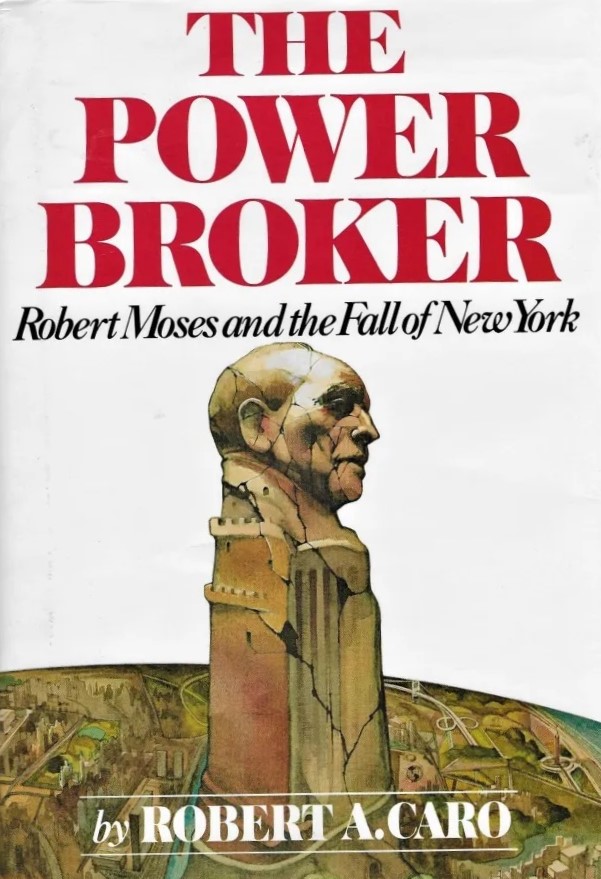
Robert A. Caro wrote a groundbreaking, award winning book about Moses: The Power Broker: Robert Moses and the Fall of New York (1974).

Caro is known as the consummate investigative journalist, an admired biographer who leaves no stones unturned in his research, which is exhaustive and prodigious. He writes massive tomes that answer every conceivable question about his subject. (He has done the same thing with Lyndon Johnson.) He unearthed incriminating information about Robert Moses that was unlikely to have otherwise ever been discovered.

So, I keep asking myself, how could Jane Jacobs have gotten completely left out of his 1246-page biography of Moses? She is not in the index.

Jacobs was the key figure in organizing opposition to and defeating Moses’s plans to extend Fifth Avenue through Washington Square Park in Manhattan; to designate the West Village as a “slum,” which would have meant essentially razing the neighborhood; and, most importantly (and most frightening), to build a Mid-Manhattan Expressway that would have destroyed the character of much of Lower Manhattan and, in the final analysis, of Manhattan itself. It was the beginning and then the apotheosis of Moses’s downfall.

As one film critic has observed, “Jane Jacobs was the David to Robert Moses’s Goliath.” She succeeded against what seemed to be impossible odds.

What is the excuse for Jane Jacobs not even being mentioned in Caro’s book?


— Roger W. Smith

   May 2017