Tag Archives: Roger Smith

Walt Whitman, “Broadway”


Walt Whitman, ‘Broadway’ (2)


Posted here (Word document above):

Wat Whitman, “BROADWAY”

Life Illustrated, August 9, 1856

an unsigned article attributed to Whitman, reprinted in

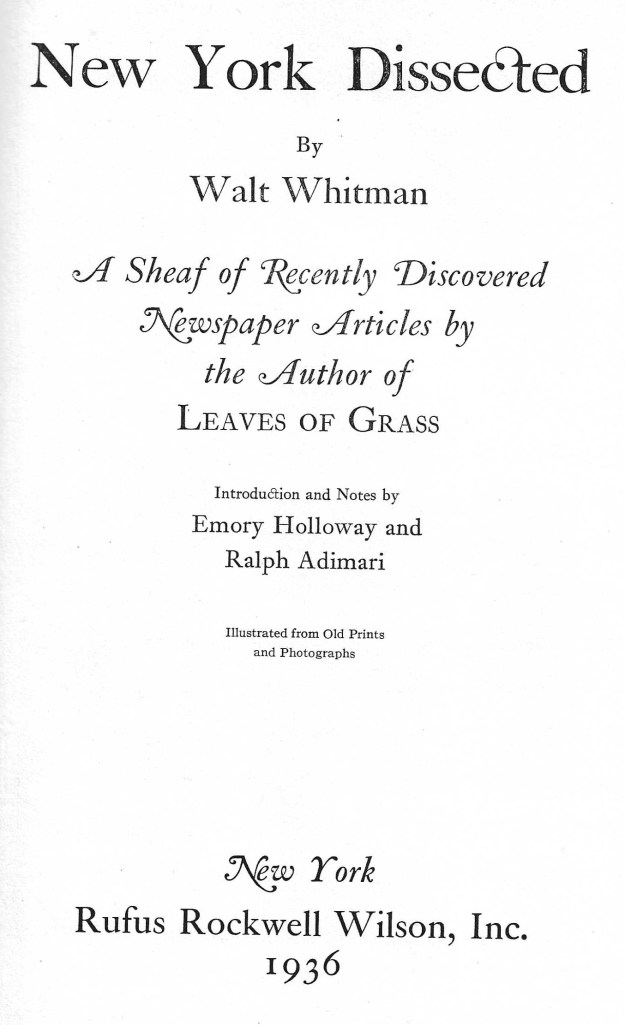
New York Dissected By Walt Whitman: A Sheaf of Recently Discovered Newspaper Articles by the Author of LEAVES OF GRASS; Introduction and Notes by Emory Holloway and Ralph Adimari (New York: Rufus Rockwell Wilson, Inc. 1936), pp. 119-124


*****************************************************

Whitman’s experiences and impressions in his pre-Civil War years are similar to my own in Manhattan jaunts. (I also love to take the ferry.) As noted by Emory Holloway and Ralph Adimari:

When Moncure D. Conway, at Emerson’s suggestion, called upon Whitman a month or so after the appearance of Leaves of Grass, in 1855, he took a walk with him through the city. “Nothing could surpass,” he says, “the blending of insouciance with active observation in his manner as we strolled along the streets”. … Whitman had been walking the streets, riding the omnibuses and crossing the ferries for many years. His memory was stored with so many such impressions that one of his early manuscripts describes his mind as a picture gallery. Perhaps it was from a desire to reconcile the contradictions in these multiform and inharmonious impressions that the poet sought escape in mystical rhapsody. The peculiar quality of Whitman’s elevated poetic mood, however, is due to the fact that instead of withdrawing his mind ascetically from experience, he sought rather to use definite concrete experiences to climb to a summit of vision which would embrace them all.

— posted by Roger W. Smith

January 2022


Broadway


Broadway


A friend of mine from Europe said in a message that he hoped to visit New York sometime and would love to see “Broadway Avenue.” I wrote him back with some facts.

I am attaching an explanatory Word document (above) and photos I have taken in my walks.

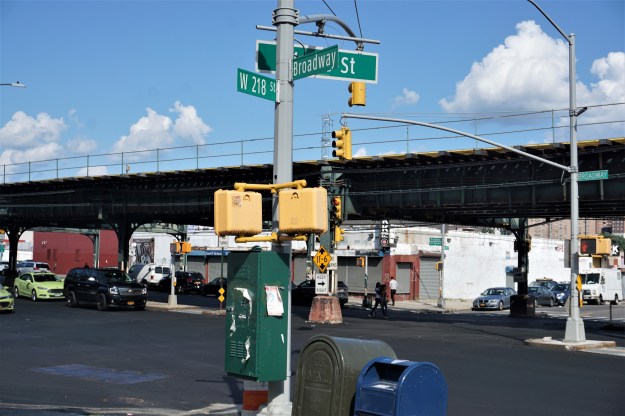
My photos show Broadway near Wall Street and Broadway way uptown; it goes from the southernmost to the northernmost point (218th Street) of Manhattan.

— Roger W. Smith

  January 2023


photos by Roger W. Smith

Broadway and Rector Street, Financial District

Times Square

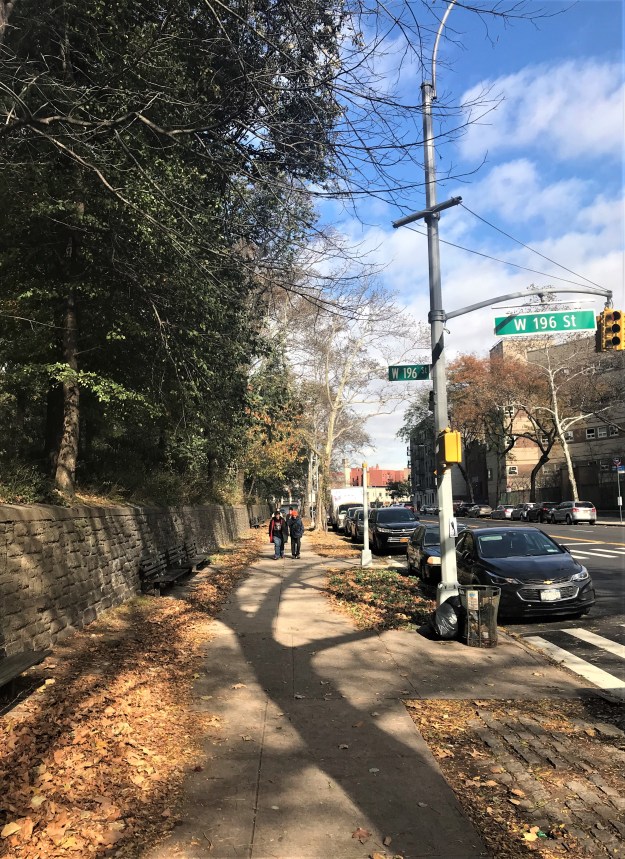
Broadway and 156th Street, Upper Manhattan

Washington Heights

Inwood

Broadway and 218th Street

my first few days in the City


I was hired by the New York Friends Group at a salary of eighty dollars a week. My job title was Workroom Supervisor. I sorted mail, ran the mimeograph machine, kept office supplies intact, was messenger and delivery boy.

I had stayed overnight in Westchester with a college roommate and his girlfriend. They were visiting her family there. They drove me to Manhattan on my first day of work. It was April 1969.

My roommate said, while we on the FDR Drive, do you have any cash? Not much, I answered. He was a rich kid with a fancy sports car and was generous. He pulled $150 out of his wallet – it seemed like a large sum to me – and handed it to me.

I had almost no money and had made no arrangements for an apartment or room. I wouldn’t be paid for a couple of weeks.

Someone – an older woman, a longtime New Yorker — at the office kindly suggested a YMCA – I think on 34th Street – to me. I don’t know why I didn’t check it out. I believe it was because it kind of sounded “institutional” and the thought of staying there did not appeal to me.

The office manager at 218 East 18th Street, who was living with his girlfriend – she worked at the same place – and his girlfriend Betsy put me up overnight on my first night at their apartment in Greenwich Village. Where his wife was or the state of his marriage I didn’t know. In the morning, his two sons – the typical precocious city kids – were at the breakfast table.

Betsy, the girlfriend, and I took a cab to the office, which was on East 18th Street. I guess the office manager reported to work either earlier or later. Betsy was in her late twenties. She wore sunglasses in New York fashion and kept saying to the taxi driver, “DRIVER, turn here. DRIVER …” Imperiously. I was sort of put off by it.

For several days, I slept on the office floor. As office boy, I had been given a key to the building. (I think I had the responsibility of opening up in the morning.) I would pretend to go home at 5 p.m., would do a reversal and come back; unlock the door, go to one of the upper floors (my “office” was in the basement), and sleep on a rug. It was relatively comfortable.

The only thing I knew how, practically, to cook was rice. Boiled. I bought a box of rice at Bohack supermarket on Third Avenue. I would cook it in a kitchen that was on one of the upper floors. I had probably bought soy sauce too.

Over the weekend, probably, I would go out and explore the neighborhood, feeling pretty lonely.

This went on a for a week or less; and then I had a series of improvised living arrangements which were mostly unsatisfactory and of short duration. I finally found a studio apartment in Queens.

— Roger W. Smith

  January 2023

visiting one of Walt Whitman’s residences


photos by Roger W. Smith

99 Ryerson Street, Brooklyn


On Ryerson Street in Brooklyn. On December 24, 2019, the day before Christmas.

I walked and walked, thought I would never find Ryerson Street. No one seemed to know where the street was located. The house is in a Brooklyn neighborhood known as Clinton Hill. It is close to the Brooklyn-Queens Expressway.

Whitman and his family lived there briefly, in 1855, and were possibly still there in early 1856. But by the time two Concord intellectuals and writers, Bronson Alcott and Henry David Thoreau, visited Whitman in October 1856, the Whitman family had moved to another house in the area. (The visitors had to take the ferry from Manhattan to get to Brooklyn, which was then a suburb.)

I have posted the following articles here:


“Should Walt Whitman’s House Be Landmarked” The New York Times, December 24, 2019

‘Should Walt Whitman’s House Be Landmarked’ – NY Times 12-24-2019

‘Should Walt Whitman’s House Be Landmarked’


selections from the diary of Bronson Alcott and the correspondence of Henry David Thoreau

‘Whitman in His Own Times’ (Alcott, Thoreau)


Lawrence Buell, “Whitman and Thoreau. Calamus no. 8 (August 1973), pp. 18-28.

Lawrence Buell, ‘Whitman and Thoreau’


— posted by Roger W. Smith

   December 2022

the museum … the library


The late William S. (Bill) Dalzell was a very important and valued friend to me, beginning in my twenties when I first came to New York.

We worked at the same place, 218 East 18th Street — technically not for the same employer, since Bill was a self-employed printer.

We hit it off immediately. Bill (as I turned out to be) was a lover of his adopted city. He grew up in Williamsburg, a suburb of Pittsburgh.

He had many pregnant thoughts. We had such interesting conversations.

He was a confirmed bachelor and a creature of habit.

He never worked on weekends.

On Saturday mornings, he would go to the Metropolitan Museum of Art. He would begin in the cafeteria, nursing a cup of coffee and lost in thought.

He said that for him the museum was like a cathedral. It had that effect on him mentally. Either explicitly or implicitly, he was also thinking of Norte Dame Cathedral. He had been there several times and said it was “the holiest place” he had ever visited.

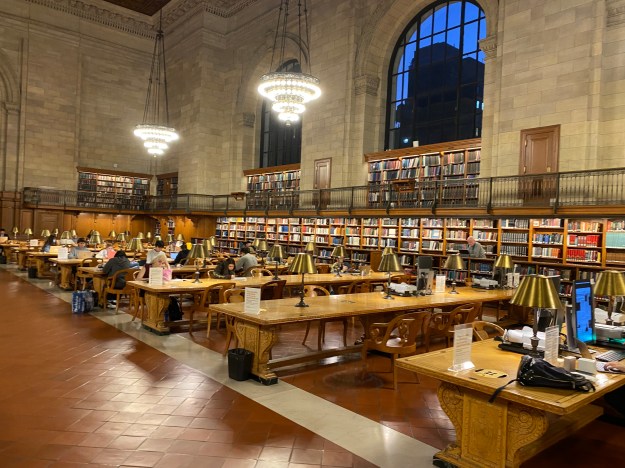
Which brings to mind the New York Public Library on Fifth Avenue.

It has that effect on me. The beautiful building. The interior. The high ceilings and sunlight streaming through. The staff. The “serious,” “dedicated” sense of purpose and calm quietness. The calming and focusing effect it has on me mentally.


— posted by Roger W. Smith

   October 2022


Walt Whitman’s New York


Walt Whitman was born on May 31, 1819, in the farming community of West Hills, Long Island, in western Suffolk County. At the age of three, Whitman was moved to Brooklyn with his family, and it was there that he spent his childhood. While still in his teens, Whitman left the family home in Brooklyn, and spent some five years at several occupations at various locations on Long Island. He served as a school­teacher, and as writer, editor, and printer for newspapers. During this period he lived and worked in what are now the urban and suburban counties of Queens, Nassau, and Suffolk. At that time, however, this area was rural, with only small scattered villages.

While in his early twenties, Whitman returned to the city, living and working in both Manhattan and Brooklyn as writer, editor, and printer for various newspapers. This was to be his life for the next twenty years until the Civil War brought about his move to Washington, D.C. Probably his most famous post during this period-was his tenure as editor of the Brooklyn Eagle.

By the summer of 1855, Whitman had published the first edition of Leaves of Grass. A second edition appeared the following year, and, in 1860, a third edition. Whitman was forty-two years old and something of a local personage when, on June 8, 1861, the Brooklyn Standard published the first of an unsigned series of his articles to which the newspaper gave the title of Brooklyniana.” …

It is of interest, and useful, to review very briefly some of the major changes in geographical and governmental entities that have taken place since Whitman wrote this work. New York City then included only what are today the Borough of Manhattan and part of the Borough of the Bronx; and, in practice, when these articles were written, “New York City” or “Manhattan” meant lower Manhattan. Manhattan north of Forty-second Street was largely rural. When Whitman wrote these articles, Brooklyn was an independent city, consisting of what are today the Brooklyn Heights, downtown Brooklyn, South Brooklyn, and Williamsburg areas. Kings County—which today comprises New York City’s Borough of Brooklyn—was mostly rural, and, in addition to Brooklyn, contained other, independent communities such as Flatbush and Gravesend. What is today New York City’s Borough of Queens was also rural, with independent communities such as Jamaica and Flushing; and what is today suburban Nassau County did not even exist at that time; it was part of rural Queens County. Nassau County was formed later by splitting the original Queens County into two new counties.

Whitman, though a native of the New York area, loved it and wrote of it with the zeal and zest usually found only in those from elsewhere who have made New York their chosen home [italics added]. One of Whitman’s favorite pastimes was to stroll through the streets of Manhattan and Brooklyn, observing people, and making new friends. He became an enthusiastic devotee of the opera. And he also enjoyed the natural beauty to be found in the meadows and on the beaches of rural Long Island. In these very articles, Whitman writes with deep affection of both the urban Manhattan-Brooklyn area and of rural Long Island, which he preferred to call by its original Indian name of “Paumanok.”

Yet Whitman did not merely use the New York area for his own pleasure; he was active in civic life. Through his association with newspapers, he encouraged and participated in crusades for social and civic improvement. He fought municipal corruption, working to expose the graft that seemed to flourish continually in every municipal department and every municipal enterprise. He was in the forefront of those defending what has become New York City’s collection of beautiful parks, helping to fight off the real-estate speculators of the day. And hospitals were a special interest of Whitman’s; he made particular efforts to publicize the services and needs of worthy hospitals.

All these activities are, of course, generally of the conventional “good government” variety—but some of Whitman’s other civic views were less conventional. He was a strong critic of the law-enforcement, judicial, and penal systems as they were applied against the outcasts of society such as the prostitutes. It appalled Whitman to see the prostitutes of the city abused by brutal police and sanctimonious politicians who themselves were notoriously corrupt. Whitman also was a sharp critic of the hypocrisy he found among the clergy of the city.

Political activity of his day centered upon three parties—the Democrats, the Republicans, and the “Know-Nothings,” more formally referred to as the Native American Party. The Democratic Party was split into two factions. The “Old Hunkers” were conservative Democrats, strongly pro-business, and pro-slavery. They were opposed within the party by progressive Democrats who were anti-slavery and who advocated greater social and economic democracy. Whitman was an active member of this latter faction, even serving as an official delegate to various Democratic Party conventions and gatherings.

Indeed, Whitman was a very active citizen, serving his city in a variety of ways. And it should be kept in mind that when Whitman wrote this work—articles dealing with Manhattan, Brooklyn, and Long Island—he had spent his en­tire life in this region, excepting only a brief stay in New Orleans. Interestingly, his best journalism on the subject of New York regional history came just at the time that the approach of the Civil War already had begun to disrupt and transform the region and the entire nation. In regard to Whitman personally, it is perhaps ironic that, so soon after he sang the praises of the New York area in this work, he was destined to leave this region of his birth and youth.

Whitman went to the Washington, D.C., area in December of 1862 in search of a brother in the Union Army who had been reported as wounded in action. He found his brother, only slightly wounded, safe in one of the Union camps. Thereafter, Whitman turned to visiting the Washington hospitals, seeking out wounded soldiers from the New York area. Whitman was so affected by his experiences in Washington hospitals that he undertook volunteer, unpaid nursing service there. Remaining in Washington, Whitman accepted a clerkship in the Federal government, giving all his spare time to the hospitals and to his writing. He was to spend the next ten years in Washington, and his final twenty years in Camden, New Jersey, where he died on March 26, 1892, at the age of seventy-two.

Whitman’s New York years not only constituted his formative period but also comprised the greater part of his life. The first forty-two of Whitman’s seventy-two years were spent in the New York area. It was in this region that he formed his philosophy of life and art—in short, the ideas and the style that distinguish his writings. This work is tangible evidence of the deep affection with which Whitman regarded the New York area, and the significance he attached to its history and traditions.

Walt Whitman’s New York: From Manhattan to Montauk, edited by Henry M. Christman


— posted by Roger W. Smith

   May 2022

what NYC is made of


taking No. 5 train downtown to my favorite spot on Wednesday afternoon

a woman gets on at 42 Street and makes a long speech asking for support and financial help

finishing, she begins to walk from one end of the car to the other, hoping someone will donate

a crowded car; she brushes past me; I manage to step aside

“Sorry, Sir,” she says politely

“That’s okay, No problem,” I answer firmly but softly, wanting to be as polite as I can

“God bless you,” she said

It’s moments like this that make life beautiful and momentarily obviate doubt and cynicism


posted by Roger W. Smith

   February 9, 2022

Barbara Grizzutti Harrison, “Joan Didion: Only Disconnect”


Barbara Grizzutti Harrison’s Essay “Joan Didion: Only Disconnect” is online at

https://www.writing.upenn.edu/~afilreis/103/didion-per-harrison.html

It complements my post

Joan Didion and NYC

Joan Didion and NYC


— Roger W. Smith

Joan Didion and NYC


Joan Didion – Saturday Evening Post 1-4-1967


Reading Joan Didion’s obituaries this week, I was reminded in particular of an essay of hers I had heard about. I don’t think I have read it before. (It is posted here above.)

Joan Didion

“Farwell to the Enchanted City” (subsequently republished as “Goodbye to All That”)

Saturday Evening Post

January 4, 1967

I desired to read it. I wanted to see what she thought about New Yok City when she first moved there from California, in the late 1950s. About ten years later, I myself first relocated to New York and settled there.

What things about the City attracted and delighted her? Repelled her?


*****************************************************

When I moved to New York, it both fascinated (I found it intoxicating) and overwhelmed me with a sort of fear or numbness (emotional deadness). Meaning that it was so impersonal; the buildings were so tall, dominating the streetscapes; there was no nature; the people were all in a hurry and seemingly cold and impersonal, too busy and goal oriented to talk to you.

Everything depended on having money, of which I had very little.

I had been to New York a very few times before. The first time was in 1954 when my parents took me to visit the City for a few days. We stayed in the Edison Hotel in Times Square. (Rooms were four dollars a day. We must have been able to park our car.) I could not get over the experience of the Empire State Building. Being on the observation deck on the top and looking down at the cars on Fifth Avenue, which seemed like toy cars. The Automat. The little windows where you would put a dime or nickel in a slot and get a piece of pie. My mother wanted to see Greenwich Village. We drove around the crooked streets. I don’t think we ever got out of the car. I recall the cobblestones and that the car was jolting.

We took the Staten Island Ferry to cool off. It was July or August and one of those sweltering NYC hot spells.


*****************************************************

As a young man and adult, I grew to love and appreciate — so much — New York. See my post

“I went to the school of New York.”

“I went to the school of New York.”

for one way in which this was true.

The art movie theaters. The bookstores. Libraries. Most of all, the intellectual energy and appetites of the people I got to know.

In Massachusetts, as a young man, I would have been embarrassed to go to a movie by myself. In Connecticut, where I worked briefly, I was once asked to leave a folk music coffee house because I was sitting at table by myself. In NYC, no problem. I went to movies almost always by myself. Good way to spend an evening or a Sunday afternoon if you felt lonely.

Sit at a restaurant table by oneself? No problem. It was the same with half the other customers.

I would go to Central Park on Sunday afternoons and sit on a park bench feeling a bit lonely but like I was an amorphous participant in something. The bars were an oasis. A glass of beer twenty cents. Every third one free. The bartender was your and everyone’s friend.

One day in a subway station, I asked some people a question of some sort (maybe directions). They answered politely and helpfully. I told a friend of mine from college who lived in Flushing, Queens about this.

“Someone was actually nice to me in the subway,” I said.

“New Yorkers are people, too,” he replied.

Indeed.

Wonderful people. So full of energy. So interesting. Except when I first came the people on the subway all seemed so pale and sickly to me.

So what was Joan Didion’s experience?

Read her famous essay (attached).

It’s really about her — instead of, at bottom, the City. It is very self-centered. It is surprising how much it seems to be built upon – – to be a tissue of — generalities. Of musings, inner thoughts. It does not convey much INFORMATION, substance.

You learn hardly anything about what New York was like when she was there.


*****************************************************

“Joan Didion: Only Disconnect”

From Off Center: Essays by Barbara Grizzutti Harrison

I do not find Joan Didion appealing. … I am disinclined to find endearing a chronicler of the 1960s who is beset by migraines that can be triggered by her decorator’s having pleated instead of gathered her new diningroom curtains. … more …. of a neurasthenic Cher than of a writer who has been called America’s finest woman prose stylist. … her subject is always herself. …

Didion uses style as argument. … for Didion, only surfaces matter. … Didion tells us, many times, and in many ways, that her mind “veers inflexibly toward the particular.”

To what in particular?


*****************************************************

Enough said. Read Joan Didion’s essay if you feel like it.


— posted by Roger W. Smith

   December 25, 2021


*****************************************************

Facebook comments

December 25, 2021


Pete Smith

Interesting thoughts. But don’t most writer’s thoughts relate largely to themselves? Think of Truman Capote’s short stories, like Dazzle. Or Melville, talking as himself (Ishmael) throughout Moby-Dick. I don’t object to your objecting to Didion but were she still alive she might have the same complaints about those of your posts, including this one, that borrow heavily on your own experience. I think this is what makes your posts interesting, and don’t see why it wouldn’t also apply to Didion’s writing.


Roger W. Smith

Barbara Grizzutti Harrison’s essay is dead on. You should read it. You are wrong about my writing. Of course everyone writes about and from the perspective of themselves and their own experience. This post insofar as it relates to me is built on experiences I had that readers can relate to.


Pete Smith

Roger, I think your reply was hidden for some reason but you missed my point. I was not criticizing you for writing about your own history or own perspective; I was basically saying that that is what everyone usually does and that I found it odd that you were criticizing Joan Didion for doing so — and I was acknowledging that this did not mean you had to like her writing. . . .


Roger W. Smith

I was criticizing her writing — from a certain point of view (view of her writing); which of course does not mean that writers should not write about themselves. Harrison’s essay articulates what I was trying to say; I had not read it before. By the way, Melville created a character, Ishmael, that was sort of his alter ego, but to say that amounts to writing about oneself is not correct. I guess the best way to put it is that Didion’s writing seems overly self-absorbed and there is something missing content- or sustenance-wise that a reader wants to be able to take away. I read some Didion before, including one of her novels. I was sort of impressed then, but now have come to the opinions of my post.


Pete Smith

All I meant was that Melville’s writing, like Truman Capote’s and like much of yours, was based on his own personal experience — in his case, whaling. I can understand your comment about Didion’s self absorption but when she’s writing a book all about the tragic and terrible year of her husband’s death, I would guess it would be difficult for any passionate observer to accuse her of self-absorption.


Roger W. Smith

I have not read [Joan Didion’s] The Year of Magical Thinking. I began this post with one essay of Didion’s which disappointed me and, based upon which, I drew inferences about her writing which seem valid. She always wrote about herself in a way that Melville didn’t.


Pete Smith

Got it, but of course you understand that I wasn’t suggesting in any way that Melville and Didion wrote about themselves in the same way.


Roger W. Smith

No, I don’t think that (your first sentence).


Ella Rutledge

I’m no fan of Didion’s either. The only thing of hers I have read is The Year of Magical Thinking. (I think a negative review at amazon.com called it “A Lifetime of Magical Thinking.”) She is a member of the NY literati and so they all praise her writing because she writes from their point of view. You, Roger, on the other hand, document and record NYC life from an “everyman” perspective. I hated that book. So shallow, so limited, in its view of grief, grieving, loss, death, faith, belief in anything other than the material world, of which she constantly reminded us with references to the best hospitals (reached by helicopter), the best doctors, Brooks Brothers suits, Hollywood and the Beverly Hills Hotel. Death is final and any tendency to hope for anything beyond is “magical” (or in her view deluded) thinking.


Roger W. Smith

Thanks very much for the incisive comments, Ella, What you say about The Year of Magical Thinking confirms what I have said. I based my comments (mainly) on the essay I read this morning and on Harrison’s devastating article about Didion. And, yes, I did see what I felt was a distinction between my own writing and hers — or do now — it wasn’t my main point, and I was thinking about her writing, not mine, but when I read her essay about leaving New York, I felt empty; and I realize now, in retrospect, that that is more or less how I felt years ago when I read “Play It As It Lays.”

why New York is one of the greatest (in my opinion, the greatest) cities in the world


The water has a lot to do with it. It is a city surrounded and bathed by water: the Hudson and East rivers, the Atlantic Ocean. New York Harbor is one of the largest and most beautiful natural harbors in the world.

All five boroughs have shorelines and ocean or river views.

Having river and ocean boundaries prevents urban sprawl. It makes the City, as big as it is, contained.

It is a city made for walking. Sidewalks are wide, and pedestrians are seen everywhere at all hours of the day. Cars do not dominate. Many streets are clogged with traffic, notably at the bridge and tunnel crossings and on cross streets in Manhattan. But, elsewhere traffic is relatively moderate. This is true on major thoroughfares such as Fifth and Park Avenues.

It has a world class transit system that runs 24 hours a day, every day.

It is a city seemingly devoid of nature, one where nature doesn’t matter, where a rain or snow storm is a nuisance. This is true. And yet, there are ample parks everywhere; and some of them are magnificent. No other city has a park to match Central Park.

It is a city of neighborhoods: the Lower East Side, Hell’s Kitchen, Soho, Inwood, Astoria, Ridgewood, Williamsburg, Park Slope.

The admixture of races and ethnicities (in a polyglot city), the visibility and importance of the immigrant population, the concentration of people of varying educational and income levels who have many opportunities to interact continually is notable.

Show me a city that has richer cultural offerings. Take music. Several major concert halls (not just one, as is the case in most American cities), and this doesn’t count concert venues in museums, churches, etc.  Splendid concerts almost daily by the best musicians.

And art museums and galleries — I can’t keep track of them.


— posted by Roger W Smith

   July 2021